Industry · May 20, 2026
What 3D Imaging Has Actually Changed About Plastic Surgery Consultations
Three-dimensional surgical imaging has become standard equipment in the better practices. What it has changed is not the surgery. It is the conversation that precedes it.
4 min read
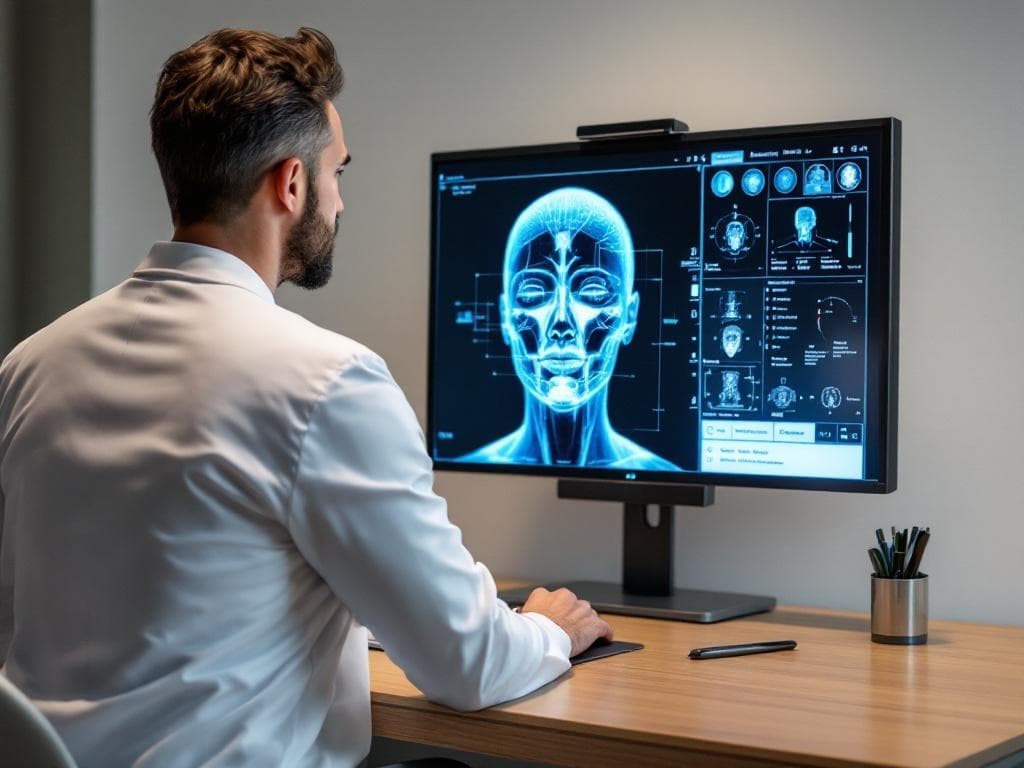
The Vectra system from Canfield Scientific has been on the market for more than a decade. For the first half of that decade, it was a curiosity, then a high-end practice differentiator, then a marketing item. By the second half it had quietly become standard equipment in the better aesthetic practices, alongside the surgical microscope and the photography room. The question that interests us is not whether 3D imaging works. It is what, specifically, it has changed.
It has not changed the surgery. It has changed the consultation.
What the imaging actually does
Vectra and the comparable systems from Crisalix and Cherry Imaging produce a calibrated three-dimensional capture of the patient's body, which the surgeon can then visually modify within the software to simulate the proposed surgical result. Implant size and shape, fat grafting volume, rhinoplasty changes, facelift outcomes: all can be approximated within the captured model.
The simulations are not photorealistic predictions. They are calibrated approximations of volume and proportion. Surgeons who use the technology well explain that distinction at the beginning of every consultation. Surgeons who do not, present the simulation as if it were a guarantee.
"The image on screen is a planning tool, not a contract. The patients who do best are the ones whose surgeons make that distinction explicit.
"
Why it changed the consultation
Before 3D imaging, the consultation relied on three communication tools: before-and-after photographs of other patients, sample implants the patient could hold, and the surgeon's verbal description. Each tool has a known limitation. Photographs are of other people. Sample implants are not the patient's chest. Verbal description is hostage to the patient's imagination.
The 3D simulation collapses all three into a single object: the patient's own body, with the proposed change rendered in proportion and volume. The result is not that the patient sees what they will look like after surgery. It is that the patient and the surgeon are looking at the same thing while discussing the same decision. That is not a small change.
What the better practices use it for
The practices that use the technology well use it for three purposes that are not interchangeable:
- Expectation calibration. A patient who imagines a result that the procedure cannot deliver sees the gap on screen. The conversation that follows is more honest because both parties are looking at the same image.
- Procedure selection. Comparing a 350cc implant simulation to a 400cc simulation to a fat-transfer simulation lets the patient understand the trade-offs in volume, projection, and proportion in a way that is otherwise abstract.
- Symmetry assessment. Existing asymmetry is documented and discussed before surgery rather than discovered after.
The practices that use the technology poorly use it as a closing tool. The simulation becomes a sales aid rather than a planning aid, presented to convince rather than to inform.
What it has not changed
Three things are worth naming because the marketing around the technology sometimes implies otherwise.
The simulation does not improve the surgery itself. The execution depends on the surgeon's hands and the patient's tissue, not the planning software. A meticulous surgeon with no imaging system will produce a better result than an average surgeon with the most advanced system available.
The simulation cannot account for individual healing variability. Skin elasticity, scar formation, and how a patient's tissue redrapes after surgery are not parameters the software can model.
The simulation cannot answer the question of whether the patient should have the surgery in the first place. That question belongs to the consultation, not to the screen.
The honest summary
Three-dimensional imaging has become standard equipment in serious aesthetic practices because it makes the consultation better. It is not a substitute for the surgeon's judgment, the patient's research, or the conversation that has to happen between them. It is a tool that helps the conversation reach a more honest place faster.
For patients evaluating a practice, the presence of the imaging system is a positive signal. The way the surgeon uses it is the signal that actually matters. A simulation framed as a guarantee is a different consultation than the same image framed as a planning sketch.
The American Society of Plastic Surgeons publishes ongoing guidance on the role of imaging in surgical planning. The Aesthetic Society's annual meetings include sessions on technique standardization in the use of the technology. The standard of care is converging, and it is converging in the direction of honest explanation rather than persuasive demonstration.
Related reading: Pre-Pectoral Breast Implants: How the Placement Plane Quietly Changed and How GLP-1 Drugs Became a Pre-Operative Variable in Plastic Surgery.