Industry · August 6, 2026
The Deep Peel: The Most Powerful Resurfacing in Aesthetics, and Almost Nobody Offers It
A phenol croton oil deep chemical peel produces the most durable facial resurfacing result in the field, with histologic evidence of new dermal collagen lasting decades. It also requires cardiac monitoring, takes two weeks to re-epithelialize, can permanently lighten your skin, and has quietly vanished from most practice menus in favor of lasers that market better. Here is what the deep peel actually does, why croton oil rather than phenol sets the depth, and why the procedure disappeared.
By The Editorial Desk
9 min read
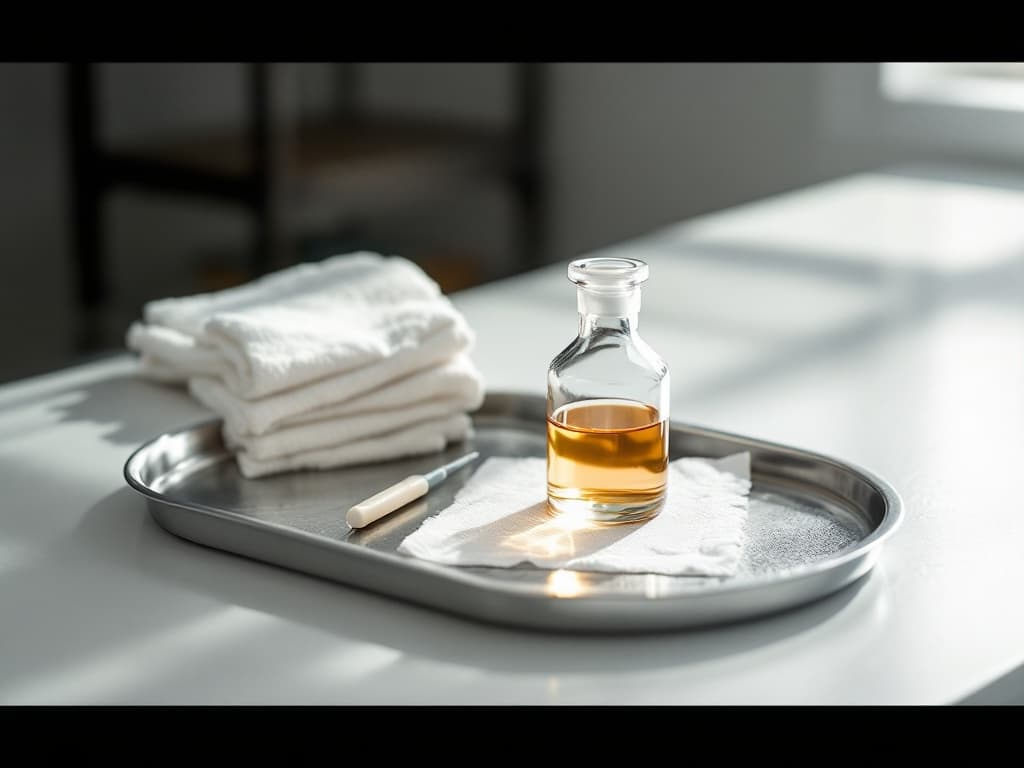
There is a facial resurfacing procedure with sixty years of published follow-up, histologic evidence of a new band of dermal collagen that persists for decades, and results on deep perioral lines that no laser has convincingly beaten. It is not new. It is not expensive to stock. It is not patented, and no device company sends a representative to demonstrate it.
Almost nobody offers it.
The phenol croton oil deep chemical peel is the strangest omission on the modern aesthetic menu. A patient can walk into ten practices in Los Angeles asking about the vertical lines above her lip and be quoted ten different laser packages, filler plans, and radiofrequency series without a single provider mentioning the one treatment with the longest track record of actually erasing them. That is not a clinical judgment. It is a market outcome, and it is worth understanding before you spend four figures on the alternatives.
What a deep peel does that the others cannot
The short answer: a deep chemical peel injures the skin all the way into the reticular dermis and forces it to rebuild, which is a different category of change than exfoliating the surface.
Most peels a patient encounters are superficial. They lift the epidermis, brighten tone, and improve the look of dull skin. We have written before about how lasers and chemical peels answer different problems at different depths, and the everyday peel sits firmly at the shallow end of that range. It is a good treatment. It is not this treatment.
A deep peel goes to the mid reticular dermis. The classic formula, published by Thomas Baker and Howard Gordon in the early 1960s, combines phenol, water, a soap emulsifier, and a few drops of croton oil, applied under occlusion or open technique to a face that has been prepared and degreased. The wound it creates is real: the skin frosts white within seconds, the patient will not have an intact epidermis for roughly a week to two weeks, and the healing response lays down a compact new zone of dermal collagen beneath the regenerated surface.
That new collagen is the point. Histologic work on treated skin has described a persistent subepidermal band of organized collagen that remains visible on biopsy many years after the procedure, and long-term photographic follow-up series on Baker-Gordon patients have reported improvement in fine and moderate rhytides holding up at intervals measured in decades rather than months. Nothing else in resurfacing has that shape of durability curve.
The clearest indication is the one patients complain about most and get the least honest answers about: perioral rhytides, the vertical etched lines around the mouth. Comparative studies against carbon dioxide laser resurfacing have generally found the deep peel at least equal in that specific zone, and practitioners who do both tend to reach for the peel there.
Croton oil, not phenol, is what sets the depth
The short answer: for forty years the field believed phenol concentration controlled how deep the peel went, and it was wrong.
This is the most important thing that has happened to deep peeling since it was invented, and most patients have never heard of it. In a series of papers published in Plastic and Reconstructive Surgery around the turn of the millennium, Gregory Hetter worked through the components of the Baker-Gordon formula and demonstrated that the croton oil, present in the original recipe at only a couple of percent, was doing the heavy lifting on depth. Phenol was the keratocoagulant and the carrier. Croton oil was the epidermolytic agent that determined how much injury the skin actually received.
The consequence was practical and large. If croton oil controls depth, then depth becomes titratable. A practitioner can mix formulas ranging from roughly 0.1 percent croton oil up to and past the original 2 percent, and treat the eyelids at one strength, the cheeks at another, and the lip at a third, in the same sitting. The all-or-nothing porcelain result that gave deep peeling its reputation was largely an artifact of a single fixed recipe applied uniformly to a whole face.
"The deep peel did not stop working. It stopped being sold, because nobody manufactures it, nobody demonstrates it at a trade show, and nobody can lease it to you monthly.
"
The modern practice of this procedure, sometimes credited to Hetter and to subsequent refinements by Richard Stone and others, is closer to a graduated regional treatment than to the historical full-face burn. It is also, notably, compounded. There is no FDA-approved phenol croton oil peel product sitting on a shelf. The solution is mixed by or for the physician, which means the concentration in the cup depends entirely on whether the person mixing it knows what they are doing. That is a genuine risk, and it is a fair question to ask out loud.
The cardiac monitor is not theater
The short answer: phenol is absorbed through the skin, is cardiotoxic at sufficient serum levels, and a full-face deep peel is an operation with a monitoring protocol, not a facial.
Cardiac arrhythmias during phenol peeling are documented in the literature, typically premature ventricular contractions, and occasionally more serious ventricular rhythms. The standard mitigation is well established and largely unchanged: continuous cardiac monitoring, intravenous hydration before and during the procedure, supplemental oxygen, and application in stages by cosmetic unit with a deliberate interval, commonly around fifteen minutes, between units so that total application time for a full face stretches across an hour or more. Rushed application over a large surface area is the specific behavior that gets patients into trouble.
Phenol is metabolized hepatically and cleared renally, so significant liver or kidney disease is a contraindication, as is a history of arrhythmia. A full-face deep peel is generally performed under sedation or general anesthesia because it is genuinely painful, which puts it into the same planning category as any other operation and raises the same questions we have covered about how anesthesia gets chosen and about whether the facility is accredited for what is happening in it. Antiviral prophylaxis is standard, because a resurfaced face is an open invitation to herpes simplex reactivation.
If a practice offers you a phenol peel in a treatment room with no monitor, no intravenous line, and no plan to stage the application, that practice has skipped the part that keeps the procedure inside its safety record.
The price is two weeks of face, months of pink, and possibly your ability to tan
The short answer: the recovery is the real reason patients decline, and the pigment change is the real reason some should.
Re-epithelialization after a true deep peel takes roughly seven to fourteen days, during which the face is raw, weeping, and requires diligent occlusive care. That is the acute phase. The erythema that follows is the part people underestimate: a pink to red flush that can persist for two to six months and occasionally longer, requiring camouflage makeup and, more importantly, requiring the patient to have understood in advance that this was coming.
Then there is pigment, which is where the honest conversation gets uncomfortable. Deep phenol peeling frequently produces permanent hypopigmentation. The skin does not merely look lighter during healing. It can lose melanocyte function to a degree that does not return, and it may no longer tan. The classic full-strength result produced the alabaster complexion that made the procedure notorious, along with a visible demarcation line at the jaw that has to be managed by feathering the peel into the hairline, under the jaw, and past the vermilion border.
This is also why the procedure has a hard boundary by skin type. Deep phenol peeling is generally not appropriate for Fitzpatrick types IV through VI, where the risk of hypopigmentation, post-inflammatory hyperpigmentation, and a permanently mismatched face and neck is unacceptable. The same principle governs aggressive resurfacing on deeper skin tones generally, and it governs the laser treatment of pigment as well. Recent isotretinoin use matters too, for reasons we examined in detail when writing about the waiting period before procedures. The other complications are the ones you would expect from a full-thickness controlled burn: milia, infection, prolonged erythema, and scarring when the depth gets away from the operator.
Why the most effective resurfacing in aesthetics is the hardest to find
The short answer: the deep peel lost to lasers on economics, marketing, and training, not on results.
Consider the incentives. A laser platform is a capital asset that a practice finances, depreciates, markets, and has to keep busy. It arrives with a company representative, clinical training, brochures, and a brand name patients have already heard on social media. A cup of compounded phenol and croton oil arrives with none of that. There is no sales force for a sixty-year-old formula that costs almost nothing per case.
Training is the second half of it. Deep peeling is a technique skill with a real learning curve, transmitted mostly by apprenticeship, and when a generation of surgeons and dermatologists shifted their resurfacing volume to devices in the 1990s and 2000s, the teaching chain thinned. Fewer trainees saw one. Fewer felt confident performing one. The practitioners who still do this well are often the ones who learned it before the pivot, which is exactly the situation where the case volume question does more work than any credential.
There is also a straightforward liability calculation. A procedure with a monitoring protocol, a two-week social downtime, and a documented risk of permanent pigment change is a harder consent conversation than a series of low-downtime treatments that produce a modest, deniable improvement. Selling six sessions of something gentle is commercially safer than selling one session of something decisive, even when the decisive thing works better.
None of which is a reason for a patient to avoid it. It is a reason to understand that its absence from a practice menu is usually a business fact rather than a clinical verdict.
The honest summary
The phenol croton oil deep peel is the most powerful resurfacing tool in aesthetic medicine, and it is the one you are least likely to be offered. It reaches the reticular dermis, builds a band of new collagen that biopsy studies have found still present decades later, and remains the strongest answer available for etched perioral lines, which is precisely the complaint that a facelift cannot fix, because a lift corrects laxity and not skin quality.
The costs are equally real and should not be softened. Two weeks without an intact epidermis. Months of erythema. A meaningful chance of permanent lightening, no ability to tan, and a demarcation line if the edges are handled carelessly. A cardiac monitoring protocol that exists because phenol has caused arrhythmias in real patients. A hard contraindication for most people with deeper skin tones. A compounded solution whose strength depends on the competence of whoever mixed it.
Weighed together, this is a procedure for a specific patient: fair-skinned, significantly photodamaged, willing to disappear for two weeks and to wear makeup for several months, and seeing a practitioner who performs it regularly and can state the croton oil concentration for each zone of the face without checking.
If that is not you, the honest conclusion is that the alternatives are gentler and weaker, and you should be told that plainly rather than sold a device series described as equivalent. And if a provider tells you that lasers made deep peeling obsolete, ask them how many deep peels they have performed. The answer usually explains the opinion.