Industry · August 18, 2026
How to Sleep After Plastic Surgery: Which Position Rules Are Load Bearing and Which Are Ritual
Every discharge sheet tells you how to sleep: on your back, head elevated, knees bent, never on the side that was operated on. Some of those instructions protect a result that took hours to build. Others are convention that has never been tested and probably never will be. The difference matters, because the strictest rules arrive exactly when sleep is hardest to control, and nobody hands you the ranking. Here it is.
By The Editorial Desk
9 min read
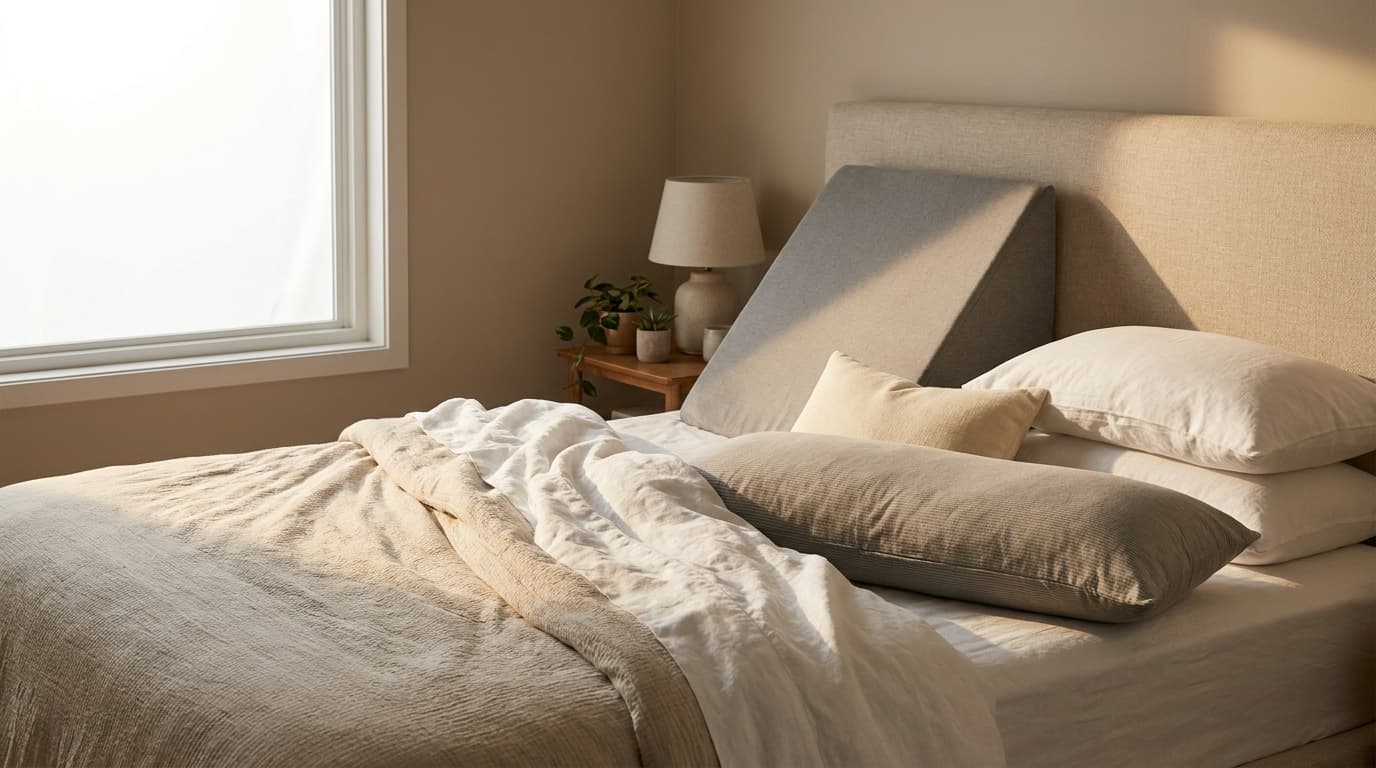
The least discussed part of plastic surgery recovery is the eight hours a night when nobody, including you, is in charge of your body. The discharge paperwork is written as if patients were conscious all night: sleep on your back, keep your head above your heart, do not roll onto the operated side, keep your hips flexed, do not sleep flat for two weeks. Then everyone goes home and does what sleeping humans do, which is move thirty or forty times a night without asking permission.
So the honest question is not "what are the rules." The rules are on the sheet. The honest question is which rules are actually load bearing: which ones protect tissue that is genuinely vulnerable, for how long, and what actually happens on the night you wake up at 3 a.m. face down with your cheek in the pillow. The published evidence here is thinner than almost anywhere else in recovery care. What follows is the ranking most consults never get around to.
Why surgeons care where you sleep at all
The short answer: position changes three things that matter to a healing surgical site, namely pressure on tissue, tension across incisions, and how much fluid pools in the area, and the first weeks after surgery are when all three have real consequences.
None of this is mystical. A fresh surgical site is a zone of cut blood vessels, raw tissue planes, and swelling that follows gravity. Lying with the site dependent, meaning below the level of the heart, lets fluid accumulate in it overnight, which is why faces are most swollen in the morning and why the swelling timeline runs in months rather than days. Direct pressure does two additional things: it can compress delicate healing structures, and in the specific case of grafted fat it can starve tissue that does not yet have a blood supply. And positions that stretch a closed incision, such as lying flat after the skin of the abdomen has been pulled tight, load the closure at exactly the moment it is weakest.
That is the entire theoretical basis. Notice what it implies: the rules should be strictest where tissue is pressure sensitive or tension sensitive, and they should relax on a biological schedule, not a superstitious one. Which is roughly what the honest version of the instructions looks like.
The face: elevation is real, side sleeping fear is mostly overrated
The short answer: sleeping with the head elevated for the first one to two weeks measurably reduces swelling and is worth doing after facelifts, rhinoplasty, and eyelid surgery, while the fear that rolling onto your cheek will shift a surgical result is mostly unfounded after the first several days.
Head elevation is the rare positioning rule with actual study support. Postoperative and post-injury edema of the head and neck responds to gravity, and small randomized trials in the facial plastic surgery literature, including head elevation studies in rhinoplasty patients, have found less swelling and bruising with the head kept above heart level in the early days. The mechanism is boring and reliable: fluid drains downhill. This is also why patients prone to malar mounds and festoons look worse in the morning, and why surgeons ask rhinoplasty patients to spend a week or two propped at twenty to thirty degrees. Two pillows or a wedge is enough. Sitting bolt upright in a chair all night is not required and costs you the sleep quality that healing also depends on.
The side sleeping prohibition deserves more nuance than it gets. In the first days after a facelift, pressure and shear on undermined skin flaps is a legitimate concern, and after rhinoplasty the external splint is there precisely because the nasal bones are mobile for about two weeks. During that window, back sleeping is a real instruction. But a healed-enough face is not clay. By a few weeks out, an accidental night on your side will leave you more swollen on that side in the morning and will not displace a SMAS repair or bend a healing nose through a splint. Eyelid patients have a different reason to care: incomplete lid closure during sleep is common early after blepharoplasty, and it is the corneal surface, not the incision, that suffers, a problem covered in dry eye after eyelid surgery.
The breast rules are the most surgeon dependent and the least evidenced
The short answer: after breast augmentation, back sleeping for a few weeks is a reasonable comfort and swelling measure, but the wide variation in instructions, from two weeks to six weeks to "whenever it feels fine," tells you the evidence behind any specific number is thin.
Ask five board certified surgeons how long an augmentation patient must sleep on her back and you will get five answers. That variation is itself the data point. There is no controlled study showing that early side or stomach sleeping displaces implants, ruptures repairs, or changes capsular outcomes, and the implant sits in a surgically created pocket that a pillow cannot relocate. What early pressure does reliably produce is pain, and pain is a perfectly good reason to stay on your back for two or three weeks without needing a scarier story attached.
The exception is surgery that depends on internal support holding a shape against gravity. A mastopexy closure, or an internal bra style mesh support, is doing structural work in the early weeks, and stomach sleeping loads it in ways the surgeon who built it is entitled to prohibit. The same logic applies to fat transfer to the breast, for the graft survival reasons that get their own section below. The pattern to notice: the rule earns its strictness from what was done inside, not from the presence of an implant.
"The strictness of a sleep rule should track the biology underneath it. Grafted fat and tight closures earn their rules. A six week ban on side sleeping after a routine augmentation is not evidence based medicine. It is a surgeon rounding up for safety, which is fine, as long as nobody pretends the number came from a study.
"
Fat grafting has the strictest rule and the strongest reason
The short answer: transferred fat spends its first several days with no blood supply of its own, so direct sustained pressure on a grafted area in the first two weeks can genuinely kill the result, which is why the Brazilian butt lift sitting and back sleeping restrictions are the one set of position rules to treat as close to absolute.
Grafted fat is the special case that deserves the fear the other rules borrow. When fat is transferred, the cells survive at first by soaking up nutrients from surrounding tissue, and only over roughly the first week do new blood vessels grow in and take over. During that window the graft is a living tissue with no plumbing, and sustained external pressure compresses away the very contact it is surviving on. The biology of fat graft survival is the difference between a result that keeps seventy percent of its volume and one that keeps thirty.
This is why BBL patients are told not to sit or lie directly on their buttocks for about two weeks, to sleep prone or on their sides, and to use an offloading pillow when sitting is unavoidable. The American Society of Plastic Surgeons' patient materials repeat the restriction, and the fat grafting outcome literature in the Aesthetic Surgery Journal is where the survival numbers behind it come from. It is a genuinely disruptive instruction, and it is also one of the few with a mechanism solid enough to justify the disruption. The same logic applies at smaller scale to facial fat transfer, where side sleeping on a freshly grafted cheek in the first week or two is worth actually avoiding, not just nodding at. Fat grafting safety has other, more important chapters, covered in the BBL safety protocols, but position is the part the patient controls after the surgeon's part is done.
Tummy tucks and the beach chair: a tension story with an expiration date
The short answer: sleeping with the torso and knees flexed for one to two weeks after abdominoplasty protects a closure that was deliberately sewn under tension, and the restriction should visibly relax as the tissue stretches, rather than persisting as a vague month of fear.
An abdominoplasty closes the abdomen tighter than it was designed to be, on purpose. For the first days, patients cannot stand fully upright, and the flexed "beach chair" sleeping position, back elevated, pillows under the knees, exists to keep the incision from being loaded while the earliest, weakest healing happens. This one is real. It is also self limiting: skin stretches, tension falls, and by two weeks most patients are standing straight and can sleep progressively flatter. Modern closure technique has changed the stakes too, since progressive tension sutures distribute the load across dozens of internal anchor points instead of concentrating it at the skin edge.
Thigh lifts, arm lifts, and body lifts follow the same principle in their own geometry: avoid positions that stretch the closure for the first two weeks or so. None of this requires gymnastics. It requires pillows, a recliner if you have one, and the understanding that the rule is about incision tension, which is measurable and time limited, not about some general fragility of the operated body.
The part nobody writes down: sleep itself is a recovery drug
The short answer: sleep deprivation measurably impairs wound healing, pain tolerance, and immune function, so a positioning rule that costs you most of a night's sleep for weeks is not automatically the conservative choice.
There is a real irony in recovery instructions that wreck recovery. Experimental work on sleep restriction shows slower skin barrier repair, higher inflammatory markers, and lower pain thresholds in sleep deprived subjects. A patient sleeping four broken hours a night in forced positions, anxious about rolling over, is not obviously healing better than one sleeping seven hours with a pragmatic setup. The practical middle ground is unglamorous: a wedge or travel pillow to make the required position comfortable rather than merely endured, body pillows as a barricade against rolling, the operated side of the bed positioned so turning toward it is awkward, and short daytime naps to pay down the debt.
And a rule of proportion for the 3 a.m. discovery: waking up in the forbidden position is an event worth exactly the response of returning to the recommended one. The exceptions are the pressure sensitive windows, a fresh fat graft in week one being the clearest, where prevention deserves real effort, up to and including the offloading pillows and positional barricades that feel excessive right up until you understand what the graft is living on. Everything else is gradient, not cliff.
The honest summary
Sleep positioning after plastic surgery is a mix of three things: rules with real mechanisms, rules that are comfort measures wearing a medical costume, and rules nobody has ever tested. The load bearing ones are identifiable. Head elevation for the first week or two after facial surgery reduces swelling and is supported by actual data. Protecting a fat graft from direct pressure for about two weeks has the strongest biological case in the entire category and is worth genuine inconvenience. Flexed positioning after a tummy tuck protects a closure that is objectively under tension, and expires as the tension does.
The rest deserves proportion. Back sleeping after breast augmentation is mostly about pain and swelling, and the six week versions of that rule are rounding, not science. The fear of ruining a facelift or a rhinoplasty by waking up on your side weeks after surgery is out of scale with what pressure can actually do to healed tissue through a splint or a settled flap. And the instruction sheet that treats every rule as equally absolute is doing you the quiet disservice of spending your limited sleep, which your healing also needs, on rituals that were never the point. Ask which rules are structural, get the expiration dates in writing, buy the wedge pillow, and stop panicking at 3 a.m.