Procedure Deep-Dive · July 29, 2026
The Vampire Facial: What Your Own Blood Can and Cannot Do for Your Face
Platelet-rich plasma is the rare aesthetic treatment whose active ingredient is you, which is exactly why it gets sold with a confidence the evidence does not support. Here is what is actually in the tube, why no two PRP treatments are the same procedure, what the published trials show once you account for the microneedling doing most of the work, and why the most serious documented harm from a vampire facial had nothing to do with the plasma.
By The Editorial Desk
10 min read
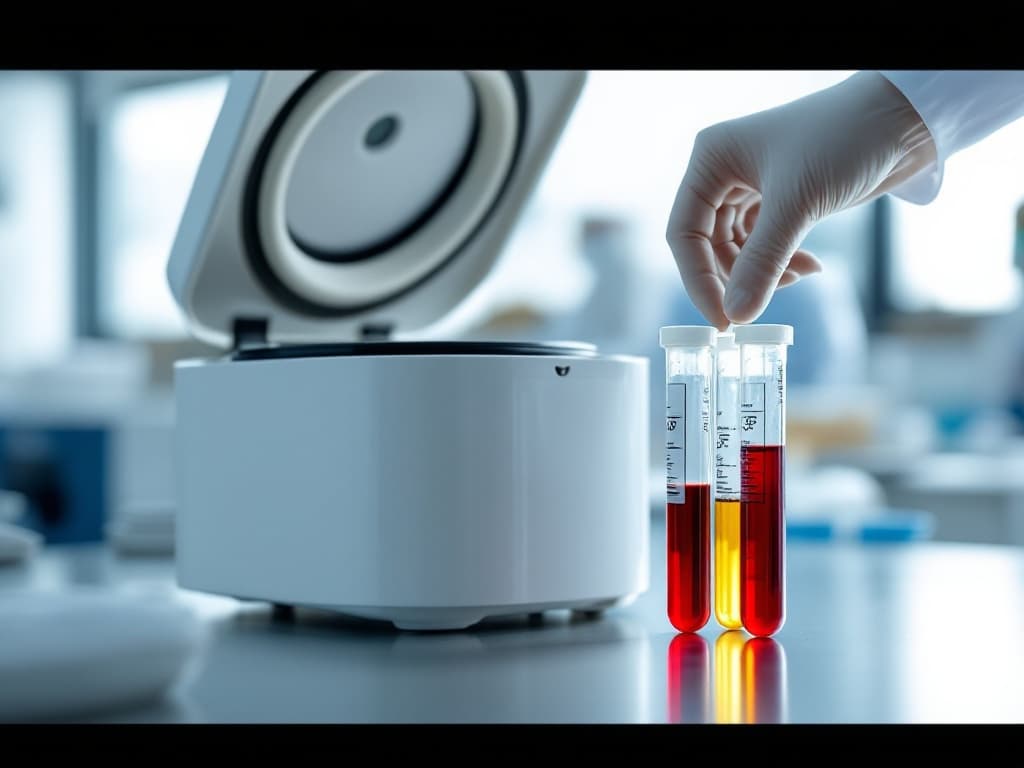
The pitch is almost too good to interrogate. There is no synthetic filler, no toxin, no foreign material of any kind. A technician draws your blood, spins it in a centrifuge for a few minutes, and puts the golden layer back into your face through a microneedling pen. Nothing goes in that did not come out of you. It is marketed, reasonably enough, as the most natural thing available in an aesthetic practice.
That framing does real work. Autologous means from the same body, and autologous is a genuinely meaningful safety category: your own platelets will not trigger an allergic reaction and cannot be rejected. But "it came from you" is a statement about immunology, not about efficacy, and it says nothing at all about whether the person holding the syringe knows how to handle a tube of human blood.
Both of those gaps matter. Platelet-rich plasma is a plausible, modestly supported, wildly inconsistent treatment sold at premium pricing. And the single most serious documented harm associated with the vampire facial in the United States did not come from the plasma. It came from the room it was prepared in.
What is actually in the tube
The short answer: PRP is your own blood spun to concentrate platelets several times above baseline, and the therapeutic claim rests on the growth factors those platelets release, not on the blood itself.
A standard treatment starts with a venous draw, typically ten to sixty milliliters depending on the protocol and the treatment area. The tube contains an anticoagulant so the sample does not clot before it can be processed. It goes into a centrifuge, which separates the sample by density into three layers: red cells at the bottom, a thin buffy coat of white cells and platelets in the middle, and platelet-poor plasma on top. The operator draws off the fraction containing the concentrated platelets. That fraction is the product.
Platelets are not just clotting cells. When activated they degranulate and release a signaling cocktail: platelet-derived growth factor, transforming growth factor beta, vascular endothelial growth factor, epidermal growth factor, insulin-like growth factor. In wound healing these recruit fibroblasts, stimulate collagen synthesis, and promote new blood vessel formation. The entire rationale for aesthetic PRP is that concentrating those signals into aging skin will push it toward a repair state: more collagen, better texture, improved tone.
That is a coherent biological hypothesis. It is not the same thing as a demonstrated clinical result, and the distance between the two is where most of the marketing lives.
Platelet-rich fibrin, PRF, is the newer sibling. It uses no anticoagulant and a slower, shorter spin, which allows a fibrin matrix to form and traps the platelets and white cells in a scaffold that releases growth factors more gradually. In practice it is often used as a thicker gel for under-eye hollows. The theory is more elegant. The published evidence behind it is thinner than the evidence behind PRP, which is itself thin.
The evidence, and how weak "supports" actually is
The short answer: controlled trials of PRP for facial rejuvenation consistently report improvement in skin texture and fine lines, and just as consistently report small sample sizes, subjective endpoints, short follow-up, and protocols too different from one another to pool.
The literature is real. There are randomized split-face studies where one side receives PRP and the other receives saline or nothing. There are trials pairing PRP with microneedling, with fractional lasers, and with fat grafting. Systematic reviews of facial PRP generally conclude that the treatment is safe, that patients report satisfaction, and that measurable improvements in texture, elasticity, and fine wrinkling are detectable. If the question is only "does anything happen," the answer is probably yes.
The question that matters more is "compared with what, and by how much." There the picture degrades fast. Most trials enroll a few dozen patients. Many rely on patient satisfaction scores and investigator visual assessment rather than instrumented measurement. Follow-up frequently stops at three or six months. Blinding is difficult when one procedure involves drawing your blood in front of you. And the comparison arm is often nothing rather than an active alternative, which answers a question nobody was really asking.
The microneedling confound deserves its own sentence. The single most common delivery method for facial PRP is to microneedle it into the skin, and microneedling on its own is a well-established collagen induction treatment with its own body of evidence. When a split-face study compares microneedling plus PRP against microneedling plus saline, the added benefit attributable to the plasma is usually modest and sometimes not statistically significant. Some studies find a clear increment. Others do not. The honest reading is that PRP appears to add something to a treatment that was already working, and that the size of that something is unresolved.
"Autologous is a claim about what cannot go wrong immunologically. It is not a claim about what will go right cosmetically, and the two have been quietly merged in almost every brochure that sells this.
"
It is worth noting where PRP does better in the evidence. Androgenetic alopecia is the strongest aesthetic indication, with a larger and more consistent trial base than facial rejuvenation, though even there the standardization problems apply. Acne scarring combined with fractional laser or microneedling also performs reasonably well across studies. The application with the weakest support relative to how aggressively it is marketed is generalized facial rejuvenation in otherwise healthy skin.
No two PRP treatments are the same procedure
The short answer: platelet concentration, white cell content, spin protocol, activation method, injection depth, and session count all vary between practices, and none of them are disclosed to you, which means "I had PRP" describes a category rather than a treatment.
This is the part of the field that should trouble anyone reading it seriously. Consider the variables that differ from one clinic to the next:
- Platelet concentration. Preparation systems produce anywhere from roughly two times baseline platelet count to seven times or more. Higher is not automatically better, and there is some evidence that excessive concentrations inhibit rather than stimulate cell activity. Almost no aesthetic practice measures the final concentration in the product it just injected into you.
- Leukocyte content. Leukocyte-rich and leukocyte-poor PRP are meaningfully different products. White cells bring additional signaling and additional inflammation. Which one is appropriate for skin is not settled, and most practices could not tell you which one their kit produces.
- Activation. Some protocols add calcium chloride or thrombin to trigger degranulation before injection. Others rely on contact with tissue collagen to activate the platelets in situ. This changes the release kinetics of the entire product.
- Spin protocol. Single spin versus double spin, and the specific speeds and durations, determine everything above. A benchtop centrifuge running a protocol somebody found online is not the same instrument as a validated closed system.
- Delivery. Topical application after microneedling, direct intradermal injection, deep injection for volume, or a combination. The depth determines what tissue actually sees the growth factors.
Regulatory oversight does not resolve this. Centrifuges and preparation kits reach the market through device clearance pathways, which establish that the device does what it says it does mechanically. That is not an efficacy finding about facial rejuvenation, and using the phrase "FDA cleared" to imply otherwise is one of the more common sleights of hand in this corner of aesthetics. PRP drawn from a patient, minimally processed, and returned to that same patient in the same visit is generally handled as the practice of medicine rather than as a regulated drug product. That is a reasonable framework. It also means the quality floor is set by the individual practice, and nobody is auditing it.
The New Mexico case, and the risk that is not theoretical
The short answer: in 2024 the CDC reported HIV transmissions among clients of a New Mexico spa that offered vampire facials, the first documented cases linked to cosmetic injection services using needles, and the failure was entirely in handling and licensing rather than in the treatment concept.
The investigation began in 2018, when a woman with no identified risk factors for HIV was diagnosed after receiving a platelet-rich plasma microneedling procedure at a spa in Albuquerque. State health investigators inspected the facility and found practices that read like a list of everything that must never happen where blood is drawn: unlabeled tubes of blood on counters and in a kitchen refrigerator alongside food, unwrapped syringes in drawers and on counters, and no infection control documentation of the kind any licensed medical facility maintains. The operator was not licensed to perform the procedures. The state ordered the spa closed, and the owner ultimately pleaded guilty to practicing medicine without a license.
Health authorities notified clients and offered testing. The molecular analysis published by the CDC in 2024 identified a cluster of infections with closely related virus among spa clients, indicating transmission within the facility rather than coincidence. Three clients plus one spouse were reported in the cluster, and one of the identified individuals had died of AIDS-related complications before the investigation concluded.
Read that carefully, because the lesson is precise. Platelet-rich plasma did not transmit HIV. Contaminated equipment and reused or improperly stored blood products in an unlicensed facility transmitted HIV. Any procedure in that room, with that handling, carried the same risk, and the same mechanism applies to hepatitis B and hepatitis C, both of which survive outside the body considerably longer than HIV does.
The reason this matters more for PRP than for most aesthetic treatments is structural. Most injectables arrive as a sealed, single-use, manufactured product. PRP is compounded on site, from human blood, in whatever room the practice has available, by whoever the practice assigns. The safety of the treatment is therefore not a property of the treatment at all. It is a property of the facility. This is precisely the category of procedure that should never be performed anywhere the medical oversight is nominal, which is a large share of where it is currently sold.
What it costs, and what it is competing against
The short answer: a course of facial PRP typically runs several hundred to well over a thousand dollars per session across three sessions, is not covered by insurance, and competes directly with treatments that have substantially stronger evidence at comparable or lower cost.
Standard protocols call for roughly three treatments spaced four to six weeks apart, with maintenance every six to twelve months. Results, where they occur, appear gradually over two to three months as collagen remodeling proceeds, which is both biologically plausible and conveniently unfalsifiable on any short timeline. There is no meaningful downtime beyond the redness and pinpoint bleeding of the microneedling itself, usually a day or two.
Now put that against the alternatives for the same complaints. For fine lines and texture, fractional resurfacing lasers have decades of controlled data and produce changes visible in standardized photography. For volume loss, hyaluronic acid filler or fat grafting addresses the actual deficit, which PRP does not. For pigment, targeted lasers and topical agents outperform it comfortably. For overall skin quality, a consistent regimen of a retinoid and daily sun protection has the strongest evidence in all of dermatology and costs a fraction of one PRP session per year.
None of that makes PRP worthless. It makes it a reasonable adjunct with an unreasonable position in the pricing hierarchy. The patients most likely to be satisfied are those with mild textural concerns, acne scarring being treated alongside microneedling or laser, or early thinning hair, who understand they are buying an incremental improvement rather than a transformation. The patients most likely to be disappointed are those with structural aging who were told that their own blood would do what an operation does.
The honest summary
Platelet-rich plasma is one of the few aesthetic treatments where the safety story and the efficacy story point in genuinely different directions, and where both get flattened into a single reassuring sentence about it being natural.
On efficacy: the biology is sound, the trials are small, the protocols are unstandardized, the endpoints are soft, and the most common delivery method is a treatment that works on its own. The reasonable expectation is a modest improvement in skin texture over several months, most defensible as an add-on to microneedling or laser and least defensible as a standalone answer to facial aging.
On safety: the product itself is about as low-risk as anything in aesthetics, because it is you. The procedure is only as safe as the facility, because the product is made on site out of human blood by whoever the practice put in that room. The New Mexico cluster is the clearest available demonstration that this distinction is not academic.
If you want the treatment, buy it from a licensed medical practice that draws, spins, and injects your blood in front of you in a labeled single-patient tube, and price it honestly against a retinoid, sun protection, and a course of microneedling. If a practice leads with the word natural and cannot tell you what its centrifuge protocol is, you are not being sold a medical treatment. You are being sold the fact that the ingredient came from your arm.