Industry · August 26, 2026
The Rash Around the Incision: Adhesive and Tape Reactions After Cosmetic Surgery
A week after a breast augmentation or a tummy tuck, a red, itchy, sometimes blistering rash appears in a neat rectangle around the incision. The wound itself looks fine. Patients read it as infection and call in a panic; practices often shrug it off as sensitivity. The usual culprit is the dressing: the skin glue, the paper strips, the acrylic adhesive on the pad, or the tape holding it all down. Here is how to tell an adhesive reaction from an infection, why the reaction is becoming more common, what the dermatology literature says about Dermabond and its cousins, and what to ask so it does not happen again at the next procedure.
By The Editorial Desk
9 min read
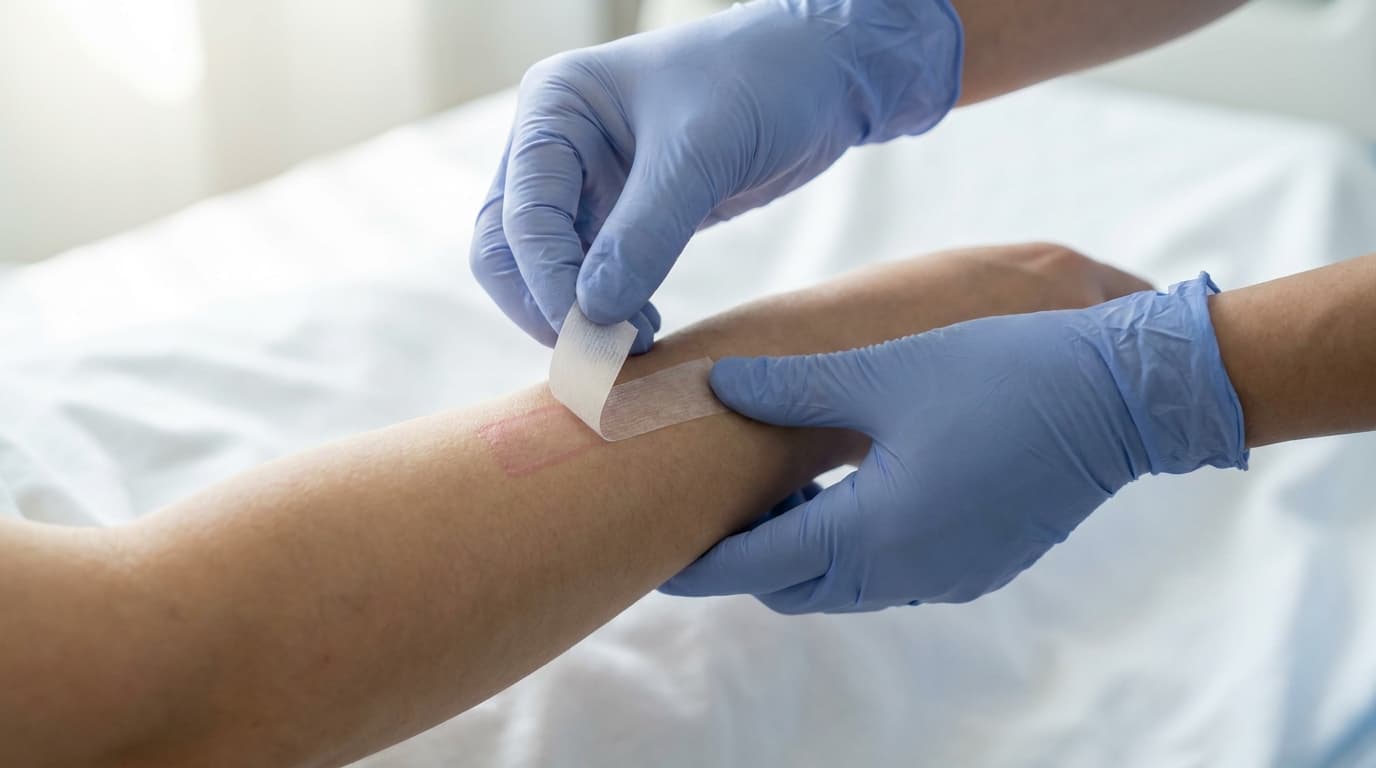
The call comes on day five or day seven, and it has a familiar shape. The incision is closed and dry. The patient is not feverish. But the skin around the wound has turned an angry pink in a sharply bordered rectangle, it itches more than it hurts, and in the worse cases small blisters have appeared exactly where the edges of the dressing sat. The patient has searched the internet and is now convinced the wound is infected. The nurse on the phone has seen the pattern a hundred times and suspects something else entirely: the skin is reacting to whatever was stuck to it.
Adhesive and tape reactions are among the most common minor complications after any surgery, and cosmetic surgery is unusually good at producing them. The incisions are long, the dressings are elaborate, the skin is often already stressed by shaving, antiseptic prep, and swelling, and the operations increasingly finish with a layer of liquid skin glue that stays on the wound for weeks. None of this is dangerous in the ordinary case. But the rash is misread often enough, in both directions, that it is worth understanding what it is, what it is not, and the small number of situations where it genuinely matters.
Irritation or allergy
The short answer: most dressing rashes are irritant contact dermatitis, a mechanical and chemical insult to the skin that anyone can develop, while a smaller share are true allergic contact dermatitis, an immune response to a specific ingredient that will recur every time the patient meets it.
Irritant dermatitis is the default. Adhesive tape pulls at the outer layer of skin each time it is removed, occlusive dressings trap moisture and sweat for days, and the skin underneath becomes macerated, red, and sore. Tension on the tape adds shearing blisters at the edges, which is why the reaction so often appears as a crisp outline of the dressing rather than a diffuse rash. This reaction does not require any prior exposure, it appears within a day or two of the dressing going on, and it resolves within a week of the dressing coming off. The American Academy of Dermatology describes irritant reactions as accounting for roughly eighty percent of all contact dermatitis, and the proportion in surgical patients is probably similar.
Allergic contact dermatitis is different in mechanism and timing. It is a delayed-type hypersensitivity, meaning the immune system has been sensitized to a chemical on a previous exposure and now mounts a T-cell response to it. The rash typically appears two to four days after contact, spreads a little beyond the borders of where the adhesive touched, itches intensely, and can produce vesicles and weeping. Its distinguishing feature is that it recurs on every subsequent exposure, often faster and worse. The chemicals responsible in surgical settings are a short list: acrylate adhesives used on tapes and dressing pads, colophony (rosin) in older tapes, and, increasingly, the cyanoacrylate compounds in liquid skin adhesives. Formal diagnosis requires patch testing by a dermatologist, which is worth pursuing for anyone who has reacted more than once, because the offending ingredient is usually in far more products than the patient realizes.
The skin glue problem
The short answer: 2-octyl cyanoacrylate, sold as Dermabond and under several other names, has an excellent record for closing incisions but is now a well-documented cause of allergic contact dermatitis, with case series in the dermatology and surgical literature showing that a meaningful minority of patients who react to it will react again to the same class of chemistry.
Cyanoacrylate skin adhesives have become nearly universal in cosmetic surgery over the past fifteen years. They seal the incision, remove the need for external sutures, act as a microbial barrier, and let the patient shower the next day. The wound closure literature, including a 2010 Cochrane review of tissue adhesives for surgical incisions, finds them equivalent to sutures for cosmetic outcome in low-tension wounds, which describes most of what happens in a plastic surgery practice. The problem is that the glue sits on the skin for one to three weeks, well past the sensitization window, and its chemistry is closely related to the ethyl cyanoacrylate in household superglue and to the acrylates in artificial nails, nail polish, and dental materials.
Reports of allergic contact dermatitis to 2-octyl cyanoacrylate began to accumulate in the 2010s and have been documented in the journals Dermatitis, Contact Dermatitis, and the Journal of the American Academy of Dermatology, as well as in orthopedic and plastic surgery journals reporting series from single institutions. The incidence in those series ranges from under one percent to over two percent of patients exposed, which is small per operation but adds up across a practice that glues every incision. The distinctive presentation is a rash that follows the exact line of the glued wound, appearing between a few days and two weeks after surgery, sometimes only when the glue begins to peel and the skin beneath is re-exposed. Patients who have artificial nails, who work with adhesives, or who have a history of reacting to bandages are at higher risk, and a practice that asks about none of those things will discover the reaction the hard way. A newer generation of adhesives that blend cyanoacrylate with a mesh backing, sold for longer incisions such as abdominoplasty, carries the same chemistry and the same risk.
"The glue that closes the wound was chosen because it makes the incision look better. It is worth remembering that it is also a chemical the skin has never met before, left in place for weeks, on a patient nobody asked about nail polish.
"
Reading the rash against an infection
The short answer: a dressing reaction is itchy, follows the borders of the material, appears while the wound itself stays quiet, and improves within days of removal, while an infection is painful rather than itchy, spreads outward from the wound in an irregular pattern, and comes with warmth, drainage, or fever.
The distinction matters because the two are treated in opposite ways. An infected incision needs assessment, sometimes culture, and often an antibiotic. A dressing reaction gets worse with more tape and better with nothing at all, and it is not improved by an antibiotic, which adds its own risk of rash and stomach upset. The features that point toward the dressing are geometric borders that match the adhesive footprint, itching as the dominant symptom, a wound edge that looks the same as it did the day before, and blisters at the edges rather than pus at the center. The features that point toward infection are increasing pain rather than itch, redness that radiates unevenly from the incision and is expanding by the hour, heat that can be felt through the skin, drainage that has become cloudy or foul, a fever above 38 degrees Celsius, and a patient who feels unwell. The Centers for Disease Control and Prevention's surveillance definition of a superficial surgical site infection rests on purulent drainage, a positive culture, or a surgeon's diagnosis, none of which is satisfied by a red rectangle.
A photograph sent the same day resolves most of the uncertainty, and a practice that does not offer a way to send one is behind the standard. Two conditions warrant more caution. Cellulitis can start as a flat, warm redness that a patient reading online will convince themselves is just the tape, and a patient with an implant beneath the incision has less margin for a missed infection than a patient recovering from a blepharoplasty. And an allergic reaction that has blistered and weeped can become secondarily infected, so a rash that started as itch and has now turned painful and crusted is no longer just a rash. This site has covered the wound breakdown and seroma presentations that get confused with both; the through-line is that a change in the wound's behavior, not the color of the surrounding skin, is the alarm.
What to do about it, and what to do next time
The short answer: remove the offending material, treat the skin with a short course of a mid-potency topical steroid and a bland emollient, leave the wound uncovered or under a non-adhesive dressing, and record the reaction so the next surgeon uses something else.
Treatment of an uncomplicated dressing reaction is simple. The tape or dressing comes off, and the adhesive residue is dissolved with mineral oil or a medical adhesive remover rather than scrubbed. Skin glue is left to shed on its own unless the reaction is severe, in which case the surgeon can loosen it with petroleum jelly over several days; peeling a cyanoacrylate seal off a fresh incision is a good way to open it. A mid-potency topical corticosteroid applied twice daily for five to seven days calms both irritant and allergic dermatitis, and an oral antihistamine at night helps with sleep more than it helps with the rash. A weeping allergic reaction benefits from cool compresses. Steroids do not go directly on an open wound, and a reaction that is spreading beyond the dressing footprint, blistering extensively, or affecting the face should be seen rather than managed by phone.
The more important work happens afterward. A patient who has reacted to a surgical adhesive should ask the practice to name the product, write it in their own record, and mention it at every future procedure, dental visit, and blood draw. If the reaction was severe or has happened more than once, referral for patch testing is worthwhile, because an acrylate allergy discovered in the surgical setting usually explains a history of reacting to bandages, gel nail polish, or glucose monitor sensors that the patient had never connected. For the next operation there are alternatives: silicone-based adhesive dressings, which are markedly less irritating than acrylics; paper or hypoallergenic tapes; and, for the incision itself, absorbable sutures under a thin non-adhesive dressing rather than glue. None of these compromises the cosmetic result, and a surgeon who says the glue is the only way to get a fine scar is describing preference, not evidence.
The systemic issue is that dressing choice is rarely discussed at all. Consent forms cover infection, bleeding, and scarring at length and say nothing about the materials that will sit on the skin for two weeks. A single intake question, asking whether the patient has ever reacted to bandages, tape, artificial nails, or superglue, would catch most of the people at risk, and it is a question many cosmetic practices do not ask. Patients can ask it of themselves and volunteer the answer.
The honest summary
A red, itchy rash that traces the outline of a dressing in the first two weeks after cosmetic surgery is almost always a reaction to the adhesive, the tape, or the skin glue, not an infection. Most are irritant reactions that fade within days of the material coming off. A minority are true allergic contact dermatitis, most often to acrylate adhesives or to the cyanoacrylate in products such as Dermabond, and those will come back at every future exposure until the patient knows the name of the chemical and the practice uses something else. The signs that separate a dressing reaction from an infection are the shape of the rash, itch versus pain, and whether the wound itself has changed. Treat the skin gently, leave the incision alone, send a photograph rather than guessing, and write the reaction down. The dressing on a cosmetic incision was chosen for the scar. The skin around it deserves the same attention.