Industry · August 20, 2026
Wound Dehiscence: When an Incision Opens After Cosmetic Surgery
An incision that separates after surgery is the complication patients fear most and understand least. It is rarely the catastrophe the word suggests, it almost never comes from nowhere, and the two forces behind it, tension and poor tissue oxygen, are both visible before anyone operates. Here is what an opening wound actually is, where it happens, why the T-junction of a tummy tuck and the breast lift is where it happens most, and the questions that reveal whether a practice plans for its own closures failing.
By The Editorial Desk
10 min read
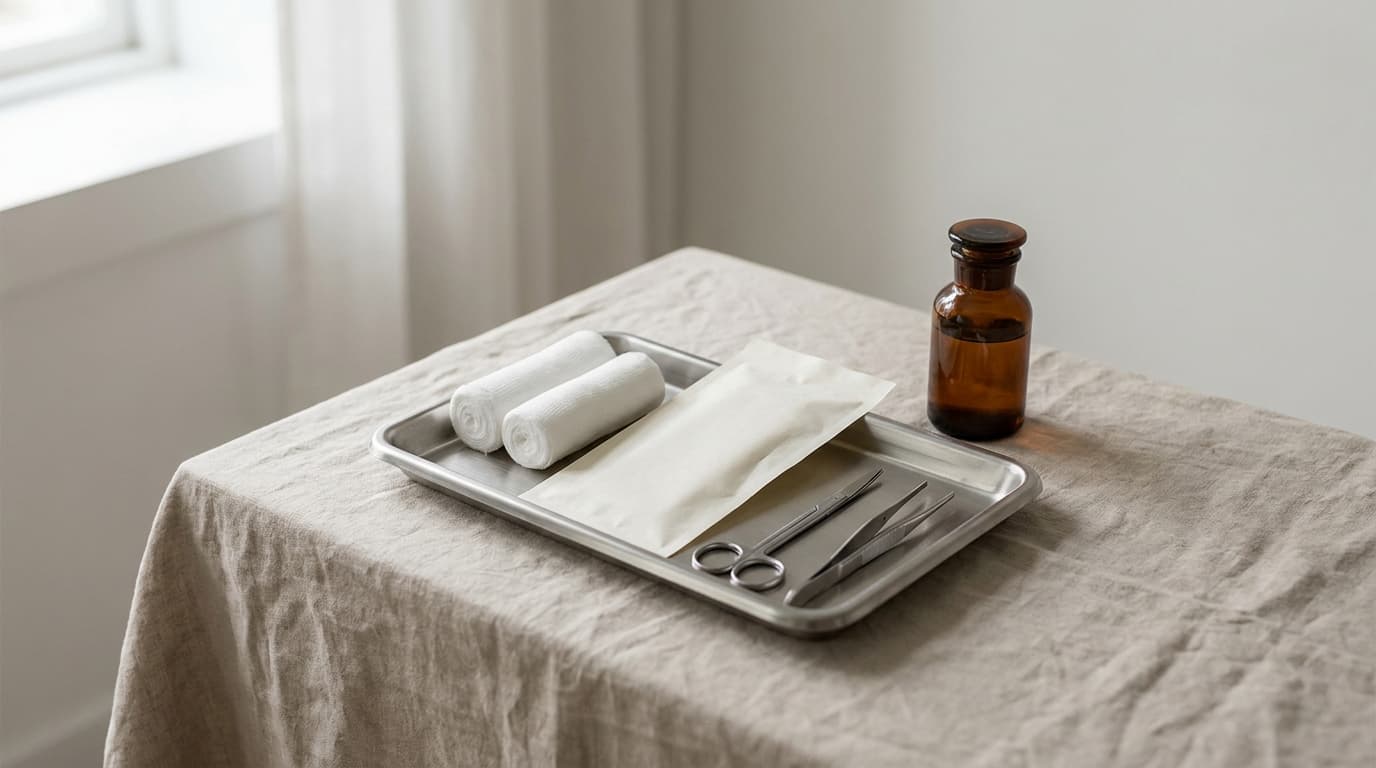
Surgeons talk about incisions as if they are finished the moment the last stitch goes in. They are not. A closed incision is a promise that the body agrees to keep over the following three weeks, and dehiscence is what it looks like when the body declines.
The word covers everything from a few millimeters of skin edge pulling apart at a tummy tuck scar to a full-thickness separation that exposes fat or, in the rare severe case, an implant. Most of what aesthetic surgeons actually see sits at the mild end, which is why the mismatch between the patient's terror and the surgeon's calm is so reliable. But the mild cases and the serious ones share one biology and one set of risk factors, and both are far more predictable than the conversation at most consultations would suggest. After the seroma and the facelift hematoma, this is the third entry in what a patient should understand about how operations fail, and the one with the most modifiable causes.
What dehiscence is, and what it is not
The short answer: dehiscence is the separation of a surgical incision that was closed, and it is a distinct problem from a scar that is merely wide, red, or slow to fade.
A closed wound gains strength slowly. In the first few days it is held together almost entirely by sutures and glue; the tissue itself contributes nearly nothing. Collagen deposition begins around day three to five and the wound's own tensile strength climbs through the following weeks. At two weeks, the point where many practices remove skin sutures, a healing incision has somewhere around ten percent of the strength of intact skin. At six weeks it has perhaps half. It never fully recovers, plateauing around seventy to eighty percent of the original. The numbers are in every surgical textbook, and they explain why the dangerous window for dehiscence is the first two to three weeks: that is when the sutures are being asked to carry a load the tissue cannot yet carry itself.
Separation comes in degrees, and the degree is what matters. Superficial dehiscence involves the skin and the layer just below it, with the deeper closure intact. It looks like a gap along part of the incision, often weeping, sometimes with a yellow base of fat or healing tissue. It is the overwhelming majority of what aesthetic practices manage. Deep or full-thickness dehiscence means the structural layers have separated too: the fascial repair in an abdominoplasty, or the pocket closure over a breast implant. That version is rare in cosmetic surgery and is a surgical problem rather than a dressing problem.
What dehiscence is not: a hypertrophic scar, a scar that has spread wide under tension over months, a suture abscess where a single buried stitch works its way out, or skin necrosis where the edge dies before it separates. Those overlap with dehiscence and sometimes cause it, but they are treated differently, and a patient who can name which one they are looking at asks better questions.
"An incision does not open at random. It opens where tension is highest and oxygen is lowest, and both of those are known before the first cut.
"
Where it happens, and why the T-junction earns its reputation
The short answer: dehiscence clusters at the points of greatest tension and poorest blood supply, and in aesthetic surgery that means the center of a tummy tuck scar and the inverted-T of a breast lift.
Every surgeon who does body contouring knows the phrase "T-junction breakdown." In a full abdominoplasty, the vertical closure around the relocated umbilicus meets the long horizontal scar, and in an anchor pattern breast lift or reduction, the vertical limb meets the fold incision. At those junctions, three flaps of skin converge, each has had its blood supply reduced by the dissection that freed it, and the tips of the flaps sit at the far end of whatever circulation remains. The lower central abdomen also carries the greatest closing tension, because that is where the most skin was removed. Minor wound separation at the T in breast reduction is reported in a substantial share of patients in the published series, often in the ten to twenty percent range depending on how it is counted, and nearly all of it heals without surgery. Abdominoplasty wound complications run in a similar broad band, with small openings along the midline far more common than anything structural.
The other hot spots follow the same logic. The medial thigh lift combines tension, a moist environment, and constant movement, and has some of the highest wound separation rates in body contouring. Arm lifts separate at the elbow end of the scar, where motion fights the closure. The earlobe and the hairline in a facelift rarely dehisce but can, when the closure was tight enough to make the lobe look pulled. And the belly button after a tummy tuck is its own small circular T-junction, which is why a slightly weepy umbilicus at week two is among the most common post-operative phone calls in all of plastic surgery.
Timing distinguishes the two main mechanisms. A wound that opens in the first few days, often after a specific event, a cough, a fall, a premature stretch, a vomiting spell, is a mechanical failure. A wound that opens at ten to twenty-one days, usually with an edge that looked dusky first, is a perfusion failure: the tissue at the margin was not getting enough oxygen to build collagen, the sutures dissolved or were removed before it had, and the edge fell away. Infection sits behind both, and deserves a sentence on its own: an incision that opens with surrounding redness, warmth, foul drainage, or fever is an infected wound that dehisced, and the infection is the priority.
The risk factors, almost all of them visible in advance
The short answer: smoking and nicotine, obesity, diabetes, poor nutrition, and excess tension are the dominant causes, and every one of them can be assessed before surgery.
This is the part of the dehiscence story that should reorganize how patients read their consultation. The things that predict a wound opening are, with few exceptions, the same things a thorough pre-operative evaluation already screens for.
- Nicotine is the single largest modifiable factor. It constricts the small vessels that feed a flap, and carbon monoxide from smoking displaces oxygen from hemoglobin. The wound-healing literature behind the four to six week cessation windows is essentially a literature about flap necrosis and dehiscence, and it applies to vaping, patches, and pouches, not just cigarettes.
- Body mass index matters because thick subcutaneous fat is poorly vascularized, closures are under greater tension, and skin folds stay moist. The BMI limits that practices set for body contouring are a wound-complication policy wearing a different label.
- Blood sugar matters because hyperglycemia impairs the cells that build collagen and fight bacteria. The case for checking glucose control before cosmetic surgery is largely a wound-healing case, including for patients who do not know they are diabetic.
- Nutrition matters more than patients believe. Protein, vitamin C, zinc, and iron are the raw materials of collagen and the red cells that deliver oxygen. A patient who has lost a great deal of weight quickly, including on a GLP-1 drug, or who is eating very little after surgery, is building scar out of a depleted pantry. The pre-operative nutrition conversation is the one most often skipped.
- Steroids, immunosuppressants, and autoimmune disease blunt the inflammatory phase that healing requires. Patients in that category need a specific plan, not a generic one.
- Prior radiation or scars across the operative field reduce the blood supply the new closure will depend on.
- Tension is the surgeon's variable. Removing more skin than the tissue can be closed over without strain produces a tighter-looking early result and a higher dehiscence rate. Progressive tension sutures, layered closure, and a conservative resection pattern are how good surgeons buy down that risk. The drainless tummy tuck technique is, among other things, a tension-distribution technique.
- Patient behavior after surgery is the last lever. Lifting, bending, reaching, and the early return to exercise all load a closure that is still borrowing its strength from sutures.
The American Society of Plastic Surgeons and the wound-healing literature in Plastic and Reconstructive Surgery have said all of this for decades. What varies between practices is not the knowledge but whether it is applied: whether the nicotine test is actually run, whether the A1c is actually drawn, whether the patient is actually told that the incision is not finished when they go home.
What actually happens when a wound opens
The short answer: most cosmetic surgery dehiscence is managed with dressings and time rather than a return to the operating room, and the result is usually a scar that can be revised later rather than a compromised operation.
The reflex when an incision opens is to want it sewn back up. Surgeons usually decline, and the reasons are worth understanding. A wound that separated because its edges were poorly perfused will not be fixed by pulling those same edges back together under the same tension; it will separate again, often worse. A wound that has been open for more than a few hours is colonized with skin bacteria, and closing it traps them. So the standard of care for superficial dehiscence is secondary intention healing: keep the wound clean and moist, let it fill from the base with granulation tissue, and let the edges contract and re-epithelialize. Moist dressings, hydrocolloids, or silver-containing products are common; negative-pressure wound therapy, the small portable vacuum dressings, accelerates larger openings. Any dead tissue at the edge is trimmed so it does not hold the process back.
The timeline is slow by post-operative standards. A centimeter or two of superficial separation at a breast lift T-junction often closes in three to four weeks with dressings alone. A wider midline opening on an abdomen can take six to eight. The result is a patch of scar that is wider and flatter than the surrounding line, and it is very often revised under local anesthesia six months to a year later, frequently as a minor procedure. The scar care that applies to every incision applies with more force here, and the same caveats hold: silicone has evidence, most of the rest does not.
Three situations change the plan. A deep dehiscence, where the fascial repair has separated or an implant is exposed, goes back to the operating room, and an exposed breast implant is a removal-and-replacement conversation, not a dressing. An infected dehiscence is cultured and treated, and the antibiotic decision is made on the basis of the wound rather than reflex. And a wound that is not progressing at all after several weeks prompts a look for the reason: unrecognized diabetes, continued nicotine, a retained suture, a seroma underneath, or nutrition so poor the body cannot build tissue. Hyperbaric oxygen has a role in the truly threatened flap, but it is a rescue measure in the hospital setting, not something to expect from a practice's standard toolkit.
The honest summary
Dehiscence is the complication whose name is scarier than its usual reality and whose causes are less mysterious than its usual explanation. Most of it is superficial, most of it heals with dressings, and most of it is concentrated in a small number of predictable locations on a small number of predictable patients.
Three things to carry out of this.
The incision is not finished when you leave the operating room. For the first two to three weeks it is held together mostly by thread, and everything you do with your body loads that thread. Bending, lifting, reaching, coughing hard, and sitting up wrong are not rules for their own sake. They are the difference between a closure that holds and one that does not.
The risk profile is mostly yours to change, and mostly before surgery. Nicotine in any form, uncontrolled blood sugar, a depleted diet after rapid weight loss, and a body mass index well above a practice's threshold are not moral failings, but they are biology, and the practices that enforce them are protecting their own wounds rather than being difficult. A consult that skips the nicotine test and the A1c is skipping the dehiscence conversation without telling you.
And if a section of your incision does open, the useful response is a photograph and a same-day call, not panic and not silence. Ask what layer is involved, ask how it will be dressed and how often you will be seen, and ask, once it has healed, whether the wider scar can be revised. The patients who do worst with an open wound are not the ones who had one. They are the ones who hid it, or kept smoking, or assumed it meant the operation had failed. It almost never does.