Industry · August 12, 2026
Operating Room Fire: The Facial Surgery Complication Almost Nobody Consents You For
Surgical fires are rare, entirely preventable, and concentrated almost exclusively in exactly the operations cosmetic patients have most often: face, eyelid, and neck procedures done under sedation with oxygen running under the drapes. Here is why the anatomy of the problem points at aesthetic surgery, what the prevention actually consists of, why the most effective step is the one most likely to be skipped, and the questions that tell you whether a facility has thought about this at all.
By The Editorial Desk
9 min read
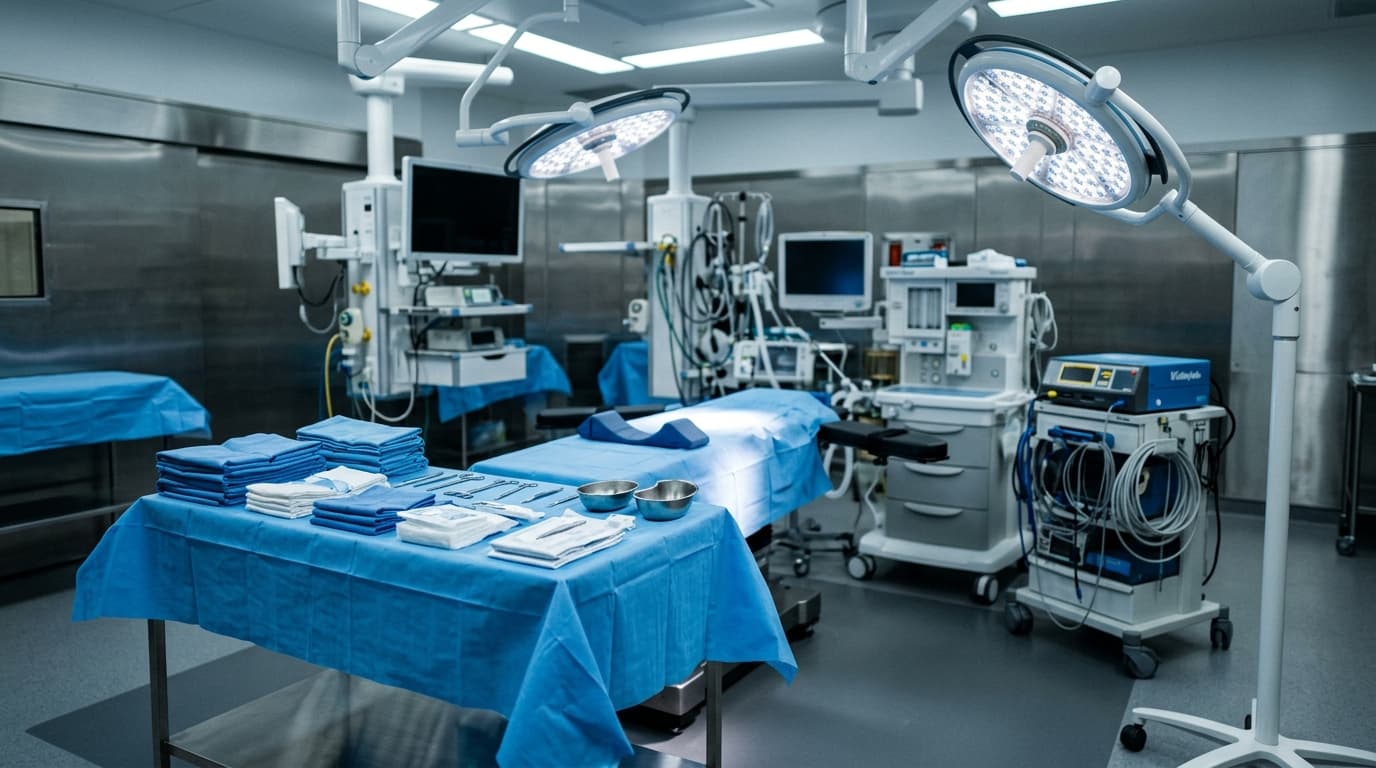
There is a category of surgical complication that behaves differently from all the others. Bleeding, infection, scarring, and asymmetry are risks in the statistical sense: they occur at some rate, in some patients, for reasons that are partly outside anyone's control. An operating room fire is not that. It is an event that requires three specific things to be present in the same place at the same time, all three of which are under direct human control, which is why safety organizations describe it not as a complication but as a never event.
It is also, by a wide margin, a facial surgery problem. The operations where fires happen are overwhelmingly the ones performed on the head, face, neck, and upper chest, under sedation rather than general anesthesia, with supplemental oxygen flowing into a draped space and an electrosurgical pencil or a laser working a few centimeters away. That description covers a large share of the aesthetic surgery calendar: upper and lower eyelid surgery, facelifts and neck lifts under sedation, mole and lesion removals, ear surgery, laser resurfacing, and hair-bearing scalp work.
Patients are consented at length for hematoma and for anesthesia risk. Almost none are consented for this, which is a reasonable thing to notice about an event that is fully preventable and occasionally disfiguring.
The fire needs three things, and facial surgery supplies all three
The short answer: every surgical fire is the product of an oxidizer, an ignition source, and a fuel occupying the same space, and in facial cosmetic surgery those three are supplied by the anesthetist, the surgeon, and the scrub setup respectively, usually within a few centimeters of one another.
The oxidizer is the piece patients never think about. Room air is about 21 percent oxygen. Supplemental oxygen delivered by nasal cannula or open face mask, which is standard practice for a sedated patient who is breathing on their own, raises the local concentration well above that, and the surgical drapes create a tent that holds the enrichment in place rather than letting it disperse. Nitrous oxide behaves the same way. Materials that will not readily burn in room air ignite easily and burn far more aggressively in an oxygen-enriched pocket, which is the single fact that makes this whole subject possible.
The ignition source is the surgeon's instrument. Electrosurgical devices, the monopolar and bipolar cautery used for hemostasis in essentially every facial operation, are the most common. Lasers are next, which matters for resurfacing and hair removal. Fiberoptic light cables are a quieter third, since the tip of a disconnected cable at full intensity is more than hot enough to ignite a drape it is resting on.
The fuel is everything else in the field. Surgical drapes and gowns, gauze and sponges, the patient's own hair, eyelashes and facial hair, and, importantly, the residue of alcohol-based skin preparation. Petrolatum ointments and hair products belong on this list too. Dry gauze in an oxygen-enriched field is not an inert item, it is kindling.
"Bleeding is a risk. Fire is a decision, or more precisely, a sequence of small decisions about oxygen, drying time, and where the cautery goes.
"
Why the numbers point at aesthetic surgery
The short answer: ECRI, the patient safety research organization that has tracked these events longest, has estimated roughly 200 to 240 surgical fires per year in the United States, and the large majority of them, commonly put at around three quarters, occur on the head, neck, face, or upper chest.
That concentration is not a coincidence of anatomy. It is the direct consequence of one anesthetic decision. In an operation under general anesthesia with a secured airway, an endotracheal tube or a laryngeal mask, the oxygen travels in a closed circuit into the lungs and out again. It is not released into the surgical field. In monitored anesthesia care, the arrangement most cosmetic facial work uses because it is lighter, faster to recover from, and cheaper to staff, the patient breathes on their own and receives oxygen openly, under drapes, directly beside the operative site.
So the risk profile follows the sedation, and the sedation follows the economics of office-based aesthetic surgery. This is one of several reasons the setting itself is worth interrogating rather than assumed, a theme covered in what accreditation of an outpatient facility actually certifies, and why the choice between sedation and a secured airway deserves to be discussed as part of the surgical plan rather than delegated as a technicality, which is the argument in why anesthesia choice is part of the operative plan. The same logic that has made awake and sedation-based procedures attractive commercially is the logic that puts open oxygen in the field.
The federal and professional response reflects the same concentration. The Joint Commission issued a sentinel event alert on preventing surgical fires in 2003. The FDA launched a dedicated Preventing Surgical Fires Initiative in 2011. The American Society of Anesthesiologists has maintained a practice advisory on the prevention and management of operating room fires, updated in 2013, whose central recommendation is blunt: for surgery on the head, face, neck, and upper chest, avoid open delivery of supplemental oxygen where possible, use the lowest concentration that maintains adequate saturation, and if a patient genuinely requires an enriched concentration, secure the airway instead of running it open.
The prep has a drying time, and the schedule does not respect it
The short answer: alcohol-based skin preparations are the most underestimated fuel in the room, they require a specific and non-negotiable drying period before drapes go on, and that period is longer than most operating schedules want it to be.
The commonly used chlorhexidine and iodine preparations are suspended in isopropyl alcohol, which is why they work so well and dry so fast on clean skin. Manufacturer labeling for these products typically specifies about three minutes of drying on hairless skin and, on hair-bearing areas, up to an hour. Facial cosmetic surgery is full of hair-bearing areas: the temporal scalp, the sideburn, the beard, the brow.
Two failure modes follow. The first is simply draping too early, trapping alcohol vapor in the tented space where the cautery will shortly be working. The second is pooling, where prep solution runs off the face and collects in the hair, behind the ear, at the neck, under the shoulder, or in the fabric beneath the patient, and stays wet long after the visible skin looks dry. Both are correctable with time and with towels placed to catch runoff. Neither is correctable once the drapes are down and the case has started.
The prevention is boring, which is exactly why it gets skipped
The short answer: every element of surgical fire prevention is procedural rather than technical, costs nothing but minutes, and depends on a team culture that treats a rare event as worth preparing for when it has never happened to them.
The standard measures are well established and unglamorous:
- Run air, not oxygen, whenever saturation allows it. Many sedated cosmetic patients do not require supplemental oxygen at all. The single most effective intervention is removing the oxidizer.
- If enriched oxygen is genuinely needed, secure the airway. This converts an open system into a closed one and removes the enriched pocket entirely.
- Perform a fire risk assessment out loud before the incision. The widely used scoring approach counts three elements: an ignition source in use, an oxidizer above room air, and an open oxygen or fuel source near the surgical site. Three out of three is a high-risk case, and naming it in the room changes behavior.
- Respect the prep drying time and manage runoff. Time it. Do not eyeball it.
- Tent and scavenge the drapes so enriched gas is drawn away from the field rather than accumulating under a fabric roof.
- Keep saline and wet gauze immediately available, and moisten gauze and any hair adjacent to the ignition site rather than leaving dry material in the field.
- Holster the active electrode when it is not in use, and do not lay live fiberoptic cables on drapes.
Notice that none of this is surgeon skill. It is checklist behavior, and its presence or absence is a property of the facility rather than of the individual operating. That distinction is the reason accreditation status and staffing are worth as much scrutiny as the surgeon's credentials, a point connected to both what board certification does and does not tell you and how many of these cases the surgeon actually does. It is also relevant to laser-based work, where the ignition source is the treatment itself, discussed in the context of what the devices are actually doing in energy-based skin tightening and in laser versus chemical resurfacing.
What happens afterward, and why you may never hear about it
The short answer: injuries range from singed hair and superficial facial burns to full thickness burns requiring reconstruction, and the reporting environment around them is weak enough that the public record understates how often they occur.
The clinical outcomes vary with what caught. A flash that ignites drape edge or facial hair may produce a superficial burn that heals with the ordinary trajectory described in what actually influences a maturing scar. A sustained drape fire in an oxygen-enriched field on a sedated patient can produce deep facial burns on a patient who cannot move away from them, and the repair of a deep facial burn is reconstructive surgery of the kind covered in rebuilding facial tissue after excision, performed on someone who came in for an elective aesthetic improvement.
The reporting picture is the other half of the problem. There is no single mandatory national registry for surgical fires. Some events surface through device adverse event reporting, some through state health department incident reporting where such requirements exist, some through accrediting bodies, and many through nothing at all when the case is settled quietly. Elective cosmetic surgery adds its own filter, because the paperwork patients sign frequently includes confidentiality and dispute-resolution provisions that keep outcomes out of public view, a structure examined in arbitration and non-disparagement clauses in cosmetic surgery agreements. The published estimates are therefore best read as floors rather than counts.
The honest summary
Surgical fire is a low-probability event that patients should still ask about, for a reason that has nothing to do with probability. Asking about it is the fastest available test of whether a facility runs on protocol or on habit. A team that can answer the oxygen question, the drying-time question, and the fire-drill question in specific terms has almost certainly thought carefully about a great many other things. A team that has never considered it is telling you something about how it handles rare events generally.
The practical takeaways are narrow. If you are having eyelid surgery, a facelift, a neck lift, ear surgery, a facial lesion excision, or laser resurfacing under sedation, cautery or a laser will be operating near your face while you are unable to protect it, and the presence or absence of open oxygen in that field is the variable that decides whether the situation is ordinary or hazardous. Ask which one you will be in. If supplemental oxygen is planned alongside cautery on your face, ask why room air will not do, and ask what would trigger a switch to a secured airway.
None of this requires you to become an expert in combustion. It requires one conversation with the person delivering your anesthesia rather than only with the person selling the operation, which is a reasonable general practice anyway, and a good reason to build the second consultation around the operative plan rather than the price. Fires in operating rooms are rare because most teams do this correctly. The ones that happen occur because somebody skipped three minutes.