Industry · August 1, 2026
Skin Boosters and the Salmon Sperm Facial: What Is Actually Approved to Go Into Your Skin
Skin boosters are the fastest-moving category in injectables, and most of the products being marketed under that name in American clinics have never been approved for injection in the United States. One product in the category holds an FDA approval, and its label covers a single indication in one anatomical area. Everything else is imported, off-label, relabeled as a topical, or some combination of the three. Here is what the regulators have actually cleared, what the trials actually show, and the question that separates a legitimate treatment from a syringe of something that crossed a border in a suitcase.
By The Editorial Desk
10 min read
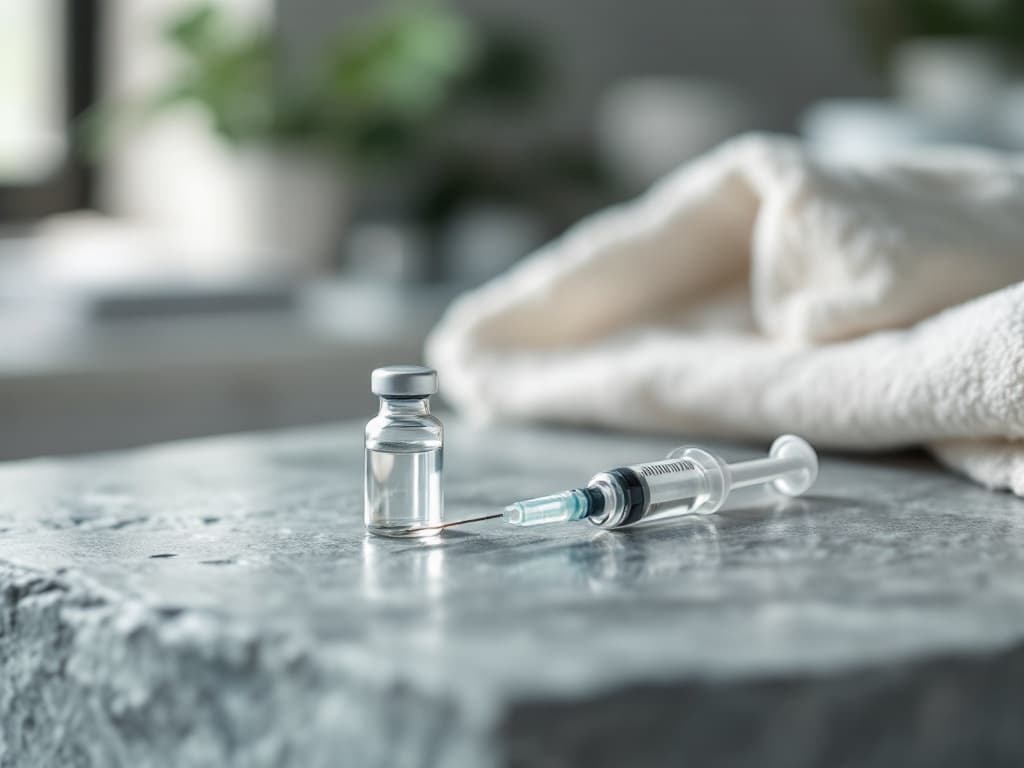
A patient walks into a medical spa in Los Angeles and asks for the salmon thing she saw on a podcast. The injector nods, produces a small vial with Korean characters on the label, and explains that it is a skin booster, not a filler, so it works with your own biology rather than adding volume. The patient pays somewhere between six hundred and twelve hundred dollars, sits through a session of microneedling or a grid of tiny injections, and leaves with a treatment plan for three more.
Nothing in that transaction was necessarily unsafe. Some of it was almost certainly illegal, and the patient was given no way to tell which parts.
Skin boosters are the most interesting new category in aesthetics precisely because they are not chasing volume. They are also the category where the gap between what is marketed and what is approved has grown the widest, and where the standard consumer defense (ask if it is FDA approved) fails, because the honest answer is frequently a sentence long and does not mean what the patient thinks it means.
The category is real, and it is not filler
The short answer: a skin booster is an injectable intended to change skin quality (hydration, elasticity, texture, fine surface lines) rather than to restore or add volume, and that difference in intent is also a difference in regulatory pathway.
Traditional dermal fillers in the United States are regulated as Class III medical devices. That is the highest risk classification, and it requires premarket approval, a full application with clinical data supporting a specific indication in a specific anatomical location. This is why filler labels are so narrow. A product approved for the mid face is not, on its label, approved for the lips or the temples, even though it is used in both constantly. That is what off-label use means: a licensed physician may exercise judgment, and the manufacturer may not advertise it.
Skin boosters sit in the same regulatory universe. Injecting a substance into the dermis to change how skin behaves is a device or drug action, not a cosmetic one, no matter how gentle the marketing sounds. The word "booster" carries no legal weight. It is a category invented by marketing departments, and regulators do not recognize it as a class.
What makes the category commercially explosive is that it targets the enormous population of patients who do not want to look treated. They have read the coverage on where filler actually goes and why it outlasts the brochure, they have seen the overfilled faces, and they want the skin without the shape change. That demand is legitimate. The supply is where it gets complicated.
In the United States, one product in the category is approved, and its label is one sentence
The short answer: Skinvive by Juvederm, approved by the FDA in May 2023, is the only hyaluronic acid intradermal microdroplet injectable approved in the United States for skin smoothness, and its approved indication covers the cheeks.
The indication reads: "indicated for intradermal injection to improve skin smoothness of the cheeks in adults over the age of 21." That is the entire scope of the approval. Not the neck. Not the under eyes. Not the hands. The cheeks, in adults over 21. Allergan Aesthetics has since filed a supplemental premarket approval application seeking to extend the label to horizontal neck lines, which is itself the clearest possible evidence that the original approval does not cover the neck.
The clinical package behind it is unremarkable in the good sense. Results were studied through six months with optimal treatment, and the product was approved across Fitzpatrick skin types I through VI, which matters more than it sounds, because a great deal of aesthetic device data has historically been generated in lighter skin and then extrapolated, a problem we covered in where the real risk sits for cosmetic procedures on deeper skin tones.
So when a clinic tells you their skin booster is FDA approved, there is exactly one product that statement can honestly describe, and it can honestly describe it for one region of the face. Any other use of that product, and every other product in the category, is something else.
""FDA approved" and "FDA approved for what you are about to have done, in the place you are about to have it done" are different sentences. In this category, the second one almost never applies.
"
Profhilo has a following, an evidence base, and no American approval
The short answer: Profhilo is a legitimate, widely used product in Europe and Asia that is not approved by the FDA, which means that any vial of it sitting in a United States clinic arrived through a channel the agency did not sanction.
Profhilo, made by IBSA, is a high concentration hyaluronic acid product carrying 64 milligrams of hyaluronic acid per syringe, delivered through a small number of standardized injection points rather than spread through the dermis. It is marketed as bio remodeling rather than filling, and it holds a CE mark, the European conformity marking that permits sale across that market. European practitioners have used it for years and many of them rate it highly.
None of that constitutes FDA approval. The CE mark and an FDA premarket approval are not equivalent instruments, and they are not reciprocal. A CE marked injectable has satisfied a European conformity assessment. It has not been through the American premarket approval process, and importing it for injection into American patients is not a gray area in the way clinic staff often imply. It is the introduction of an unapproved device into interstate commerce.
The honest version of the pitch would be: this product is used widely in Europe, the European regulator permits it, the American regulator has not evaluated it, and I obtained it anyway. Patients almost never hear the last clause.
The salmon sperm facial: a real molecule, a thin literature, and a legal sleight of hand
The short answer: polynucleotides derived from salmon DNA have a plausible mechanism and a small, mostly favorable evidence base, no injectable form is FDA approved in the United States, and the workaround the American market invented (apply it topically during microneedling) is a distinction that gets thinner the deeper the needles go.
Start with what the molecule is, because the nickname does it no favors. Polydeoxyribonucleotide and polynucleotide preparations are fragments of DNA, purified from salmon or trout milt, that appear to act on adenosine receptors and to supply nucleotides that support tissue repair. The most established clinical use is wound healing, not cosmetics. The Korean product Rejuran built a large market on injecting it into the dermis for skin quality, and it is approved in South Korea for that purpose.
The evidence is early and it is honest about being early. A systematic review of randomized clinical trials searching the literature through January 2026 found seven randomized trials covering 183 participants in total: four in skin rejuvenation, one in postoperative scar prevention, two in wound healing. Directionally the results favored treatment, with improvements in wrinkle outcomes, scar quality and patient satisfaction, and the most consistent effect appearing in wound healing, where re epithelialization was faster than in controls. A separate systematic review in the Journal of Cosmetic Dermatology reached a similar posture. Seven trials and 183 subjects is not a body of evidence that justifies the current volume of marketing. It is a promising signal that deserves the large standardized trials the reviewers explicitly say have not been done.
Now the legal part. Topical cosmetics containing these ingredients can be sold in the United States, and are: retail lines built on the technology now sit on mainstream beauty shelves. Injectable polynucleotide products are not FDA approved here. So American practices have converged on a formulation of the offer in which the product is applied to the skin surface and driven in with a microneedling device, which allows the clinic to describe the substance as a topical cosmetic rather than an injectable.
Consider what a microneedling pass actually does. It creates thousands of channels through the epidermis into the dermis, which is the entire point of the treatment. A cosmetic applied to intact skin and a cosmetic applied to skin that has just been perforated to a controlled depth are not the same exposure, and the safety testing behind a topical cosmetic assumes the first one. This is not a hypothetical concern in aesthetics. The most consequential microneedling failures on record have been infection control failures, which is why the facility risk around platelet rich plasma and vampire facials became a public health story rather than a cosmetic one.
The supply chain is the risk nobody puts on the consent form
The short answer: the dominant safety hazard in this category is not the molecule, it is the parallel import market that has grown up to supply it, and federal enforcement has moved from theoretical to routine.
On November 3, 2025, the FDA issued 18 warning letters to operators of websites illegally marketing unapproved and misbranded botulinum toxin products, and the agency stated it was aware of adverse events associated with those products, including botulism symptoms. Several of the recipients were retail operations selling Korean manufactured injectables directly to practitioners, with names built around exactly the search terms an injector looking for cheap product would type. In December 2025 the agency went a step further and sent a warning letter to a United States medical spa itself for importing and promoting unapproved injectable fillers, which collapses the convenient assumption that enforcement stops at the seller.
The reason this matters to a patient rather than to a compliance officer is straightforward. A product outside the regulated supply chain has no assured identity, no assured concentration, no assured sterility and no traceable lot if something goes wrong. When a complication occurs, and complications in this category are the same complications as in any injectable, up to and including vascular occlusion, the treating physician needs to know precisely what was injected. "A skin booster" is not an answer an emergency department can work with.
There is also the older, uglier version of this story. Every generation of aesthetics has produced a category of substance injected into faces and bodies outside any regulatory framework, sold on the promise that it is natural or biological or minimally invasive, and cleaned up afterward by surgeons who spend careers removing it. That history is documented in what the industrial silicone and biopolymer era left behind. Polynucleotides are not industrial silicone, and the comparison is not about the molecule. It is about the distribution pattern, which is identical.
The honest summary
Skin boosters address a real gap. Not every patient wants volume, plenty of them want skin that behaves better, and the injectable market spent fifteen years selling shape to people who were asking about texture.
But the American version of this category is mostly unapproved. One product, Skinvive, holds an FDA approval, and that approval covers intradermal injection to improve skin smoothness of the cheeks in adults over 21. Profhilo is a serious European product with no FDA approval, which means every syringe of it in this country got here around the system rather than through it. Injectable polynucleotides are approved in South Korea and not here, and the topical plus microneedling workaround that dominates the American market is a regulatory posture rather than a pharmacological one.
The evidence, meanwhile, is genuinely immature. Seven randomized trials and 183 participants, with the clearest effects in wound healing rather than rejuvenation, is a reason to be curious and a reason to be patient. It is not a reason to buy a package of four sessions.
The practical rule is narrow enough to remember. Ask for the product name, ask whether it is approved for injection in the United States, and ask where the vial came from. If the product is Skinvive and it is going into your cheeks, you are inside the label. If the answer is anything else, you are not necessarily in danger, but you are in an experiment, paying retail, with no lot number and no recall path, and you deserve to be told that before the needle rather than after.