Industry · August 26, 2026
Staph Decolonization Before Cosmetic Surgery: What the Chlorhexidine Wash and Nasal Ointment Actually Do
A growing number of cosmetic surgery practices now send patients home before a breast augmentation or tummy tuck with a bottle of chlorhexidine wash, a tube of mupirocin for the nose, and a five-day schedule. The instructions rarely explain why. The reason is Staphylococcus aureus, which lives in the noses of roughly a third of healthy adults and is the single most common cause of surgical site infection. Here is what the decolonization evidence actually shows, where it is strong and where it is thin, how it applies to implants and body contouring, and what a patient should ask when the pre-op bag arrives.
By The Editorial Desk
9 min read
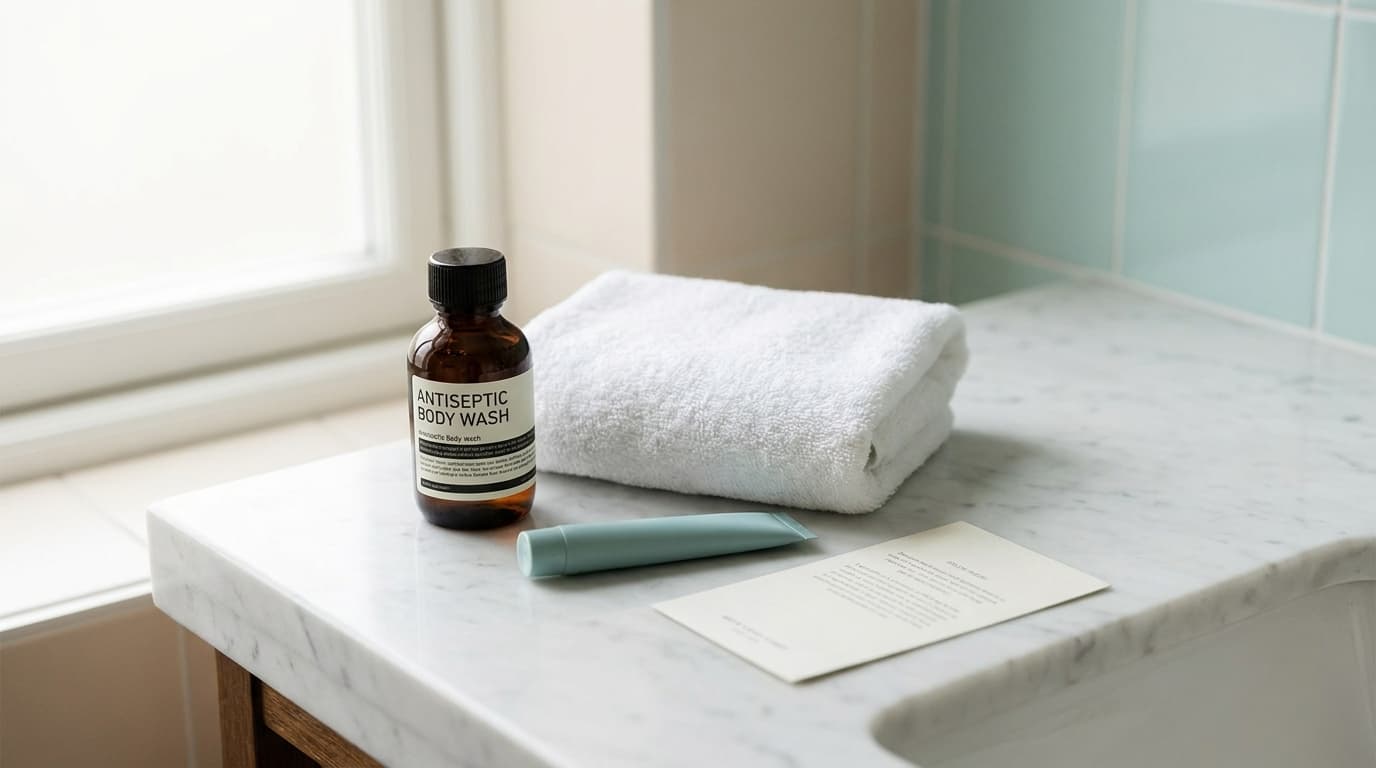
The pre-op bag has changed. A decade ago a cosmetic surgery patient went home from the final consultation with a prescription for an antibiotic, a pain reliever, and a sheet about not eating after midnight. Now the bag often contains an antiseptic body wash with a five-night schedule, sometimes a tube of antibiotic ointment to be smeared inside each nostril twice a day, and occasionally a nasal swab result the patient never asked for. The practice is called staph decolonization, and it migrated into cosmetic surgery from orthopedics and cardiac surgery, where surgeons implanting hardware learned the hard way that the most dangerous bacterium in the operating room usually arrives on the patient.
The logic is simple and the evidence is real, but it is narrower than the marketing around it. Decolonization has a strong trial record in one specific setting: patients who carry Staphylococcus aureus, having operations where an infection is catastrophic. Its record as a blanket ritual for every healthy patient having every kind of elective surgery is much weaker. Cosmetic surgery sits in an interesting spot between the two, because breast implants are foreign bodies in the same sense a hip prosthesis is, while a facelift or a liposuction case is not. A patient handed the bag deserves to know which category they are in.
Why the nose matters
The short answer: about thirty percent of adults carry Staphylococcus aureus in the front of the nose without symptoms, carriers are several times more likely to develop a surgical site infection, and in most of those infections the organism on the wound is the patient's own strain.
Staphylococcus aureus is the most frequently isolated pathogen in surgical site infections in the United States, according to surveillance data from the Centers for Disease Control and Prevention's National Healthcare Safety Network, and it is the organism most likely to be found around an infected breast implant or a wound breakdown after abdominoplasty. Its home base is the anterior nares, the front vestibule of the nose, from which it seeds the skin of the hands, chest, groin, and armpits. Studies using molecular typing have matched the strain in the nose to the strain in the wound in more than eighty percent of Staphylococcus aureus surgical infections, which is the observation that turned decolonization from a theory into a strategy.
Carriage is not a character flaw and it is not a hygiene problem. Roughly twenty percent of people carry the organism persistently, another thirty percent carry it intermittently, and the rest rarely do, for reasons that involve nasal immunology more than handwashing. A small fraction, generally one to three percent of the community population and higher in healthcare workers and people with recent hospital exposure, carry methicillin-resistant strains, the MRSA that makes headlines. The point of screening or blanket treatment is to reduce the bacterial load on the patient's own skin and nose in the days before an incision, so that whatever gets into the wound during surgery is less likely to be the organism that matters most.
What the trials actually found
The short answer: the strongest evidence comes from a landmark 2010 trial in which treating known carriers with nasal mupirocin plus chlorhexidine washes cut Staphylococcus aureus surgical infections by about sixty percent, and the weakest comes from studies that gave the regimen to everyone regardless of carrier status.
The trial that anchors the entire field was published in the New England Journal of Medicine in 2010 by a Dutch group led by Lonneke Bode. Nearly nine hundred surgical patients who screened positive for Staphylococcus aureus by rapid nasal PCR were randomized to five days of mupirocin nasal ointment and chlorhexidine soap or to placebo. Staphylococcus aureus infections at the surgical site fell from 7.7 percent to 3.4 percent, a relative reduction of nearly sixty percent, and deep infections fell most of all. The regimen was cheap, short, and well tolerated. That study is why orthopedic and cardiac surgery guidelines now recommend screening or treating carriers before implant surgery, and it is the paper a cosmetic surgeon should be able to cite when asked why the nasal ointment is in the bag.
The earlier and larger trial, published by Trish Perl and colleagues in the same journal in 2002, is the one that complicates the picture. Nearly four thousand patients received mupirocin or placebo regardless of carrier status. Overall surgical infection rates did not differ. Among carriers, the rate of infection with the patient's own strain fell significantly, but the effect washed out across the whole population because most of the patients were not carriers and gained nothing. The lesson of the two trials together is precise: decolonization works for people who are colonized. Given to everyone, it dilutes into a smaller effect that large studies struggle to detect, and it exposes non-carriers to the cost and the small resistance risk of an antibiotic they did not need.
The chlorhexidine wash on its own has an even more modest record. A Cochrane review of preoperative bathing with chlorhexidine versus ordinary soap, updated most recently in 2015, found no clear reduction in surgical site infection across more than ten thousand patients in randomized trials. The 2017 CDC guideline for the prevention of surgical site infection accordingly recommends that patients shower or bathe with either soap or an antiseptic agent at least the night before surgery, and it declines to say the antiseptic is better. Where chlorhexidine earns its evidence is inside the operating room, as the skin preparation painted on before the incision, where an alcohol-chlorhexidine prep outperformed povidone-iodine in a 2010 New England Journal of Medicine trial and is now the standard.
"Decolonization is a treatment for a finding, not a ritual for a category. The trial that proved it worked screened patients first and treated the ones who carried the organism. A practice that hands the same regimen to everyone has borrowed the conclusion without the method.
"
Where cosmetic surgery fits
The short answer: breast implant surgery is the cosmetic operation where the decolonization logic transfers most directly, because a biofilm on an implant is both an infection risk and the leading theory behind capsular contracture, while for procedures without a foreign body the case is far weaker.
A breast implant is a permanent foreign surface, and bacteria that reach it during surgery can form a biofilm that the immune system and antibiotics cannot clear. That is the mechanism behind frank implant infection, which occurs in roughly one to two percent of cosmetic augmentations and requires removal of the device in most cases. It is also the leading hypothesis for a much more common problem, capsular contracture, which this site examined in its piece on what the evidence shows about capsular contracture. Peer-reviewed work from Anand Deva's group in Sydney, published in Plastic and Reconstructive Surgery, cultured bacteria from a majority of contracted capsules, and the resulting fourteen-point plan for reducing implant contamination, which includes antibiotic irrigation, nipple shields, glove changes, and minimal implant handling, has been adopted widely. Reducing the patient's own skin and nasal load before surgery is a logical extension of that plan, and several plastic surgery groups now include screening or decolonization in their implant protocols, though no randomized trial in breast augmentation specifically has yet tested it.
For operations without an implant the argument thins out. A facelift, a blepharoplasty, a rhinoplasty, or a liposuction case carries a low baseline infection rate, generally under one percent in accredited settings, and the trials of decolonization in clean surgery without a foreign body have not shown a benefit worth the intervention. Abdominoplasty is the exception worth thinking about. Its wound complication rate is higher than any other common cosmetic operation, infection is a leading cause of the wound breakdown that turns a tummy tuck into a months-long recovery, and the groin and umbilical skin near the incision are heavily colonized. Whether a targeted decolonization protocol reduces those complications has not been tested in a trial, but the biological case is reasonable, and a surgeon who applies it selectively to higher-risk body contouring patients is not acting outside the evidence.
The patient with a documented history is a separate matter altogether. Anyone who has had a MRSA infection, a recurrent boil or abscess, a prior implant infection, or a hospitalization in the past year is a candidate for screening on any guideline, and a cosmetic practice that does not ask about that history is skipping the one question that actually stratifies risk.
The parts of the regimen that carry their own risks
The short answer: mupirocin resistance rises measurably where the drug is used indiscriminately, chlorhexidine causes contact reactions in a small minority and rare anaphylaxis, and neither risk is large, but both are reasons to treat the regimen as medicine rather than as a spa product.
Mupirocin is one of the few topical antibiotics that reliably clears nasal Staphylococcus aureus, and the reason infectious disease specialists guard it is that resistance follows use. Surveillance studies from hospitals with broad decolonization programs have documented high-level mupirocin resistance rising into the double digits within a few years, and once a strain is resistant the drug is useless for the patient who later needs it most. That is the practical argument for screening first and treating carriers, and it is why the Society for Healthcare Epidemiology of America and the Infectious Diseases Society of America frame decolonization as a targeted strategy in their guidance. Some practices have shifted to povidone-iodine nasal swabs applied on the day of surgery, which do not select for resistance and showed non-inferiority to mupirocin in a 2014 orthopedic trial, and that is a reasonable alternative to ask about.
Chlorhexidine is broadly safe on intact skin but it is not inert. The Food and Drug Administration issued a warning in 2017 about rare but serious allergic reactions to chlorhexidine products, including anaphylaxis, and asked manufacturers to add the risk to labels. Contact dermatitis, dry skin, and irritation are far more common and usually harmless, though a patient who arrives on the day of surgery with a chlorhexidine rash across the operative field has a genuine problem. The wash should not be used on the face, near the eyes or ears, or on mucous membranes, which is a sensible reason it has no place in the pre-op routine for facial surgery. And a patient who has reacted to chlorhexidine before, including to the antiseptic mouthwash dentists use or to a coated central line, should say so, because the same product will be painted across their skin in the operating room whether or not it was in the bag.
The other cost is the one nobody discusses: the five-day regimen is a rehearsal for compliance that many patients fail. Studies of decolonization adherence report that a meaningful minority of patients skip doses or stop early, and a half-completed regimen provides less of the benefit while carrying all of the resistance pressure. A practice that prescribes it should confirm the patient did it, and a patient who did not should tell the surgeon rather than nod on the morning of surgery.
The honest summary
Staph decolonization before surgery is supported by good evidence in one specific situation: patients who carry Staphylococcus aureus, having operations where a deep infection is a disaster. The five-day mupirocin and chlorhexidine regimen cut those infections by nearly sixty percent in the trial that established it, and screening carriers before implant surgery is now standard in orthopedics and cardiac surgery. Cosmetic surgery inherits that logic most cleanly for breast augmentation, where an implant biofilm drives both infection and capsular contracture, and reasonably for higher-risk body contouring patients and anyone with a staph history. It does not transfer to a healthy patient having a facelift or a modest liposuction case, and the chlorhexidine wash alone has never clearly outperformed ordinary soap. Ask whether you were screened, why you are being treated, and whether the answer has to do with you or with the form. A practice that can tell you is using the evidence. One that cannot is using the bag.