Industry · August 13, 2026
Calf and Pectoral Implants: Solid Silicone in the Places the Body Moves Most
Calf and pectoral augmentation sit at the edge of aesthetic surgery: a few thousand operations a year, carved solid silicone rather than gel, placed into a closed leg compartment and under a muscle that contracts thousands of times a day. The devices never rupture, which is the part the marketing leads with. The reoperation rates are the part it does not. Here is what these implants actually are, why the two sites fail in completely different ways, and what the absence of any surveillance record means for a patient trying to compare risk.
By The Editorial Desk
11 min read
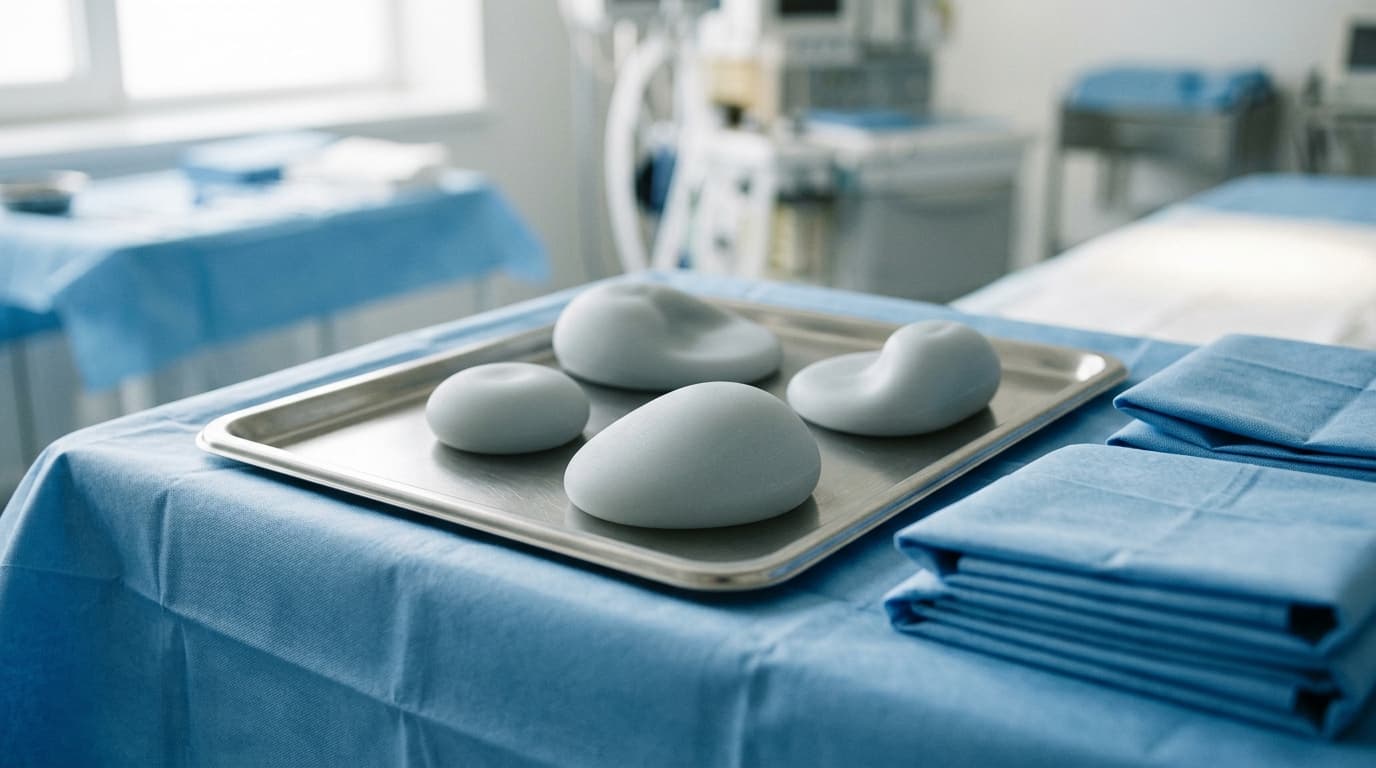
Almost every conversation about implants in aesthetic surgery is a conversation about breasts, and occasionally about the face. There is a third category that rarely comes up: solid silicone implants placed in the calf and under the pectoralis major, along with their smaller cousins in the biceps, triceps, and along the deltoid. They exist, they are performed in the United States by a small number of surgeons, and they occupy an unusual position in the field. The devices are simpler than breast implants in every respect. The operations are considerably less forgiving.
The gap between those two facts is where patients get into trouble. A solid implant cannot rupture, cannot leak, and does not carry the associated disease questions that have followed gel-filled devices for four decades. That is genuinely reassuring, and it is where most consultations begin and end. What it obscures is that the failure modes for body implants have almost nothing to do with the material and almost everything to do with the pocket: a leg compartment that does not expand, and a chest muscle that contracts several thousand times a day and takes the implant with it.
These are not breast implants, and the difference decides everything
The short answer: calf and pectoral implants are carved blocks of solid silicone elastomer, closer in engineering terms to a chin implant than to a breast implant, and they reached the market through a regulatory route that never asked how often they fail.
A gel-filled breast implant is a shell containing a filler. That construction creates the rupture question, the silent-rupture imaging question, and the long surveillance conversation covered in what long-term implant monitoring actually requires and whether older implants need replacing. Body implants have none of that. They are one continuous piece of cured silicone rubber, soft and flexible but not fluid, manufactured in a range of anatomical shapes and sizes and frequently carved further in the operating room to match a specific leg or chest. They are the same class of object as the cheek and jaw devices discussed in what a bone-level facial implant does that filler cannot.
That construction removes an entire category of worry. It also removes the regulatory scrutiny that came with it. Gel-filled breast implants sit in the most heavily regulated device class, went through premarket approval with clinical trials, and carry mandated post-approval study obligations. Solid silicone body implants do not travel that road. They enter the market through the clearance pathway, which asks whether a new device is substantially equivalent to something already being sold, not whether it works, not how long it lasts, and not how often it has to come out. That distinction is the same one running underneath what a device clearance actually certifies, and it means the honest answer to "what is the published failure rate for this implant" is that no one is required to know.
"A solid implant cannot rupture. That is true, it is the first thing you will be told, and it is close to irrelevant, because nothing about these operations fails at the material.
"
The calf is a closed compartment, and that is the complication that matters
The short answer: calf implants are placed under the fascia covering the gastrocnemius muscle, in a lower leg that has fixed compartment volume and no capacity to accommodate an extra object, and the specific catastrophic risk is acute compartment syndrome.
Calf augmentation is usually performed for one of three reasons: a cosmetic patient whose calves stay thin regardless of training, an asymmetry from a congenital difference or childhood illness such as clubfoot or post-polio atrophy, or a reconstructive case after trauma or nerve injury. The implant is inserted through a short incision in the crease behind the knee and slid down into a pocket over the medial head of the gastrocnemius, with a second implant over the lateral head when more circumferential bulk is wanted. Placement is either subfascial, under the tough sheet of connective tissue over the muscle, or submuscular in some techniques.
Subfascial placement is what produces the shape, and it is also the problem. The fascia of the lower leg is not a stretchy envelope. It is the wall of a compartment that contains muscle, nerves, and blood vessels at a specific pressure, and it is the anatomic reason a fractured tibia can turn into a surgical emergency. Putting a solid object inside that compartment raises the pressure inside it by design. Add ordinary postoperative swelling on top and the pressure can cross the threshold at which capillary flow to the muscle stops. That is acute compartment syndrome, and the treatment is an emergency fasciotomy, meaning the compartment is opened surgically to release it. Delay produces muscle death and permanent nerve injury.
This is rare. It is also the reason the calf gets talked about differently from every other implant site. The more routine complications are frequent enough on their own:
- Wound problems at the incision. The popliteal crease behind the knee is a flexion crease on a limb the patient has to use, which makes it an unhelpful place to put a healing wound.
- Seroma and prolonged swelling, in a dependent limb where fluid collects and stays.
- Implant displacement, particularly downward migration, which is visible and usually requires reoperation to correct.
- Capsular contracture, the same scar-envelope tightening described in what actually causes and predicts contracture, which in a calf produces a firm, visibly edged mass rather than a natural muscle contour.
- Sensory changes along the sural nerve distribution on the back and outer calf, following the general recovery pattern of nerve numbness after surgery.
- Venous thromboembolism risk, raised by lower limb surgery, calf swelling, and reduced mobility together, which puts these cases squarely into the territory of clot risk that belongs in every consult.
Published calf implant series are small, single-surgeon, and retrospective. Reported overall complication rates across them range from under ten percent to above twenty, with meaningful reoperation numbers even in the favorable ones. There is no registry, no pooled dataset, and no independent denominator. A patient comparing this operation to breast augmentation is comparing a procedure with decades of tracked outcomes to one with a scattering of case series.
The pectoral pocket moves, and the implant goes where the muscle sends it
The short answer: pectoral implants are placed under the pectoralis major through an incision in the armpit, and the dominant complication is not rupture or infection but displacement, because the pocket is defined by a large muscle that contracts constantly.
The reconstructive version of this operation is well established. Poland syndrome, a congenital absence or underdevelopment of the pectoralis major on one side occurring in roughly one birth in twenty to thirty thousand, leaves a visibly hollow chest wall that no amount of training corrects, and an implant is a reasonable answer to a missing muscle. The cosmetic version, in a man who trains hard and cannot build the upper or inner chest he wants, is a different proposition performed on intact anatomy.
The technique is transaxillary: an incision hidden in the armpit, a pocket dissected under the pectoralis major, and a solid implant delivered into it. There are no external chest scars, which is a real advantage. What the approach cannot do is anchor the implant, and the pectoralis is among the most mobile muscles in the body. Every push, pull, and press moves it, and over time the implant can rotate, ride laterally toward the armpit, or drift upward, producing an asymmetry that is obvious in a mirror and correctable only by returning to the operating room. Restricted arm use for several weeks after surgery is not caution for its own sake, it is the only thing holding the pocket still while a capsule forms around it.
The other honest limitation is that a pectoral implant adds bulk in the region it is placed and does nothing to the surrounding definition. It does not sharpen the lower chest border, it does not thin overlying fat, and it will not produce a defined look on a chest with a fat layer over it. Patients wanting sharper contour rather than more volume are often better served by fat removal techniques of the sort described in high definition liposuction and what standardizing it means. Patients whose real complaint is glandular breast tissue are describing something else entirely, and the diagnosis and treatment of that is covered in what the evidence supports in gynecomastia surgery. Putting an implant under a chest with untreated gynecomastia makes the gynecomastia more prominent, not less.
A rare operation is a rare skill, and these are rare operations
The short answer: national procedure counts for calf and pectoral implants sit in the low thousands at most, which means the pool of surgeons with genuine repetition in them is very small, and case volume matters more here than in almost any other cosmetic operation.
Annual statistics from the major professional bodies, the same reporting discussed in what procedure statistics do and do not tell you, put breast augmentation in the hundreds of thousands and liposuction higher. Calf and pectoral implants appear far down the same tables, at volumes low enough that the reported figures are unstable year to year. Divide a few thousand cases across a country of board-certified plastic surgeons and the arithmetic is unavoidable: most surgeons who offer these operations perform a handful over a career.
That matters because these procedures reward pattern recognition that only comes from repetition. Pocket dissection in the correct plane, implant sizing against a specific muscle, and, above all, recognizing when postoperative calf pain is normal tightness versus rising compartment pressure, are all judgments built on having seen the range. The general argument for asking about volume, laid out in the case volume question that outranks the diploma, applies here with more force than usual, alongside the baseline verification in what board certification does and does not establish and the facility question in what accreditation actually certifies.
There is a second consequence. Because volumes are low and marketing is competitive, body implants are disproportionately offered by practices positioning themselves toward the growing market described in why male aesthetic surgery keeps expanding. Growth in demand is not the same thing as growth in surgical experience, and the two have moved at different speeds.
The alternatives: fat, patience, and the oil that fills emergency rooms
The short answer: fat grafting is the legitimate alternative and performs worse in the calf than almost anywhere else in the body, while the illegitimate alternative, injectable site enhancement oil, is a recurring reconstructive disaster.
Fat transfer to the calf and to the chest is offered, and it avoids a foreign body entirely. Its limitation in the lower leg is anatomic. Graft survival depends on the recipient site delivering blood supply to every injected parcel quickly, the biology explained in what determines whether transferred fat survives. The calf offers a tight subcutaneous layer with limited room to distribute graft in small aliquots, and it is a dependent limb subject to chronic swelling. Retention is inconsistent, and achieving significant volume usually means multiple sessions with unpredictable results. In the chest, fat grafting behaves better but adds soft volume rather than the projected shape an implant creates, and it requires donor fat the target patient often does not have.
Then there is the practice that sits outside medicine altogether. Injectable site enhancement oils, the class of products known generically by the trade name synthol and typically consisting of oil with small amounts of lidocaine and alcohol, are injected directly into biceps, triceps, deltoids, and calves to create bulk. They are not medications, they are not implants, and they are not regulated for this use in any jurisdiction. The result is oil dispersed through muscle tissue, where it produces inflammatory nodules, fibrosis, chronic pain, nerve compression, abscess, muscle necrosis, and, in reported cases, pulmonary complications when oil reaches the circulation. Removal means excising the affected muscle, which is a functional loss rather than a cosmetic revision. This is the same category of harm, with the same permanence and the same reconstructive endpoint, as the products described in the injections surgeons spend careers removing.
The most underrated alternative remains the unglamorous one. Calf and chest muscle hypertrophy respond to training over years, not months, and a proportion of patients seeking these implants have not actually exhausted that route. A surgeon willing to say so is worth more than one who books the case.
The honest summary
Calf and pectoral implants are legitimate operations with real indications, and for a patient with Poland syndrome, a post-polio calf, or genuinely refractory anatomy after years of training, they solve a problem nothing else solves. They are also, measured by the ordinary standards of aesthetic surgery, the least documented implants a patient can be offered. The devices came to market through a pathway that never asked how often they fail. There is no registry, no post-approval study requirement, and no pooled complication dataset. The published evidence is a set of small retrospective series from the surgeons most invested in the outcome.
That absence has a practical consequence you can act on. Because the public record is thin, the only real due diligence available is the specific one: this surgeon, these two years, this many cases, this many reoperations. Ask for the device brand and manufacturer, then check the complaint record yourself using the approach described in how to read the FDA device database before you consent. Expect the file to be sparse, and understand that a sparse file is a reporting artifact rather than a safety finding.
Weigh the two sites separately, because they fail in unrelated ways. The pectoral risk is mostly aesthetic and mostly recoverable: displacement, rotation, asymmetry, another operation. The calf risk includes one complication that is time-critical and limb-threatening, which changes what an acceptable aftercare arrangement looks like and rules out any setting where you cannot reach a surgeon within hours. Price the operation accordingly, including the revision that a meaningful fraction of these patients eventually need, using the framework in what a cosmetic surgery quote actually covers.
Solid silicone will not rupture inside you. That is the one guarantee on offer here, and it is worth exactly what it says and nothing more.