Procedure Deep-Dive · September 4, 2026
The Fleur-de-Lis Tummy Tuck: The Second Scar Nobody Wants, the Skin a Standard Abdominoplasty Cannot Reach, and the Corner Where the Wound Comes Apart
A standard tummy tuck pulls skin down. It cannot pull skin in. The patient who has lost a hundred pounds, whose abdomen hangs in folds from the ribs as well as from the waist, is left with a choice the brochures skip: accept an upper abdomen the horizontal scar cannot fix, or accept a second scar running up the midline to the breastbone. That operation is the fleur-de-lis abdominoplasty. Here is what it removes that the standard operation cannot, who actually needs it, how the two excisions are sequenced so the wound can still close, why the corner where the scars meet is the place it fails, and what the belt, the high-lateral-tension tuck, and the GLP-1 waiting room have changed about the decision.
By The Editorial Desk
22 min read
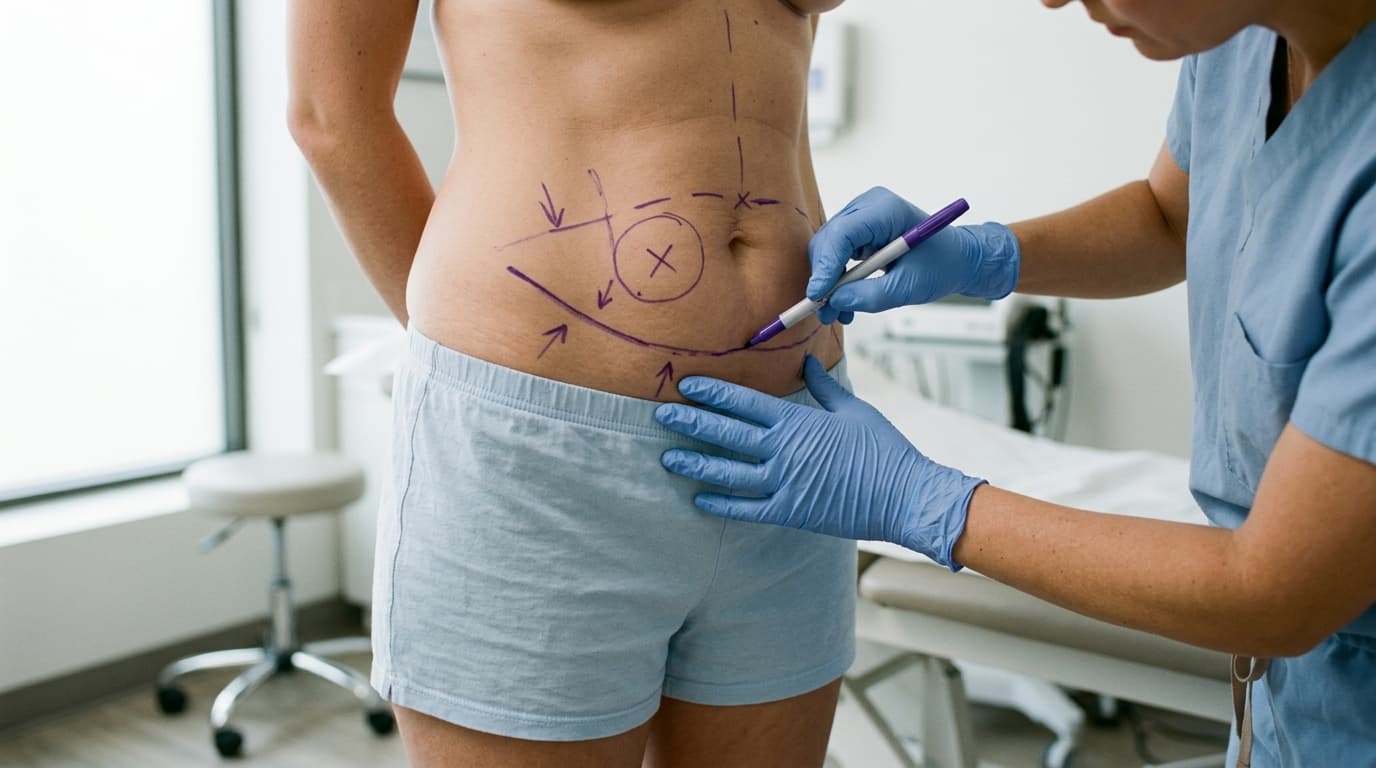
There is a moment in the consultation of a patient who has lost a great deal of weight when the surgeon stops talking about the standard tummy tuck and starts drawing a line up the middle. The patient usually flinches. They came in expecting the scar every tummy tuck patient expects, low across the pelvis, hidden by underwear, and they are being offered a second one running from the pubic bone to the breastbone, straight through the belly button, visible in every swimsuit ever made. The name of the operation does not help. A fleur-de-lis is a heraldic lily, and the pattern of skin removed, a wide horizontal ellipse joined to a tall vertical wedge, looks like one when it is drawn on the body. It sounds like a flourish. It is a concession.
The concession is to geometry. Skin that has stretched around a much larger body is loose in two directions: vertically, from the ribs down toward the pubis, and horizontally, around the circumference of the trunk. A standard abdominoplasty removes the vertical excess by cutting a strip across the lower abdomen, lifting the skin off the muscle up to the ribs, and pulling it down to close the gap. It removes almost nothing horizontally, because a horizontal scar cannot tighten a horizontal fold. The upper abdomen of a massive weight loss patient after a standard tummy tuck is often flatter and still loose, with a roll below the ribs that the operation could not reach and a pair of folds at the ends of the scar where the extra width had nowhere to go. The vertical scar exists to take that width out.
This piece is about the trade. What the operation removes that the standard one cannot, how surgeons decide who needs it and who is being oversold it, how the two excisions are sequenced so the wound can still close, why the corner where the scars meet is where it fails, and how the alternatives, and the new population of weight-loss-drug patients arriving at the consultation, have changed the decision.
What a fleur-de-lis tummy tuck is, and why the standard operation leaves the upper abdomen behind
The short answer: a fleur-de-lis abdominoplasty is a standard tummy tuck with a second, vertical excision added up the midline, removing a wedge of skin and fat from the pubis to the lower chest, so that the abdominal skin is tightened both downward and inward, at the cost of a vertical scar the standard operation does not leave.
The standard operation is one-directional by design. The incision runs low across the abdomen from hip to hip, the skin and fat are lifted off the muscle wall as a single flap up to the ribs, the muscle is tightened if it has separated, the flap is pulled down, the excess below the belly button is cut away, and the belly button is brought out through a new hole in the flap. Everything about it is a downward pull. The tension is vertical, the scar is horizontal, and a horizontal scar has no capacity to remove skin from side to side, any more than a belt can take in the width of a shirt. In a patient whose excess is mostly vertical, which describes most patients after pregnancy and modest weight change, that is the right tool, and the piece on panniculectomy versus tummy tuck lays out what the standard operation and its insurance-coded cousin each do.
The fleur-de-lis adds the other direction. On top of the low horizontal excision, the surgeon removes a vertical ellipse of skin centered on the midline, widest at the level of the belly button and tapering to a point below the breastbone, and closes it as a vertical seam. The width of that ellipse is the horizontal skin excess, measured by pinching the upper abdomen from side to side with the patient standing. The result is an inverted T: a low horizontal scar, a vertical scar meeting it in the middle, and an abdomen that has been tightened like a corset rather than like a curtain. The upper abdominal roll that the standard operation leaves is gone, because the skin that formed it has been cut out rather than pulled past.
The idea is older than its name. Salvador Castañares and John Goethel described a combined vertical and horizontal abdominal excision in Plastic and Reconstructive Surgery in 1967, in an era when the patients were mostly women with large, pendulous abdomens after many pregnancies. A. Lee Dellon gave the operation its heraldic name in a 1985 paper in Aesthetic Plastic Surgery, and for the following decade it remained a niche procedure, because the patient it suited was uncommon. Bariatric surgery changed that. As gastric bypass and then sleeve gastrectomy produced a population of patients who had lost eighty, a hundred, a hundred and fifty pounds, the fleur-de-lis became the abdominal operation of the massive weight loss clinic, and the body contouring literature of the 2000s is largely a literature of surgeons learning where it works and where it comes apart. The American Society of Plastic Surgeons counted roughly 170,000 tummy tucks in the United States in 2023, and the share that are fleur-de-lis is not reported separately, but every program that treats post-bariatric patients performs them routinely, and the arrival of weight-loss drugs has put a new stream of candidates in the waiting room.
Who needs the vertical scar: the Pittsburgh scale, the pinch, and the weight-loss body
The short answer: the fleur-de-lis is for the patient with significant horizontal skin excess, meaning an upper abdomen that pinches loose from side to side, multiple rolls above the belly button, and often a midline scar from earlier open surgery, and it is almost never the right operation for the patient with a single lower fold and a firm upper abdomen, however much weight they have lost.
Surgeons in the massive weight loss field grade the abdomen before they choose the operation, and the grading system most of them use came out of the University of Pittsburgh. Angela Song, J. Peter Rubin, Dennis Hurwitz, and colleagues published the Pittsburgh Rating Scale in Plastic and Reconstructive Surgery in 2005, a zero-to-three grading of contour deformity at ten body regions after bariatric weight loss. For the abdomen, grade one is loose skin without an overhang, grade two is an overhanging apron of skin and fat below the belly button, and grade three is multiple rolls, an apron plus an upper abdominal roll, or a panniculus that hangs below the pubis. The scale pairs each grade with the operation that fits it. Grade one is liposuction or a mini tuck, grade two is a standard abdominoplasty, and grade three is the fleur-de-lis, because grade three is the definition of skin that is loose in two directions.
The pinch is how the grade is checked on the body. With the patient standing, the surgeon pinches the skin of the upper abdomen from side to side, above the belly button, and again below the ribs. A pinch that gathers a few centimeters and snaps back is vertical excess that a downward pull will take care of. A pinch that gathers a hand's width of loose skin, in a fold that stays folded, is horizontal excess, and nothing that pulls downward will remove it. The surgeon then does the same pinch on the lower abdomen and compares. A patient whose lower abdomen hangs and whose upper abdomen is firm has a grade two problem and does not need the vertical scar. A patient whose upper abdomen pinches as loose as the lower does, and whose skin has the thin, striated, crepe-paper quality of skin that has been stretched far past its limit, is the fleur-de-lis patient, and the honest consultation says so before the patient has to ask.
Three features push the decision toward the vertical scar:
- An existing midline scar. Many patients who had open gastric bypass before the laparoscopic era, or an open hernia repair, or any midline laparotomy, already carry a vertical scar from the breastbone to the belly button or below. The fleur-de-lis excises that scar within the vertical wedge and replaces it with a fresh closure, so the patient ends up with the same number of scars, in better condition, and a flat abdomen. For this patient the second scar costs nothing.
- A ventral hernia. Weight loss patients, particularly after open bariatric surgery, frequently have incisional hernias along the old midline. The vertical excision gives direct access to the whole midline for hernia repair and fascial tightening under vision, without the tunneling that a standard flap requires. The overlap between muscle repair and skin surgery here is real, and the piece on diastasis repair versus exercise covers what the muscle side of the operation does and does not fix.
- Epigastric rolls that a downward pull will not reach. The roll under the ribs, above the level of the belly button, is the tell. A standard flap pulled down from that height tightens the skin below the roll and leaves the roll, because the excess in a roll is circumferential. The fleur-de-lis removes the roll by cutting through it.
The other half of candidacy is the patient's condition rather than their contour. The body contouring programs that publish their outcomes screen for a weight that has been stable for at least six months and usually a year after bariatric surgery, a body mass index below the low thirties, protein intake adequate to heal a wound this long, corrected iron, B12, and vitamin D deficiencies, no nicotine for at least four weeks before and after, and a plan for the venous thromboembolism risk that comes with a long operation on a large trunk. Each of those is a subject in its own right: the weight and BMI thresholds are in the piece on BMI limits for cosmetic surgery, the nutritional workup in the piece on preoperative nutrition, the nicotine rule in the piece on smoking cessation timelines, and the clot arithmetic in the piece on blood clots after plastic surgery. A surgeon willing to do a fleur-de-lis on a patient who fails those screens is not doing the patient a favor. This is the operation in which the screens matter most, because it is the operation with the longest wound and the most vulnerable corner.
The operation: two excisions, the order that decides whether the wound can close, and the belly button in the seam
The short answer: the fleur-de-lis is performed as a horizontal excision and a vertical excision that must be sized against each other, with the second one tailor-tacked with temporary staples before any skin is cut so the surgeon can confirm the wound will close without tension, the belly button is either brought out through the vertical seam or rebuilt in it, and undermining of the flap is kept deliberately narrow to preserve the blood supply that the T-junction depends on.
The marking is done standing, the day of surgery, and it takes longer than the marking for a standard tuck. The horizontal incision is drawn low, at or just above the pubic hairline, curving up toward the hips, placed so that it will sit inside a swimsuit line once the skin above it is pulled down. The vertical wedge is drawn next: the surgeon gathers the upper abdominal skin toward the midline with both hands, marks how far in from each side the skin can be brought, and draws the resulting ellipse from the pubis to a point somewhere below the breastbone. The width of the ellipse at the belly button is commonly ten to twenty centimeters in a post-bariatric patient, and the length is dictated by how far up the ribs the horizontal excess extends. Where the vertical wedge meets the horizontal ellipse is the T, and the surgeon draws it as the last mark, because it is the point where the most skin will be asked to meet.
The order in which the two excisions are cut is a matter of surgical judgment and is the difference between a wound that closes and one that does not. The problem is simple to state: skin removed in the vertical direction reduces what is available to close the horizontal gap, and vice versa. A surgeon who cuts both excisions to their full marks and then discovers that the flaps will not meet has nowhere to go. Most surgeons therefore excise one direction completely and stage the other. The common sequence is to make the vertical excision first, close it, and then resect the horizontal excess as a standard tuck, pulling the now-narrowed flap down and trimming what is redundant. Others do the reverse, completing the horizontal resection and then tailor-tacking the vertical wedge. Either way, the safeguard is the same: before any skin is removed from the second direction, the flaps are held together with temporary staples or a running suture, the patient is flexed at the hips on the table, and the surgeon confirms that the closure holds without blanching before committing to the cut. Tailor-tacking is not a flourish. It is the step that prevents the operation from removing more skin than the body can spare, and it is worth asking a surgeon whether they do it.
The belly button is the second problem. In a standard tuck the umbilicus is left on its stalk and brought out through a new opening in the flap, on the terms the piece on the belly button after a tummy tuck describes. In the fleur-de-lis the vertical seam runs straight through where the belly button sits, and the surgeon has three choices. The umbilicus can be preserved on its stalk and inset into the vertical closure, so that it sits in the seam; the stalk is often long and the skin around it thin in weight loss patients, and this is the technique with the highest rate of a belly button that heals distorted or in the wrong place. The umbilicus can be removed altogether and a new one created from the local skin, a neo-umbilicus, which trades the original for a controlled shape. Or, in a patient who does not care, it can be removed and not replaced, which is rare but is a legitimate answer to the question of what to do with a belly button that has become a fold. Each choice should be discussed before the operation, and a surgeon who has not raised it has not thought about the vertical scar in enough detail.
The third decision is how far to undermine. In a standard abdominoplasty the flap is lifted off the muscle wall all the way up to the ribs and often out to the flanks, so that it can slide down. In the fleur-de-lis the vertical excision already gives the surgeon access to the midline, and the flaps on either side of it need to move inward rather than down, so wide undermining is unnecessary and, for blood supply reasons explained below, dangerous. The technique that most of the massive weight loss literature settled on is limited undermining: the flaps are lifted only as far as they need to be to close, the lateral perforating vessels are left alone, and liposuction of the flap is avoided or kept away from its edges. Progressive tension sutures, the technique of quilting the flap down to the muscle wall as it is closed, are as useful here as in the standard tuck for closing dead space and reducing seroma, and the piece on the drainless tummy tuck explains why, though the amount of raw surface in a fleur-de-lis means that most surgeons still place drains, on the terms in the piece on surgical drains after plastic surgery.
The operation takes three to five hours as a stand-alone procedure and considerably longer when combined with a belt or a breast operation. The two scars are closed in layers with the deep fascial layer taking the tension, so that the skin edges meet without pulling, and the T-junction is closed last, with the surgeon watching the color of the three skin corners that meet there. The patient goes to recovery flexed at the hips, stays flexed for several days, and wears a compression garment for six weeks on the evidence in the piece on compression garments. The swelling sequence is longer than for a standard tuck, and the vertical scar is the last part of the abdomen to settle, on the pattern the piece on the swelling timeline after plastic surgery describes.
"A horizontal scar cannot remove a horizontal fold. The fleur-de-lis exists because geometry does not negotiate, and the vertical scar is the price of a flat upper abdomen in a body that has lost a hundred pounds.
"
What goes wrong: the T-junction, the blood supply map, and the scar itself
The short answer: the fleur-de-lis carries the complications of any large abdominoplasty, seroma, wound separation, skin edge necrosis, infection, blood clots, and numbness, and concentrates them at one place, the T-junction where the vertical and horizontal scars meet, which is the point of the flap farthest from its remaining blood supply and the point under the most tension, and where small wound separations are common enough that most programs consider them expected rather than exceptional.
The reason is a map published before most of today's surgeons were trained. William Huger described the blood supply of the abdominal skin in three zones in the American Surgeon in 1979. Zone one is the central abdomen, fed by perforating vessels from the deep epigastric arteries that come up through the rectus muscles. Zone two is the lower abdomen, fed by the superficial vessels that come up from the groin. Zone three is the flanks, fed by intercostal, subcostal, and lumbar vessels that enter from the sides. A standard abdominoplasty divides the zone one perforators when it lifts the flap off the muscle and removes zone two with the excised strip, and the flap survives on zone three, the vessels coming in from the sides. The fleur-de-lis makes this worse in a specific way. The vertical excision removes the center of the flap, the two remaining halves are pulled toward the midline, and the T-junction is the tip of each half: the point farthest from the flank vessels that are keeping it alive, and the point where three skin edges meet under the most tension. Wide undermining, which cuts into zone three, is the thing that turns a slow-healing corner into a dead one, which is why the limited undermining described above is not a preference but a rule.
The result is a predictable pattern of complications:
- Wound separation at the T. Small openings at the junction, a centimeter or two of skin edge that separates in the second week and heals by dressings over a month, show up in published series of fleur-de-lis patients at rates that vary from roughly one in ten to one in three depending on how the authors counted. Most are minor. The mechanics of why a wound opens and how it is managed are in the piece on wound dehiscence after cosmetic surgery, and the T-junction is that piece's textbook case.
- Skin edge necrosis. The corner tips blanch, then darken, and a thin rim of skin dies. In a nonsmoker with an intact zone three and a tension-checked closure it is usually a rim; in a smoker or a patient whose flap was undermined too far it can be a full-thickness loss that takes weeks of wound care and sometimes a revision. The piece on skin necrosis after facelift and tummy tuck explains why the flap tip is where it happens.
- Seroma. Fluid collecting under the flap is the most common complication of any large abdominoplasty and the fleur-de-lis has more raw surface than most, which is why quilting sutures and drains both stay in the plan. The management is in the piece on seroma after plastic surgery.
- Blood clots. A long operation on a large trunk with the patient flexed for days afterward is the profile that the venous thromboembolism scoring systems flag, and chemical prophylaxis is standard in massive weight loss body contouring rather than optional.
- The scar itself. The vertical scar is closed under more tension than the horizontal one and is more prone to widening and thickening, particularly in its upper third where the skin is thicker and the chest wall moves with every breath. It is also, unlike the horizontal scar, impossible to hide in a two-piece swimsuit. Scar management for the year after the operation, sun protection, silicone, and the timing of any revision, follows the sequence in the piece on scar care after plastic surgery.
The reassuring finding, and the reason the operation is standard rather than exceptional in the weight loss clinic, came from the same Pittsburgh group that built the rating scale. Tali Friedman, Devin O'Brien Coon, Joseph Michaels, and colleagues published a comparison in Plastic and Reconstructive Surgery in 2010 titled, without hedging, "Fleur-de-Lis Abdominoplasty: A Safe Alternative to Traditional Abdominoplasty for the Massive Weight Loss Patient." They compared fleur-de-lis patients against traditional abdominoplasty patients from the same program and found no statistically significant difference in overall complication rates once patient factors were accounted for. The vertical scar did not, in that series, make the operation more dangerous. What it did was move the trouble to the T. That is the honest way to describe the risk: not more, but concentrated, and concentrated in a place the surgeon can see and the patient can be prepared for.
There is one more complication that is specific to what the operation does to the lower abdomen, and it is the same one the standard tuck can cause. A horizontal closure under tension pulls the pubic skin upward, and in a weight loss patient whose mons has descended with the rest of the abdomen the pull can spread the labia or lift the hairline. The piece on the mons pubis lift describes the deformity and the stitch that prevents it. In the fleur-de-lis the vertical closure adds a second, inward pull at the bottom of the T, and the surgeon who has not planned for the mons will produce a lifted, flattened, pulled-apart pubic area as a souvenir of a flat abdomen.
The alternatives and the timing: high lateral tension, the belt, and the GLP-1 patient
The short answer: for moderate horizontal excess the high-lateral-tension abdominoplasty and the extended tuck remove some width at the flanks without a vertical scar; for circumferential excess the belt lipectomy takes the horizontal incision all the way around the body and lifts the back and buttocks in the same operation; the fleur-de-lis can be added to either; and the patient losing weight on a GLP-1 drug is a fleur-de-lis candidate in waiting who should not be operated on until the weight has stopped moving.
Ted Lockwood's high-lateral-tension abdominoplasty, published in Plastic and Reconstructive Surgery in 1995, was the first serious attempt to get horizontal tightening out of a horizontal scar. Lockwood placed the tension of the closure at the ends of the incision rather than the middle, anchored the deep fascial layer to the hip, and extended the incision laterally, so that the flanks and the upper outer thigh were lifted along with the abdomen. It tightens the sides. It does not reach the epigastric roll, and for the patient whose upper abdomen pinches a hand's width of loose skin it is a half measure. The extended abdominoplasty, which carries the incision around the hip toward the back, does the same thing more aggressively and stops at the same limit.
The belt lipectomy, or circumferential body lift, solves a different problem. Al Aly and colleagues published the University of Iowa experience in Plastic and Reconstructive Surgery in 2003, describing the horizontal incision carried all the way around the trunk, so that the abdomen, flanks, back, and buttocks are lifted together. It is the operation for the patient whose excess wraps around the body, with rolls on the back and a fallen buttock as well as the apron in front. It remains a horizontal operation. It removes vertical excess all the way around, and it does nothing for the epigastric roll, which is why the surgeon facing a grade three abdomen on a patient who also needs a belt combines the two: a circumferential lift with a vertical fleur-de-lis wedge added in front. The combination is the longest operation in body contouring, the one with the highest complication rate, and the one that is usually staged rather than done at once. How the stages are ordered, and why the abdomen almost always comes first, is the subject of the piece on body contouring sequencing, and the operations that follow it on the arms and thighs are in the piece on brachioplasty versus arm liposuction and the piece on the medial thigh lift.
The newest complication of the decision is pharmacological. Patients losing weight on semaglutide and tirzepatide are arriving at body contouring consultations in numbers the field has not seen since the bariatric boom, with the same two-directional skin excess and a variable the bariatric patient did not have: a weight that is still moving and that may reverse if the drug is stopped. A fleur-de-lis planned on a body that then loses another thirty pounds is a fleur-de-lis that needs revising, and one planned on a body that regains thirty is a vertical scar stretched over a return of the fat it was designed to fit. The rule the bariatric programs settled on, a stable weight for at least six months and preferably a year before the operation, applies with more force to the drug patient because the drug can be stopped, and the timing questions are laid out in the piece on GLP-1 drugs before plastic surgery. The surgeon who is willing to operate while the injections are still producing weight loss is answering the wrong question.
The honest summary
A fleur-de-lis abdominoplasty is a tummy tuck with a second scar, vertical, from the pubis to the lower chest, added because a horizontal scar cannot remove horizontal skin. It exists for the patient whose abdomen is loose in two directions after major weight loss, with rolls above the belly button that a downward pull cannot reach, and it is the wrong operation for the patient with a single lower fold, whatever the number on the scale. The grading is done standing with a pinch, the Pittsburgh scale gives the pinch a number, and grade three is the vertical scar. The patient with an old midline scar or a hernia along it gets the second scar at no extra cost, because the operation removes the old one. The operation is two excisions that must be sized against each other, tailor-tacked before the second cut so the wound can close, with the belly button kept in the seam, rebuilt, or given up, and with undermining kept narrow to protect the flank vessels that keep the flap alive. It fails at one place, the T-junction, where the corners of the flap are farthest from their blood supply and under the most tension, and where small wound separations are common enough to be expected rather than feared. The most rigorous comparison published to date found that the vertical scar did not raise the overall complication rate; it moved the complications to the corner. The alternatives remove less: the high-lateral-tension tuck tightens the sides, the belt tightens all the way around, and neither reaches the upper roll, which is why the fleur-de-lis is added to both. The candidate is off nicotine, nutritionally replete, at a stable weight for six months to a year, and prepared to trade an upper abdomen that a swimsuit cannot flatten for a scar that a swimsuit cannot hide. For the patient losing weight on a GLP-1 drug the operation waits until the weight stops moving, however long that is. The question to ask the surgeon is what they will do at the corner. The question to ask yourself is whether you can live with the line up the middle, because the flat abdomen does not come without it.