Industry · August 27, 2026
Itching After Plastic Surgery: Why Healing Wounds Itch and When It Means Something
Around the end of the first week, the pain of a tummy tuck or a facelift gives way to something patients are rarely warned about: an itch that can be maddening, that antihistamines barely touch, and that in some scars lingers for months. Most of it is the biology of repair, the return of nerves and the churn of a fresh scar. Some of it is an allergy to the tape, a reaction to the pain medication, or the first sign of an infection. Here is what the wound healing literature says about postoperative itching, what actually relieves it, and the handful of itches that should be examined rather than scratched.
By The Editorial Desk
10 min read
Nobody puts it in the brochure. The consultation covers bruising, swelling, the drains, the compression garment, and the timeline for going back to work, and then somewhere around day five or six the patient calls the practice with a complaint the sheet never mentioned. The incision itches. Not a little. The abdominoplasty scar, the breast fold, the skin behind the ear after a facelift, the whole numb plateau of a liposuctioned flank, all of it crawls, and the antihistamine from the pharmacy has done nothing.
Itching after plastic surgery is close to universal and almost entirely undiscussed, which is a strange combination for a symptom that patients consistently rank among the most distressing parts of recovery. In studies of burn patients, where the phenomenon has been studied most carefully, more than 80 percent report significant itch in the first months of healing, and surveys of patients after elective procedures put the figure for at least some postoperative itch well above half. It is, in the great majority of cases, a sign that the wound is doing exactly what it should. It is also, in a smaller number, the presenting symptom of a problem that is easier to fix early. Telling those apart is not hard once you know what the itch is made of.
Why a healing wound itches at all
The short answer: the itch of a healing incision is produced by regenerating nerve fibers, histamine released from the cells rebuilding the wound, and the mechanical pull of new scar tissue on the skin around it, and it typically begins as the acute pain fades.
An incision cuts through the fine sensory nerve endings in the dermis, which is why the skin around a fresh scar is numb. Those fibers begin to regrow within days, and the regrowing sprouts are hyperexcitable: they fire at stimuli that would not have registered before, and the brain interprets much of that noise as itch. The same regeneration explains the pins-and-needles sensations and the odd electric twinges that arrive in the second and third week, and it is why numbness after plastic surgery and postoperative itching tend to travel together and resolve on a similar, slow schedule.
Layered on top of that is the biology of repair itself. The proliferative phase of wound healing, which runs from roughly day four through the third week, is when fibroblasts lay down collagen and the wound contracts. Mast cells, which are recruited to the wound in large numbers during this phase, release histamine, and histamine is the textbook itch mediator. The National Institutes of Health's wound healing literature describes this mast cell activity as part of normal repair rather than an allergic event, which is the first clue to why oral antihistamines are so disappointing: the itch of a maturing scar is only partly histamine-driven, and a great deal of it runs through nerve pathways that antihistamines do not reach. Finally there is the purely mechanical contribution. A contracting scar pulls on the skin around it, dry skin under a compression garment cracks and flakes, and the low-level irritation of both registers as itch. Put together, the picture is of a symptom that peaks between the first and third week, fluctuates for a couple of months, and then fades as the scar matures and the nerves settle.
The itch that is not the wound
The short answer: itching that is diffuse rather than confined to the incision, that comes with hives or a rash, or that started with a new medication, is more likely a drug reaction or a contact allergy than a healing response, and both are treatable once identified.
Opioids are the most common culprit in the first days. Morphine, hydromorphone, oxycodone, and codeine all trigger histamine release and act directly on itch receptors in the spinal cord, which is why a patient can be itching all over, including the nose and the face, on day two with a perfectly quiet incision. This itch is generalized, arrives with the medication, and disappears when the opioid is stopped or switched, which is one more argument for the opioid-sparing recovery protocols that a growing number of practices now use. Antibiotics can do the same, and a new itchy rash appearing a week into a course of cephalexin or clindamycin should be reported rather than endured.
The second impostor is the skin around the wound rather than the wound itself. Adhesive and tape reactions produce an itchy, red, sometimes blistering patch that maps precisely to where the dressing or the surgical tape sat, with sharp edges that stop where the adhesive stopped. Compression garments are another source: the fabric traps sweat, the elastic seams rub, and the combination produces an itchy dermatitis along the garment edge that patients understandably attribute to their surgery. Topical antibiotic ointments are a quieter offender. Neomycin and bacitracin are among the most common causes of allergic contact dermatitis in the United States, according to the American Academy of Dermatology, and a patient diligently applying triple antibiotic ointment to an incision that is becoming redder and itchier by the day is often treating a rash the ointment is causing. Plain petrolatum does the job of keeping a wound moist without that risk, and most surgeons now advise exactly that.
"The itch that stays on the line of the scar is the wound healing. The itch that has spread past it, or that showed up with a pill, is telling you about something else.
"
When itching means infection or a scar going wrong
The short answer: itching by itself almost never signals infection, but itching that arrives together with spreading redness, increasing pain, warmth, or cloudy drainage does, and an itch that persists past three months in a scar that is thickening and rising is the early signature of a hypertrophic or keloid scar.
The distinction that matters is the company the itch keeps. A surgical site infection announces itself, usually between day three and day seven, with pain that is getting worse rather than better, redness spreading outward from the incision in an irregular halo, warmth, and discharge that has turned from thin and pink to thick and cloudy. Some patients notice a new or intensifying itch at the same time, and the itch gets the attention while the redness gets ignored. Itch plus any of those features is a visit, not a phone call. Itch on its own, with a wound that looks the same as yesterday and a patient who feels fine, is not.
The longer-term concern is the scar itself. Hypertrophic scars and keloids are both marked by itching, and often by pain, that outlasts the normal healing window. In hypertrophic scarring, the scar becomes raised, red, and firm within the first few months but stays within the boundaries of the original incision; in keloids, the scar grows beyond those boundaries and can keep growing for years. Both are more common in patients with darker skin, in younger patients, and in scars under tension such as the sternum, the shoulder, and the lower abdomen. The itch in these scars is not a side effect; it is part of the pathology, driven by an ongoing inflammatory process and abnormal nerve fiber density within the scar tissue. A scar that is still intensely itchy at the three-month mark and is visibly rising rather than flattening is the moment to intervene, because early treatment with silicone sheeting, pressure, and intralesional corticosteroid injections is considerably more effective than treatment of a mature keloid. Practices that tell patients to wait a year and see are leaving that window closed.
What actually relieves it
The short answer: moisturizing the surrounding skin, cool compresses, keeping the scar out of the sun, silicone gel or sheeting once the wound has closed, and, for severe cases, gabapentin or a prescription topical, are the interventions with evidence behind them; oral antihistamines help less than patients expect.
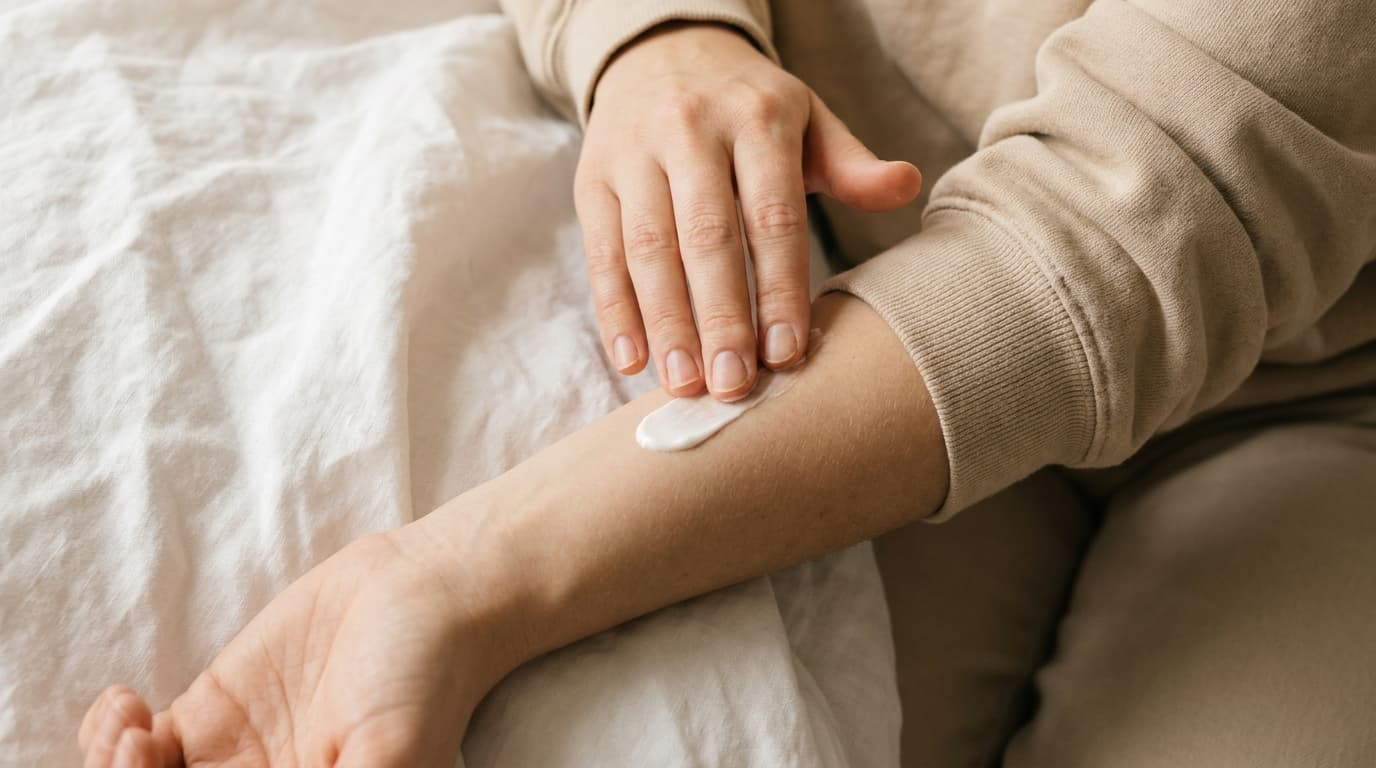
The first-line measures are unglamorous and effective. Dry skin itches, and the skin under a compression garment or around a healed incision dries out badly, so a plain unscented emollient applied several times a day to the skin around the closed wound (not into an open one) makes a measurable difference. Cool compresses and a cool shower calm the regenerating nerves in a way that heat aggravates. Loose cotton clothing reduces friction. Silicone gel sheeting, once the incision has fully epithelialized, has the best evidence of any scar product for reducing both itch and hypertrophic scarring, and the international clinical recommendations on scar management published in Dermatologic Surgery have endorsed it as first-line for years. Sun protection matters because ultraviolet exposure drives inflammation in a young scar and worsens both its color and its symptoms.
Oral antihistamines occupy an awkward middle. Sedating ones, such as diphenhydramine or hydroxyzine, help patients sleep through the worst nights and blunt the histamine component, but studies of postoperative and post-burn itch consistently show them to be modestly effective at best, because so much of the itch runs through non-histaminergic pathways. Non-sedating antihistamines do less still. For patients whose itch is severe or persistent, the drugs with better evidence are the ones that target nerve signaling: gabapentin and pregabalin have reduced itch in trials of burn and post-surgical patients, and a prescribing surgeon should know this. Topical corticosteroids can help a contact dermatitis or an early hypertrophic scar but are not a general answer for normal healing itch and thin the skin if overused. What does not help, and can make matters worse, is scratching. A fingernail dragged across a two-week-old incision can open it, introduce bacteria, and turn a benign itch into a wound dehiscence. Patting, tapping, or pressing the area gives the nerves something to report without the damage.
What a good practice tells you before surgery
The short answer: a competent consent conversation warns you the itch is coming, tells you roughly when, gives you a plan for it, names the features that mean call, and tells you not to put antibiotic ointment on the incision.
The reason itch causes so much anxiety is that it is unexpected, and unexpected symptoms after surgery feel like complications. A practice that says, at the pre-operative visit, "around the end of the first week the incision is going to itch, that is nerves regrowing and the scar forming, here is what to use and here is what to watch for," has removed most of the problem before it arrives. The American Society of Plastic Surgeons' patient education on recovery advises reporting increasing redness, pain, or drainage, and the useful addition is that itch alone is not on that list, but itch with any of them is.
The two other things worth asking at the consultation are what the practice recommends applying to the incision, and how it handles scars that are not settling. The first answer should be something close to petrolatum or a silicone product, not a triple antibiotic ointment. The second should include a scar check at the six-week to three-month visit and a plan, with specific interventions, for a scar that is rising or still intensely symptomatic. A surgeon who treats the scar as finished the day the sutures come out is leaving the most visible part of the operation to chance.
The honest summary
Itching after plastic surgery is the rule, not the exception. It begins as the pain fades, usually in the first or second week, and it is the product of nerves regrowing into numb skin, histamine released by the cells rebuilding the wound, and a young scar pulling on everything around it. It peaks in the first month, fluctuates for two or three, and fades as the scar matures. Moisturizer, cool compresses, silicone sheeting, sun protection, and patience handle most of it; oral antihistamines help you sleep more than they stop the itch, and nerve-targeting drugs are the option for the severe cases. The itch that needs an examination is defined by what comes with it: spreading redness, new pain, warmth, or cloudy drainage mean infection, a rash with sharp edges means the tape or the ointment, itching everywhere means the medication, and a scar that is still intensely itchy and visibly rising at three months is becoming hypertrophic and should be treated now rather than watched for a year. Do not scratch, do not put antibiotic ointment on it, and do not let a practice that never mentioned the itch tell you afterward that it is nothing. Most of the time it is. You should have been told which times it is not.