Procedure Deep-Dive · September 15, 2026
Red Light Therapy for Skin: What LED Photobiomodulation Actually Does at the Cellular Level, Why the Evidence Is Real but Modest, and Where the Marketing Runs Far Past the Data
Red light devices have moved from dermatology offices to bathroom counters in about a decade, and the pitch has gotten simpler as the price has dropped: shine this light on your face and the collagen comes back. The mechanism behind red and near-infrared light therapy is real and has been studied since the 1960s, but the honest picture is narrower and slower than the mask ads suggest, and it depends enormously on which device, which wavelength, and which claim is actually being made.
By The Editorial Desk
9 min read
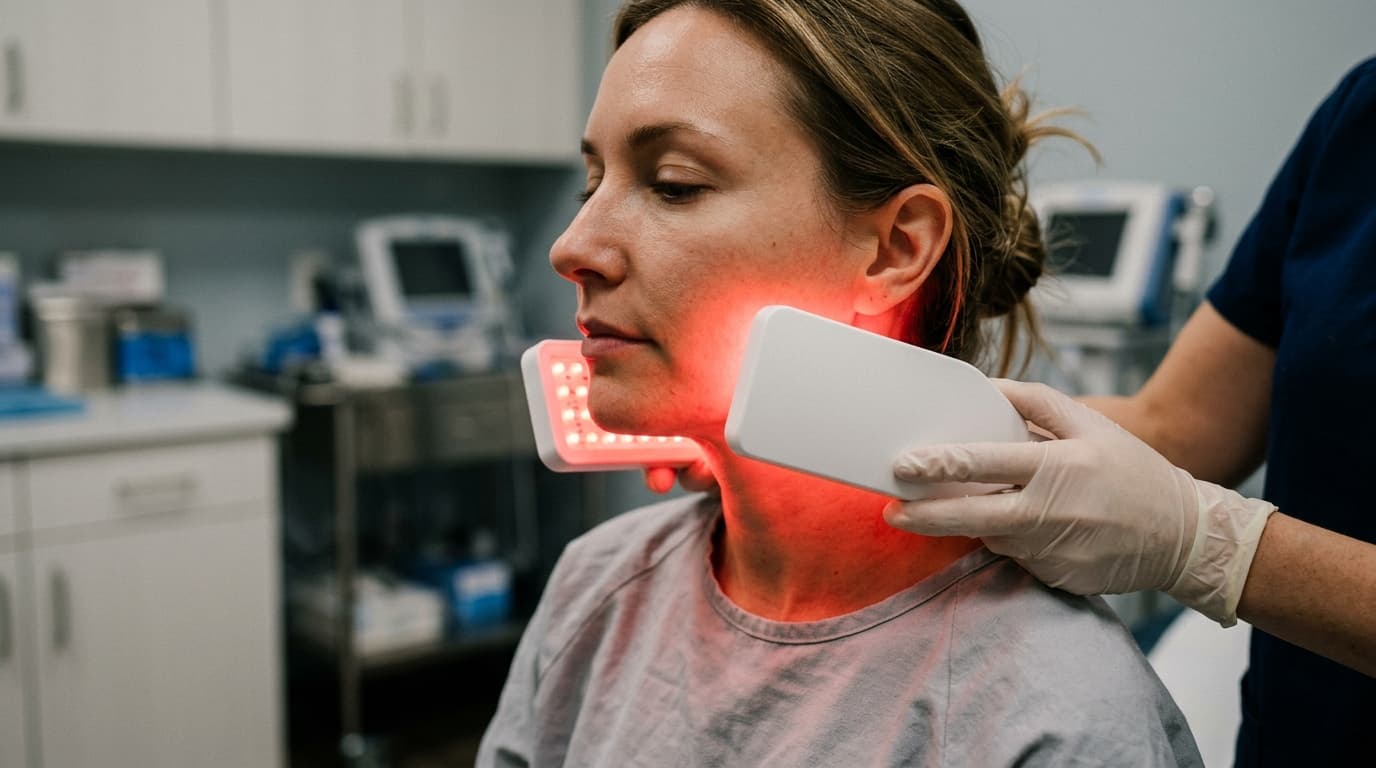
Red light panels started showing up in physical therapy clinics and dermatology offices decades before they showed up on a nightstand, and the gap between those two contexts is most of this story. In a clinical setting, low-level light therapy was tested, dosed, and studied for wound healing and inflammation, with modest but real findings published over more than fifty years. In a wellness marketing context, the same underlying technology gets sold as a near-universal skin fix: fewer wrinkles, less redness, faster healing, thicker hair, better sleep, sometimes all from the same eleven-hundred-dollar mask. Both pictures are built on the same physics. Only one of them is honest about how far that physics actually gets you.
This piece covers what red and near-infrared light actually does inside skin cells, what the clinical evidence supports and does not support, how the current wave of at-home LED masks and panels differs from the devices used in the studies that get cited to sell them, how red light compares to the energy-based devices already covered on this site, and who is actually a reasonable candidate for adding it to a skin routine.
What red light therapy actually is, and what happens inside the cell
The short answer: red and near-infrared light, typically in the 630 to 850 nanometer range, penetrates skin without generating the heat that defines most other energy-based devices, and the leading mechanistic explanation is that specific wavelengths are absorbed by a mitochondrial enzyme called cytochrome c oxidase, modestly boosting cellular energy production and triggering a mild, favorable inflammatory and repair signal.
This is the part of the pitch that is genuinely grounded in real photobiology. Unlike ablative and non-ablative lasers, radiofrequency, or ultrasound, which work primarily by generating controlled thermal injury that triggers a wound-healing and collagen-remodeling response, described in detail in the piece on ablative versus non-ablative laser resurfacing and the piece on energy-based skin tightening, red and near-infrared light at therapeutic doses is not primarily a heat-based mechanism. The photons are absorbed by chromophores in the mitochondria, and in cell culture and animal studies this measurably increases adenosine triphosphate production, modulates reactive oxygen species, and shifts inflammatory signaling in a direction associated with tissue repair rather than tissue damage. This is why the field's own literature calls it photobiomodulation rather than a laser or a light-based ablative treatment: the intended effect is a biological signal, not a controlled injury.
The research history is older than most patients assume. Low-level laser and LED therapy has been studied since the late 1960s, originally in wound healing and pain management contexts far removed from cosmetic dermatology, and it carries a genuine clinical track record in those adjacent fields before it was ever marketed as an anti-aging device.
Where the evidence is real: the applications with actual clinical support
The short answer: the strongest evidence for red and near-infrared light sits in wound healing support, mild reduction of treatment-related redness and inflammation, and modest, cumulative improvements in fine lines and skin texture when used consistently over months, not the dramatic single-session transformation implied by most marketing photography.
Photobiomodulation has the most consistent supporting evidence as an adjunct rather than a standalone treatment. Used around the time of another procedure, it has shown a reasonable signal for calming post-treatment redness and inflammation, which is one reason it shows up as a recovery add-on after resurfacing procedures discussed in the piece on laser versus chemical peel and after vascular treatments covered in the piece on facial redness and broken capillaries, rather than as the primary intervention in either case. For fine lines, skin texture, and overall tone, published trials generally show statistically real but visually modest improvement, and the studies that find an effect almost universally involve multiple sessions per week over eight to twelve weeks or longer, not the occasional ten-minute session a busy patient actually manages to fit in.
There is also a legitimate, separate application worth naming: low-level light therapy has a real, FDA-cleared evidence base for androgenetic hair loss, distinct from the skin claims entirely. That is its own topic covered in the piece on what actually works for hair loss, and it is worth mentioning here mainly because it is the one red light claim with the clearest regulatory and clinical support, which makes the vaguer skin-rejuvenation claims on the same devices look weaker by comparison rather than stronger.
"The honest version of red light therapy is a slow, cumulative, adjunctive tool with real biology behind it. The marketed version is a ten-minute miracle that replaces retinoids, sunscreen, and in some ads, apparently a facelift. Only the first version is supported by the studies actually being cited.
"
Where the marketing runs past the data
The short answer: the gap between the research and the retail pitch comes down to dose, wavelength precision, device power, and the conflation of a device's FDA clearance category with proof that it delivers a specific cosmetic outcome, and all four of those gaps favor the seller over the buyer.
Regulatory clearance is the single most misunderstood part of this category. Many consumer red light devices are FDA-cleared, but that clearance is frequently for a broad, low-risk category such as temporary relief of minor muscle and joint pain or general wellness use, not for a specific, tested claim of wrinkle reduction or collagen increase at that device's actual output. A device can be entirely legitimately cleared and still not have independent evidence that its specific power density and wavelength produce the cosmetic result shown in its marketing photos, and most consumers have no way to tell the difference from the packaging alone. This is the same pattern of the confident before-and-after image doing more persuasive work than the underlying evidence that the piece on reading a before-and-after gallery honestly and the piece on natural results in plastic surgery marketing both cover in different contexts, and red light devices are arguably the purest current example of it, because the technology itself is real enough to make the exaggeration feel credible.
Power output is the second gap, and it is where the clinical studies and the consumer products diverge most sharply. The devices used in published trials are frequently professional-grade panels delivering meaningfully higher irradiance than the at-home masks and handheld wands sold at a fraction of the price and a fraction of the output. A lower-powered device is not necessarily useless, but it likely requires substantially longer or more frequent sessions to approach the dose used in the studies its marketing implicitly leans on, and few consumer products disclose their actual irradiance in a way that lets a buyer make that comparison.
Wavelength specificity is the third gap and the least visible one to a shopper. Photobiomodulation's mechanism is wavelength-dependent, meaning a device tuned to the range shown to interact meaningfully with cytochrome c oxidase behaves differently from one using a nearby but less-studied wavelength, and marketing copy rarely distinguishes between the two with the precision the underlying photobiology actually requires.
How red light compares to the energy-based devices already covered here
The short answer: red and near-infrared light is gentler, has essentially no downtime, and carries a far smaller evidence base for dramatic change than the thermal and mechanical devices used for genuine skin tightening and resurfacing, which makes it a reasonable maintenance or adjunct tool but a poor substitute when meaningful tightening or resurfacing is actually the goal.
Radiofrequency and ultrasound-based tightening devices, covered in the piece on energy-based skin tightening, work by heating deeper tissue layers to a specific temperature threshold that triggers collagen remodeling, and they carry a clinical evidence base built on measurable, if still modest, tightening outcomes. Ablative and non-ablative resurfacing lasers, covered in the piece on ablative versus non-ablative resurfacing, work through controlled thermal injury at the skin's surface or within it, with recovery time scaled to the intensity of that injury. Red light therapy sits in a genuinely different category from both: it is not attempting to heat tissue to a remodeling threshold or create controlled injury, which is exactly why it has effectively no downtime, and exactly why its effect size in the literature is consistently smaller than either of those categories. None of this makes red light therapy worthless. It makes it the wrong tool to reach for when a patient's actual goal is the kind of visible tightening or resurfacing that the thermal and ablative categories were built to deliver, and a reasonable tool when the goal is calming inflammation, supporting a recovery window already discussed in the piece on the swelling timeline after plastic surgery, or adding a low-risk maintenance habit alongside the fundamentals covered in the piece on collagen banking in your thirties and the piece on skin thinning with age.
It is also worth being honest about cost relative to benefit. A professional-grade panel used consistently under proper guidance is a different financial and time commitment than a bathroom-counter mask, and the piece on what a cosmetic quote actually covers is a useful reference for thinking about where red light fits on a spending priority list relative to procedures with a larger, better-documented effect size.
Who is actually a reasonable candidate
The short answer: red light therapy is a reasonable, low-risk addition for patients who want a gentle, cumulative maintenance habit or a recovery adjunct after another procedure, and a poor primary choice for anyone expecting the visible, single-category transformation implied by most of the marketing around it.
The clearest reasonable use case is as a supporting habit rather than a headline treatment: alongside sun protection and a retinoid-based routine, as a calming adjunct in the days after a resurfacing or vascular procedure, or as a low-risk option for patients who are not medically appropriate candidates for heat-based devices or who want something to do between more substantial treatments. It is not a reasonable substitute for an in-office assessment of what is actually driving a specific concern, whether that is genuine laxity that only a thermal or surgical option addresses, pigmentation that responds better to the approaches covered in the piece on melasma treatment, or true acne scarring, where the piece on what actually works for acne scars covers the interventions with a considerably stronger evidence base. Anyone considering red light therapy purely on the strength of a testimonial or a dramatic marketing photo should apply the same scrutiny that belongs on any device sold with a striking before-and-after image, and anyone receiving it in a professional setting should confirm who is actually administering it and under what supervision, a question the piece on med-spa supervision covers for a related category of device-based treatments.
The honest summary
Red and near-infrared light therapy is not a fabricated technology and not a pure marketing invention. The mechanism, mitochondrial absorption of specific wavelengths leading to a modest boost in cellular energy production and a favorable shift in inflammatory signaling, is grounded in photobiology research going back more than fifty years, and it has genuine, if adjunctive, clinical support for wound healing, post-procedure calming, and androgenetic hair loss specifically. What it does not have is strong evidence for the dramatic, standalone skin transformation implied by most consumer marketing, and the gap between the two is built on real differences in device power, wavelength precision, and the loose relationship between a broad FDA wellness clearance and a specific cosmetic claim. Used consistently, over months, as a gentle adjunct to sun protection, a retinoid routine, or recovery from an actual resurfacing or tightening procedure, it is a reasonable, low-risk habit. Used as a replacement for an honest assessment of what is actually causing visible aging, or for a heat-based or surgical option that has a larger, better-documented effect on that specific concern, it is a way to spend months and hundreds of dollars finding out the slow way what an in-person consultation could have said honestly on day one.