Procedure Deep-Dive · September 9, 2026
Ablative vs Non-Ablative Laser Resurfacing: What a CO2 Laser Actually Does to Skin, Why the Fully Ablative Era Ended in Permanently Pale Faces, How a 2004 Paper Invented the Fractional Compromise, and Why a Laser Sold With No Downtime Usually Delivers Not Much Result
Every laser resurfacing consultation comes down to one trade the brochure never states plainly: the amount of skin the laser removes is the amount of result it can deliver, and also the amount of wound the patient has to heal. Fully ablative carbon dioxide resurfacing proved that in the 1990s with results that surgeons still cannot match and a run of permanently pale, demarcated faces that ended the era. A 2004 paper from Boston split the beam into thousands of microscopic columns and created the fractional compromise that every device since has been a variation on. Here is what ablative and non-ablative actually mean at the level of the tissue, what the downtime is for each, why darker skin changes the calculation entirely, and how to read a treatment plan that promises a resurfaced face without a resurfacing wound.
By The Editorial Desk
20 min read
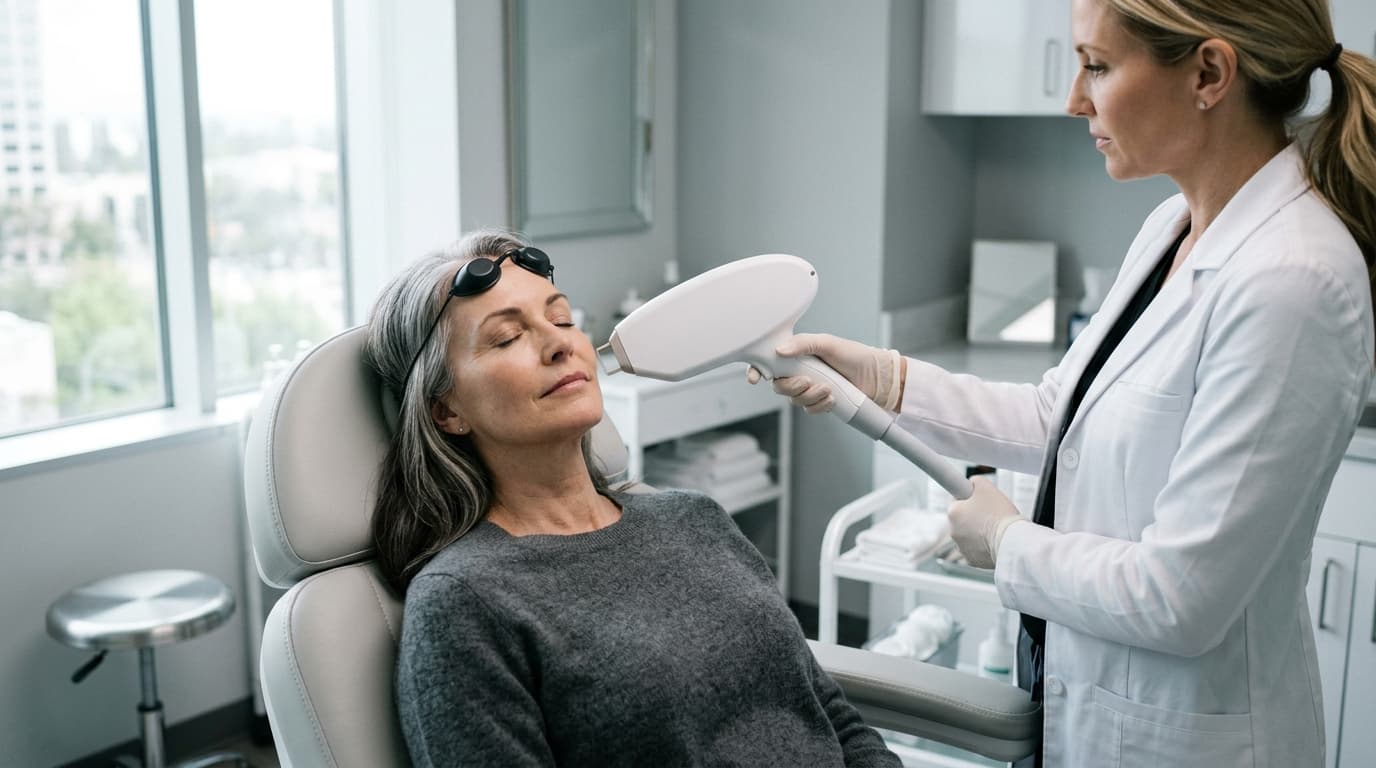
Ablative vs non-ablative laser resurfacing is the question underneath almost every laser consultation, and it is usually answered with a brand name rather than an explanation. A patient is told she is a candidate for Fraxel, or for CO2, or for a hybrid with a trademarked name, and leaves with a price and a downtime estimate and no idea what any of those words mean at the level of her skin. The words matter, because the two families of laser do fundamentally different things. An ablative laser vaporizes skin. A non-ablative laser heats it and leaves the surface intact. Every result, every day of downtime, and every complication in the category follows from that single distinction, and the fractional devices that dominate the market are not a third category but a way of applying either one in a pattern of dots.
The short version, which the rest of this piece defends: the result a resurfacing laser can deliver is roughly proportional to the amount of skin it removes or injures, the downtime is proportional to the same quantity, and no engineering trick has yet broken the link. Fully ablative carbon dioxide resurfacing in the 1990s produced the deepest, most durable improvement in photodamaged skin that any device has ever achieved, and it did so at a price in healing, redness, and permanent pigment loss that the field decided was too high. Fractional lasers, ablative and non-ablative, are the negotiated settlement: less result per session, far less wound, and a series of sessions to make up the difference. A laser marketed on the absence of downtime is a laser that has been turned down to the point where it does very little, and a patient who understands why can read any treatment plan in the category.
This piece sits beside the piece on laser versus chemical peel, which covers how a practice chooses between light and acid, and the piece on the deep phenol peel, which covers the one chemical procedure that competes with ablative CO2 on depth. The piece on lasers for sun spots and pigmentation covers the pigment-specific lasers, which are a different technology aimed at a different target. None of that is repeated here. This is about resurfacing, the lasers that change the texture of skin by wounding it, and the arithmetic of how much wound buys how much change.
What ablative and non-ablative actually mean, and why the water in your skin decides everything
The short answer: an ablative laser emits a wavelength that water absorbs so strongly that the top layers of skin are vaporized outright, while a non-ablative laser emits a wavelength that water absorbs weakly enough to pass through the surface and deposit heat in the dermis below, and the difference between vaporizing the skin and heating it is the difference between a wound that must re-grow a surface and a wound that does not.
Skin is mostly water, and a resurfacing laser is a machine for putting energy into that water. The carbon dioxide laser, at a wavelength of 10,600 nanometers in the far infrared, is absorbed by water within a fraction of a millimeter of the surface. When it fires, the water in the top layer of skin boils and the tissue is vaporized, the epidermis and a portion of the upper dermis lifted away as vapor. Beneath the vaporized layer is a zone of tissue that was heated but not removed, and it is this residual thermal damage, on the order of 50 to 150 microns with a CO2 laser, that produces the collagen contraction and remodeling the procedure is known for. The erbium:YAG laser, at 2,940 nanometers, sits almost exactly at the peak of water's absorption curve and is absorbed roughly ten times more strongly than CO2. It vaporizes tissue with almost no residual heating, a thermal damage zone of a few microns to perhaps twenty, which makes it a cleaner sculpting tool that heals faster and tightens less.
A non-ablative laser works from the other end of the absorption curve. Wavelengths in the near infrared, 1,064, 1,320, 1,450, and 1,550 nanometers among them, are absorbed by water weakly enough to penetrate through the epidermis and deposit their energy as heat in the dermis. The surface is protected by cooling, either a cryogen spray or a chilled contact plate, and stays intact. The heat denatures dermal collagen and triggers a repair response that lays down new collagen over the following months. There is no open wound, no crust, no re-epithelialization, and the result is correspondingly smaller: the early non-ablative lasers of the late 1990s and early 2000s, which heated the whole dermis under an intact surface, produced improvement that patients frequently could not see and that studies measured in fractions of a grade on a wrinkle scale.
The point to hold onto is that the wavelength is not a marketing detail. It sets, by physics, whether the laser removes skin or warms it, how deep the effect goes, and how much of the tissue is left to heal from. The names on the devices, from the UltraPulse and SilkTouch CO2 systems of the 1990s to the Fraxel and Clear + Brilliant devices of the last two decades, are trademarks placed on top of that physics, and the piece on trademarked procedure names is the right companion for a patient who has been quoted a brand rather than a wavelength.
- Ablative: CO2 at 10,600 nanometers or erbium:YAG at 2,940 nanometers, absorbed by water at the surface, vaporizes the epidermis and upper dermis, leaves a wound that must re-grow a surface.
- Non-ablative: near-infrared wavelengths between about 1,000 and 1,600 nanometers, penetrate an intact, cooled epidermis and heat the dermis, no open wound and a smaller result.
- CO2 versus erbium: erbium is absorbed roughly ten times more strongly by water, ablates with far less residual heat, heals faster, and tightens less.
- The rule: the result scales with the tissue injured, and so does the downtime.
Why fully ablative CO2 resurfacing produced the strongest results in the history of the field, and why almost nobody offers it now
The short answer: full-face CO2 resurfacing in the mid-1990s erased deep wrinkles and decades of sun damage in a single treatment, and the same depth of injury produced months of redness, a meaningful rate of permanent pigment loss that appeared six to twelve months later, and scarring whenever the laser went too deep, which is why the procedure that defined the category is now a rarity performed by a small number of surgeons on a small number of carefully chosen faces.
The pulsed CO2 lasers that arrived in the early 1990s were a genuine advance. Earlier continuous-wave CO2 lasers had cooked tissue indiscriminately; the new devices delivered energy in pulses short enough to vaporize a layer of skin before heat could spread, which allowed a surgeon to remove the skin in controlled passes and to see the dermis change color as the collagen contracted. The results in photodamaged skin were the most dramatic the field had produced. Deep perioral wrinkles, the crosshatched cheeks of a lifetime of sun, and acne scarring all improved in ways that no cream, peel, or earlier device had matched, and by the late 1990s full-face CO2 resurfacing was one of the most requested procedures in American cosmetic practice. The piece on the deep phenol peel covers the one chemical procedure whose depth compares, and the two were, for a few years, direct competitors.
The problem was the wound. Fully ablative CO2 resurfacing leaves the entire treated face without an epidermis. Re-epithelialization takes seven to ten days, during which the patient is managing an open wound with occlusive dressings, ointments, and soaks, and the risk of infection, bacterial, fungal, and viral, is at its peak. The piece on herpes reactivation after cosmetic procedures explains why antiviral prophylaxis became mandatory in this setting, after cases in which a cold sore virus spread across a freshly resurfaced face. Once the surface is back the skin is red, and it stays red, typically for three to six months, occasionally longer. The redness fades. What came next often did not.
Delayed hypopigmentation is the complication that ended the era. Six to twelve months after a deep CO2 treatment, a proportion of patients developed a permanent loss of pigment in the treated skin, an alabaster paleness with a sharp line at the jaw where the treated face met the untreated neck. Published series from the late 1990s reported it in a meaningful minority of deep full-face treatments, with rates in some reports approaching one in five, and it did not respond to anything. Scarring, particularly along the jawline and around the mouth where the laser was pushed hardest, and ectropion of the lower eyelid where the skin beneath the eye was tightened beyond what the lid could tolerate, were the other signature injuries. The piece on blepharoplasty and under-eye skin covers why the lower lid is the least forgiving skin on the face for any tightening procedure.
By the early 2000s the market had moved on, and the field learned something that should have been obvious: the reason the procedure worked was the same reason it injured. There was no way to remove the epidermis and a portion of the dermis across the whole face without removing the melanocytes and the adnexal structures the skin heals from, and no way to tighten skin that much without occasionally tightening it too much. What remained were a small number of surgeons, mostly in facial plastic surgery and dermatologic surgery, who still perform full-face or perioral CO2 resurfacing in fair-skinned patients with severe damage who have understood and accepted the trade, often in combination with a facelift, as the piece on the quiet end of the pull-tight facelift notes when it discusses what a lift does and does not do for the surface of the skin.
- The result: the deepest, most durable improvement in wrinkles and photodamage any device has produced, in a single treatment.
- The wound: seven to ten days without an epidermis, three to six months of redness, and peak infection risk in the first week.
- The signature injury: delayed permanent hypopigmentation appearing six to twelve months later, reported in a meaningful minority of deep treatments, with a line of demarcation at the jaw.
- The status now: a niche procedure for fair, severely damaged skin, in the hands of a small number of surgeons who still offer it.
How a 2004 paper split the beam and created the fractional compromise that every laser since has copied
The short answer: in 2004 a group at Massachusetts General Hospital led by Dieter Manstein and R. Rox Anderson published a technique called fractional photothermolysis, in which a laser injures skin in thousands of microscopic columns surrounded by untouched tissue, and the untouched tissue heals the columns within days, which allowed both ablative and non-ablative lasers to be used at depths that would previously have required weeks of healing.
The paper appeared in Lasers in Surgery and Medicine, and its idea was simple enough to describe in a sentence. Instead of injuring the whole surface, the laser creates a grid of microscopic thermal zones, each a fraction of a millimeter across, separated by skin the laser did not touch. Because every injured column is surrounded by intact epidermis and dermis, the cells that repair the wound are never more than a few hundred microns away, and re-epithelialization that takes ten days after a full-surface injury takes a day or two. The device treats only a fraction of the skin per pass, commonly somewhere between five and twenty percent of the surface, occasionally more, and the untreated fraction carries the treated one through healing. The first commercial device built on the idea was the Fraxel laser from Reliant Technologies, cleared by the FDA that same year, a non-ablative 1,550 nanometer erbium-doped fiber laser delivered through a handpiece that rolled across the skin.
Two things followed. The first was that a non-ablative laser, which had been a disappointment when it heated the dermis diffusely, became useful once its heat was concentrated into columns that went deeper and provoked a more vigorous repair. The second, and the more consequential, was that the same fractional pattern could be applied to an ablative laser. Fractional CO2 devices arrived around 2007, from Reliant, Lumenis, and others, and they vaporize columns of skin down into the dermis while leaving the bridges between them intact. The result is a wound that crusts and heals in five to seven days rather than ten, redness measured in weeks rather than months, and a hypopigmentation risk far lower than the fully ablative procedure because the melanocytes in the untreated bridges repopulate the treated columns. The result per session is also smaller than the fully ablative procedure, and the honest way to describe fractional CO2 is as a controlled fraction of the old operation, repeated if needed.
The fractional idea has since been applied to nearly every wavelength in the category. There are low-energy non-ablative fractional devices sold for minimal downtime, the Clear + Brilliant at 1,440 nanometers among them. There is a 1,927 nanometer thulium fractional laser, paired with the 1,550 in the Fraxel Dual, that targets the epidermis and is used for pigment and superficial texture, a use the piece on melasma treatment covers with appropriate caution. There are hybrid devices, the Sciton Halo among them, that fire a non-ablative and an ablative wavelength through the same handpiece in one pass. And there is fractional erbium, which ablates columns with almost no surrounding heat. Every one of them is a point on the same line: more depth and more coverage per session buys more result and more downtime, and the fractional pattern moves the whole line toward faster healing without abolishing it.
"A fractional laser did not repeal the rule that result follows wound. It changed the shape of the wound from a sheet to a grid, so the skin could heal it faster. What the grid removes per session, it also delivers per session, and no less.
"
- The paper: Manstein, Anderson, and colleagues, Lasers in Surgery and Medicine, 2004, describing fractional photothermolysis.
- The mechanism: microscopic columns of injury surrounded by intact skin that re-epithelializes them within a day or two.
- The coverage: typically five to twenty percent of the surface per session, which is why a series is prescribed.
- The consequence: ablative CO2 became usable in a fractional pattern with five to seven days of crusting and weeks rather than months of redness, at a lower hypopigmentation risk.
What the downtime and the result actually look like for each option, from the fully ablative CO2 to the lunchtime laser
The short answer: fully ablative CO2 means about ten days of open wound care and months of redness for one treatment that changes the face; fractional CO2 means five to seven days of crusting and a few weeks of pink for a result that usually takes one to three sessions; non-ablative fractional means a day or two of swelling and a week of bronzed flaking for a result that takes three to five sessions and never reaches the ablative ceiling; and the low-energy devices sold with no downtime produce a glow that lasts about as long as the redness would have.
The clearest way to see the trade is to lay the four options side by side, because each one is a setting on the same dial. At the top is fully ablative CO2 or deep erbium resurfacing: a single treatment under sedation or general anesthesia, a face without an epidermis for seven to ten days, occlusive dressings and daily wound care, three to six months of redness, a permanent change in the texture and tightness of the skin, and the pigment risk already described. This is the treatment for severe photodamage and deep wrinkling in fair skin, and it is the only option in the category that a patient with those problems should expect to make them go away.
One step down is fractional ablative CO2 or fractional erbium at a meaningful density and depth. This is done under topical anesthesia with or without nerve blocks and oral sedation, produces pinpoint bleeding and a fine crust across the treated area for five to seven days, and leaves the skin pink for two to four weeks. The piece on numbing cream before cosmetic procedures covers what topical anesthesia can and cannot do for a procedure at this level. A single session improves moderate wrinkling, acne scarring, and texture visibly; two or three sessions, spaced two to three months apart, approach but do not reach what the fully ablative procedure does once. The piece on acne scar treatment covers why fractional CO2 became the workhorse for scarring specifically.
Below that is non-ablative fractional resurfacing at the 1,550 nanometer wavelength and its relatives, the treatment most patients mean when they say Fraxel. Topical anesthesia, a sunburned feeling for a day, swelling for one to three days, and a bronzed, sandpaper texture that flakes off over about a week. No open wound, no crust, and no dressings. The result after a series of three to five sessions is a real improvement in fine lines, tone, and mild scarring, and a modest improvement in anything deeper. It does not tighten skin in a way a patient can rely on, and the piece on energy-based skin tightening is the right place to read about what does and does not tighten.
At the bottom of the dial are the low-energy fractional devices marketed on the absence of downtime. They use the same non-ablative principle at a fraction of the energy and density, produce a day of pinkness and a few days of subtle roughness, and are sold as a maintenance treatment in a package of sessions. They brighten the skin for a few weeks. They do not resurface it in any sense a photograph six months later would show, and a patient who buys a package of them expecting the results in a fractional CO2 gallery has been sold the wrong end of the dial. The piece on how to read a before-and-after gallery is worth applying to any laser gallery, because the lighting, the flash, and the timing of the after photo can make a low-energy treatment look like a high-energy one.
Cost follows the same line in a way that surprises patients. A single fully ablative or deep fractional CO2 treatment costs more than any single non-ablative session, and the non-ablative series, once three to five sessions are added up, often lands in the same range or above it for a smaller result. The piece on what a plastic surgery quote covers is written for surgery, but its central instruction, to price the course rather than the session, applies to every laser plan in this category.
- Fully ablative CO2 or deep erbium: one treatment, seven to ten days of open wound, three to six months of redness, the largest and most durable result, the highest pigment and scarring risk.
- Fractional ablative: five to seven days of crusting, two to four weeks of pink, one to three sessions for a strong result in moderate damage and scarring.
- Non-ablative fractional: one to three days of swelling, a week of bronzed flaking, three to five sessions for a modest to moderate result in fine lines and tone.
- Low-energy no-downtime devices: a day of pink, a brief glow, no lasting change in texture.
Why skin color changes the entire calculation, and what the honest plan looks like on darker skin
The short answer: the darker the skin, the more likely any resurfacing injury is to leave post-inflammatory hyperpigmentation that lasts months, and the more likely a deep ablative injury is to leave permanent hypopigmentation, which is why fully ablative CO2 is generally avoided beyond Fitzpatrick type III and why non-ablative fractional lasers at lower densities, with test spots and pigment-suppressing preparation, are the usual and still imperfect approach for types IV through VI.
The mechanism is the same one that causes a scrape or an acne lesion to leave a dark mark on brown skin. Any injury that inflames the epidermis and upper dermis stimulates melanocytes, and in skin with more active melanocytes the response is larger and slower to fade. A resurfacing laser is a deliberate, uniform version of that injury, and the darkening that follows is the most common complication of every laser in the category on Fitzpatrick types IV, V, and VI. It is not confined to ablative devices. A series from Hong Kong, published in Lasers in Surgery and Medicine in 2007, reported post-inflammatory hyperpigmentation in a meaningful minority of Asian patients treated with the non-ablative 1,550 nanometer fractional laser, and found that the rate rose with treatment density, the fraction of the skin injured per session. The piece on cosmetic procedures on deeper skin tones sets out why this risk has been systematically underweighted in a field whose trials were largely conducted on fair skin.
Ablative lasers add the second and worse risk, the loss of pigment. Where a fractional device leaves bridges of intact skin, the melanocytes in those bridges repopulate the treated columns and pigment generally returns; where the whole surface is removed, as in fully ablative CO2, repopulation depends on the melanocytes that survive in the hair follicles and sweat ducts, and in darker skin the resulting mismatch, patches of lighter skin against the untreated background, is far more visible and far more distressing than the same change on a fair face. It is for this reason that most experienced laser surgeons will not perform fully ablative CO2 resurfacing beyond about Fitzpatrick type III, and treat type IV with fractional devices only, at conservative settings.
The honest plan for darker skin, then, is a compromise within a compromise. It usually means a non-ablative fractional laser or a low-density fractional erbium, a test spot behind the ear or at the hairline several weeks before the full treatment, a course of a pigment-suppressing topical such as hydroquinone or a retinoid beforehand, the same topical resumed once the skin has healed, and strict sun avoidance for months on either side. It also means more sessions to reach a result that fair skin reaches in fewer, and a lower ceiling on what the series can deliver. A patient with type V skin and deep acne scarring cannot expect the result a fractional CO2 gallery of type II faces shows, and a practice that promises it has either not treated much darker skin or not followed its patients for the three to six months the pigment takes to show.
Two further cautions apply regardless of skin color. The first is location. The neck, the chest, and the backs of the hands have far fewer hair follicles and sweat ducts than the face, and because the skin re-epithelializes from those structures, an ablative laser at facial settings on the neck heals slowly, scars readily, and was the source of a well-documented run of neck scarring in the CO2 era. The piece on hand rejuvenation covers the same constraint for the hands. The second is recent isotretinoin. The long-standing rule was to wait six to twelve months after the drug before any resurfacing, on the strength of reports of atypical scarring; a 2017 consensus published in JAMA Dermatology concluded that the evidence did not support that delay for non-ablative and most fractional treatments, while leaving the deep fully ablative procedures in a more cautious category. The piece on the isotretinoin waiting period covers the shift and what it means in practice.
The honest summary
- Ablative removes skin and non-ablative heats it. CO2 at 10,600 nanometers and erbium at 2,940 nanometers vaporize the surface; near-infrared wavelengths pass through an intact, cooled epidermis and warm the dermis. Everything else in the category follows from that.
- Result scales with wound, and no device has broken the link. Fully ablative CO2 produced the strongest results in the history of the field and was largely abandoned because of months of redness and a meaningful rate of permanent hypopigmentation appearing six to twelve months later.
- Fractional is a shape, not a third category. The 2004 paper on fractional photothermolysis let both ablative and non-ablative lasers injure skin in columns that heal within days, trading result per session for faster recovery, and every modern device is a point on that same line.
- The dial runs from ten days of open wound to a lunchtime glow. Fully ablative, fractional ablative, non-ablative fractional, and low-energy maintenance devices deliver progressively less change for progressively less downtime, and the series required at the lower settings often costs as much as the single treatment at the higher ones.
- Skin color moves every number. Post-inflammatory hyperpigmentation is the commonest complication on Fitzpatrick types IV through VI with any device, permanent pigment loss is the worst one with ablative devices, and the honest plan on darker skin is a lower-density non-ablative or fractional erbium approach with test spots, preparation, and a lower ceiling.
Laser resurfacing is one of the few areas in aesthetics where the physics is settled and the marketing has simply declined to mention it. A laser that removes skin changes it, at the cost of a wound; a laser that warms skin changes it less, at the cost of less; and a laser that promises no downtime has been turned down until it promises very little. A patient who walks into a consultation knowing which of the three she is being offered, in a wavelength and a density rather than a brand, will not be surprised by the result, the recovery, or the bill. A patient who walks in knowing only the trademark is trusting that the person holding the handpiece understands the trade on her behalf, and in this category, that trust should be earned in writing before the first pass.