Industry · September 1, 2026
Scar Camouflage and Nipple Tattoos: What Medical Tattooing Can Actually Fix, and Who Is Holding the Machine
Medical tattooing sits at the end of plastic surgery's assembly line: the three-dimensional nipple tattoo that finishes a breast reconstruction, and the flesh-tone camouflage work that quiets a pale surgical scar. When it is done well it is the cheapest, least invasive win in the entire field. But the ink is not approved by anyone, the certificates on the studio wall are not regulated by anyone, and the pigment that matches your skin in January will not match it in July. Here is what a needle and pigment can genuinely do for a scar, what they cannot, and how to vet the person doing it.
By The Editorial Desk
11 min read
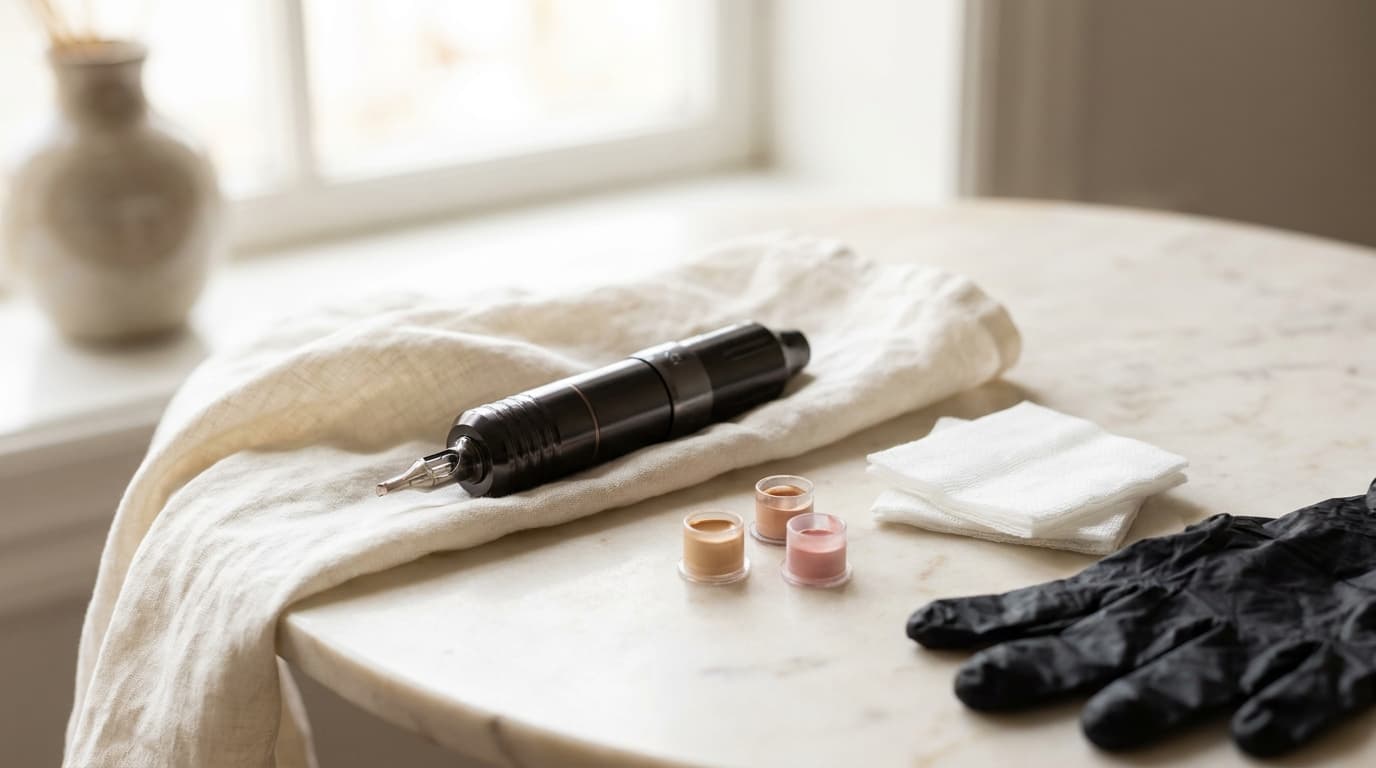
There is a version of plastic surgery that involves no scalpel at all, and it happens months after the last operation. A tattoo machine, loaded with pigments mixed to the color of skin or the color of an areola, runs over a healed surface for an hour or two. The industry calls it paramedical tattooing, medical micropigmentation, or camouflage tattooing, and it has quietly become the finishing step for two very different populations: breast reconstruction patients getting a nipple and areola drawn back onto a rebuilt chest, and cosmetic surgery patients trying to make a facelift, tummy tuck, or breast lift scar recede into the surrounding skin.
The appeal is obvious. Compared to everything that came before it, a tattoo is cheap, fast, needs no anesthesia, and carries no downtime. The problem is that the field has grown much faster than its guardrails. The pigments are effectively unregulated, the training credentials are invented by the schools that sell them, and the marketing routinely promises texture correction that ink is physically incapable of delivering. This is a procedure worth having, for the right problem, from the right hands. Sorting that out takes about fifteen minutes of literacy that nobody hands you.
What medical tattooing is, and why plastic surgery adopted it
The short answer: medical tattooing uses the same dermal pigment implantation as any decorative tattoo, but aimed at restoration, and its two established uses in plastic surgery are recreating the nipple-areola complex after breast reconstruction and blending mature, pale scars toward the color of surrounding skin.
Strip away the branding and the technique is ordinary tattooing: a needle deposits insoluble pigment particles into the dermis, the layer below the epidermis, where they stay because the body cannot clear particles of that size. What changes is the palette and the intent. Instead of black linework, the artist mixes browns, roses, and olive tones to imitate an areola, or blends warm neutrals to approximate the client's skin. The sibling procedure on the scalp, micropigmentation dotted between follicles to mimic stubble, runs on the same logic and shows up in the hair transplant world as a companion or alternative to grafting.
The nipple-areola tattoo is the older and better established of the two. Nipple reconstruction with local skin flaps can rebuild a bump, but it cannot rebuild color, and many patients skip the surgical nipple entirely in favor of a flat tattoo shaded to look three-dimensional. The trompe l'oeil version, with highlights and shadows that read as projection from a few feet away, was pushed forward not by medicine but by professional tattoo artists who brought portrait-shading skills into a clinical niche, and their results were visibly better than what most hospital-based providers were producing with older equipment and flatter technique. That gap, between the medical setting and the artistic result, still defines the field.
Scar camouflage is the newer growth market, advertised to anyone with a pale stripe from an old surgery, a self-harm history, stretch marks, or vitiligo. Here the honest evidence is thinner, the color matching is harder, and the marketing runs furthest ahead of the physics.
The nipple tattoo: the last step of reconstruction, and the step most often botched by the system that covers it
The short answer: nipple and areola tattooing is a recognized stage of breast reconstruction, which means federal law requires group health plans that cover mastectomy to cover it, but the shading skill that makes the result look real is concentrated in a small number of practitioners, and the flat, faded, orange-drifting areola is common enough to have its own revision market.
The legal footing matters and is worth stating plainly. The Women's Health and Cancer Rights Act of 1998 requires plans that cover mastectomy to cover all stages of reconstruction, including procedures to produce symmetry, and nipple-areola reconstruction and tattooing fall inside that mandate, a point covered in more depth in the breast reconstruction piece. A patient being told the tattoo is cosmetic and out of scope is being told something the statute does not say, though plans do impose network and setting restrictions, and a tattoo done at an independent studio rather than a medical office is frequently paid out of pocket and sometimes reimbursed after the fact.
The quality problem is structural. In a hospital workflow the tattoo is often delegated to whoever was trained to do it, a nurse or physician assistant with a short course behind them, using conservative iron-oxide pigment sets. The results are frequently uniform discs of a single tone: anatomically placed, medically safe, visually flat. Pigment retention on reconstructed tissue is also genuinely harder than on normal skin. A reconstructed breast mound is scarred, sometimes thin, sometimes irradiated, and irradiated skin both holds pigment poorly and tolerates trauma worse, so fading and patchy uptake are common and touch-ups are the norm rather than the exception. Patients who went to shading specialists, including tattoo artists working in ordinary studios, consistently show the more convincing three-dimensional results, which is why some surgeons now refer out to artists rather than keeping the tattoo in-house.
Two cautions belong in this section. First, timing: the tattoo goes on a settled result, typically several months after the final reconstructive operation, after revisions are done, because tattooing a mound that will be operated on again wastes the work. Second, the thin-flap problem: on a reconstruction with little tissue between skin and implant, an aggressive needle depth is not a theoretical concern, and this is one reason the surgeon should know and approve who is doing the tattoo. The same logic applies to chest surgery patients outside the cancer context: areola resizing and repigmentation after gender-affirming top surgery, where grafted nipples often lighten, is routine finishing work, and the considerations are identical. So are the proportions questions covered in the nipple and areola reduction piece: a tattoo can set diameter and color with more precision than surgery, which is exactly why the artist's aesthetic judgment matters as much as their hygiene.
"A tattoo can change the color of a scar. It cannot change the texture, the sheen, or the way it catches light. Every honest practitioner says this in the first five minutes. Every dishonest advertisement is built on not saying it.
"
Scar camouflage: ink adds color, and color is the only thing it adds
The short answer: camouflage tattooing works on flat, fully mature, stable scars that are lighter than the surrounding skin, and it fails or backfires on raised, depressed, dark, or fresh scars, because pigment can imitate skin tone but cannot rebuild skin texture.
Understand what a camouflage tattoo is doing: depositing a fixed, opaque color into a scar so that, at conversational distance, the pale stripe stops announcing itself. That works when color is the scar's main offense. A mature facelift scar in front of the ear, a breast lift scar gone silvery white, a well healed tummy tuck line sitting below the waistband: these are the good candidates. The scar must be mature, which in practice means at least a year old and often closer to two, flat, and done changing, the same maturation arc described in the scar care piece. Tattooing an immature scar risks reactivating inflammation, distorting the eventual color, and wasting pigment in tissue that is still remodeling.
Now the failure modes, which the consultation should volunteer. Texture is untouched: a shiny, crinkled, or depressed scar with perfectly matched color is still shiny, crinkled, or depressed, and under some lighting the color match makes the texture more noticeable, not less. Raised scars are worse than poor candidates: needling a scar with hypertrophic or keloid history can provoke exactly the overgrowth you were trying to hide. Dark scars are the wrong direction entirely, since tattooing works by adding pigment, not removing it, and post-inflammatory hyperpigmentation needs the approaches discussed in the deeper skin tones piece, where the melanin-related risks of every energy and needle procedure run higher and a test patch is not optional but mandatory.
Then there is the problem nobody puts in the brochure: your skin changes color and the tattoo does not. Tattooed pigment sits in the dermis and does not tan. A camouflage patch matched to winter skin becomes a pale island on tanned summer skin; matched in summer, it darkens the scar all winter. Pigment also ages on its own schedule, drifting warm toward orange-pink or cool toward grey-ash as particle mixes break down over years, which is why reputable artists insist on a small healed test patch reviewed weeks later, describe touch-up cycles measured in years, and match slightly conservative rather than exact. A camouflage tattoo is not a one-time correction. It is a maintenance relationship with a colorant that behaves differently than skin for the rest of your life.
The ink: approved by nobody, occasionally contaminated, and chemically opaque
The short answer: no tattoo pigment on the American market is approved by the FDA for injection into skin, sealed bottles of ink have repeatedly been found contaminated with bacteria, and the practical defenses are boring ones, single-use sterile setups and practitioners who can tell you exactly whose pigment they use and why.
The regulatory status of tattoo ink surprises almost everyone who looks it up. The FDA treats tattoo inks as cosmetics, and no pigment has premarket approval for intradermal use. For decades the agency's involvement was almost entirely reactive, warning letters and recalls after problems surfaced. The 2022 Modernization of Cosmetics Regulation Act tightened the frame, bringing facility registration, ingredient listing, and adverse event reporting to cosmetics including inks, and the FDA has since pushed guidance at manufacturers about insanitary production. That is progress from a very low baseline. It is still nothing like the scrutiny applied to an injectable drug, a bar worth remembering from the skin booster regulatory story, and Europe has gone further than the United States, with REACH restrictions that pulled thousands of ink formulations and specific pigments off the EU market on hazard grounds while the same bottles remain legal here.
Contamination is not hypothetical. In 2012 the New England Journal of Medicine documented an outbreak of Mycobacterium chelonae skin infections traced to a contaminated, prediluted grey-wash ink, infecting people through sealed bottles used exactly as directed, and FDA surveys since have repeatedly found microbial contamination in unopened inks, prompting recalls in 2019 and again in the 2020s. The lesson for a medical tattoo client is specific: sterile needles do not save you from a contaminated bottle, distilled water dilution done at the studio is a known risk point, and the deep red pigments carry the field's most notorious allergy profile, producing itchy, raised, sometimes granulomatous reactions months or years later. On a reconstructed breast or a surgical scar, an ink reaction or an atypical mycobacterial infection is not a nuisance, it is a complication sitting on top of an operated field, and unwinding a bad tattoo means laser removal, a multi-session project with its own scarring and pigment risks that works worst on exactly the cosmetic flesh tones camouflage uses, since titanium-dioxide-heavy pigments can paradoxically darken under a laser.
Who is holding the machine: the certificate wall and the regulation gap
The short answer: medical tattooing sits in a regulatory no man's land where the practitioner is usually licensed as a body artist by a county health department, the "paramedical certification" on the wall comes from an unaccredited weekend course, and the burden of vetting falls entirely on the patient and the referring surgeon.
Who is legally allowed to tattoo a scar? In most American states, anyone with a body-art license, a credential focused on bloodborne pathogen training and studio sanitation, issued by state or local health authorities that do not distinguish between a decorative rose and a nipple on a mastectomy scar. Medical boards have essentially no jurisdiction unless the practitioner is separately a licensed clinician. Into that vacuum has grown an industry of training academies selling multi-day "paramedical tattoo certification" courses, and the certificates are marketing documents: no national accrediting body, no examination standard, no oversight. Some graduates are excellent. The certificate is not what tells you.
This is the same supervision-shaped hole that runs through the medical spa industry, with one honest difference: tattooing's ceiling of harm is lower than an injectable's, since nobody loses vision to an areola tattoo. But the floor is not zero, infection, allergic reaction, keloid activation, and permanent discoloration on an operated field are all real, and the practical vetting is the same. Ask where the person trained and how many scar or areola cases they do a month. Ask whether they work with plastic surgeons by referral, because a practitioner whom surgeons trust with their own results has passed a screening no certificate provides. Conversely, ask your surgeon whom they send patients to; a practice that finishes reconstructions should have an answer ready, and a blank look is information. And confirm the boring things directly: single-use needle cartridges opened in front of you, pigment decanted into disposable caps, gloves, and a studio or clinic that would pass the same hygiene glance you would give any procedure room.
The honest summary
Medical tattooing is one of the genuinely good deals in aesthetic medicine, provided the problem is a color problem. A shaded three-dimensional areola tattoo is the difference between a reconstruction that reads as a mound and one that reads as a breast, federal law puts it inside covered reconstruction, and the better results increasingly come from artists with real shading skill rather than from whoever the clinic trained last spring. Scar camouflage can quiet a pale, flat, fully mature scar to the point where nobody's eye snags on it.
The limits are just as clear. Ink adds color and only color: raised, depressed, dark, or young scars are poor or dangerous candidates, tattooed pigment will not tan or age the way your skin does, and the match is a negotiated compromise maintained by touch-ups for years. The ink itself is approved by no regulator, has been found contaminated in sealed bottles, and carries a known allergy profile in the reds. The credentials are unregulated, so the vetting is on you: healed photographs a year out on skin like yours, a practitioner surgeons refer to by name, a test patch when tone matching is delicate, and a consultation that spends more time on what ink cannot do than on what it can. Get all of that, and this is the rare procedure where a small needle finishes what the scalpel started. Skip it, and you have traded a pale scar for a permanent, slowly discoloring reminder that the last step is still a procedure.