Industry · August 25, 2026
Spitting Sutures: Why Your Body Is Pushing Out the Stitches, and When It Matters
Weeks after a facelift, a tummy tuck, or a breast lift, a small red bump appears on the incision line, opens, and produces a tiny white or blue thread. Patients assume something has gone wrong. Usually nothing has. A spitting suture is the body extruding a buried absorbable stitch it has decided not to dissolve, and it is one of the most common and least explained events in cosmetic surgery recovery. Here is what the suture materials actually are, why some of them get expelled, what the surgeon should do about it, and how to tell a harmless spit from the infection or dehiscence that occasionally hides behind the same red bump.
By The Editorial Desk
10 min read
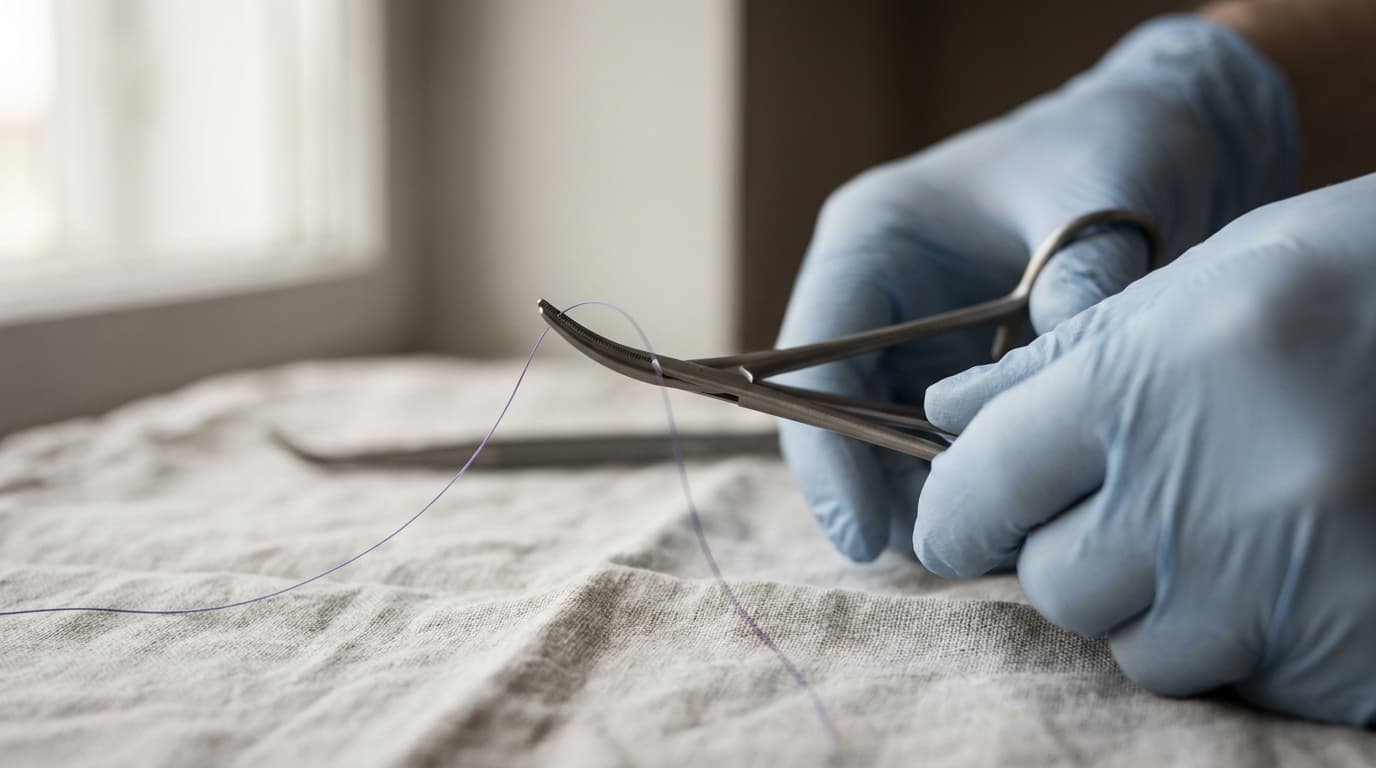
Every cosmetic operation that involves an incision is closed in layers, and the layers the patient never sees are the ones holding the result together. The skin stitches that come out at a week are cosmetic. The deep stitches, buried in the dermis and the fascia beneath it, carry the tension of the closure for the months it takes a scar to gain strength, and they are almost always made of a material designed to dissolve on its own. Most of them do. Some of them do not, and the body's response to a stitch it cannot digest is to push it toward the surface, where it emerges through a small pimple-like opening on the incision line as a thread the patient can see and sometimes pull.
Surgeons call this a spitting suture. It is so ordinary that many practices mention it in a single line of the post-operative handout, and so alarming to the patient who was not warned that it generates a steady volume of anxious phone calls, emergency visits, and online forum threads asking whether the surgery has failed. It has not. But the same small red bump on an incision can also be the first sign of a stitch abscess, an early infection, or a closure that is beginning to open, and the difference is worth understanding rather than guessing at.
What the buried stitches are made of
The short answer: deep sutures in cosmetic surgery are nearly all synthetic absorbables, braided or monofilament, engineered to lose strength over weeks and disappear over months, and the timeline for each material is published and predictable.
The workhorse of dermal closure for decades has been braided polyglactin, sold as Vicryl, which holds roughly three quarters of its strength at two weeks, about half at three weeks, and is essentially gone by ten weeks. Monofilament poliglecaprone, sold as Monocryl, is smoother and dissolves faster, losing most of its strength by three weeks and absorbing within about four months. For the fascial and deeper layers that need to hold longer, surgeons reach for polydioxanone, sold as PDS, which keeps meaningful strength for six weeks and takes about six months to absorb. Barbed sutures, the self-anchoring monofilaments that have become common in facelift and body contouring closures, are typically made of the same polymers with a knotless design.
Absorption in every case happens by hydrolysis: water in the tissue breaks down the polymer chains, and the body clears the fragments. The rate is chemistry, not biology, which is why the manufacturers can state it. What varies from patient to patient is the inflammatory reaction along the way. The American Society of Plastic Surgeons describes absorbable sutures as the standard for buried closure precisely because the body handles them without a second procedure, and the peer-reviewed wound-healing literature has consistently found that braided materials provoke more tissue reaction than monofilaments, and that larger diameter stitches provoke more than fine ones. Both facts matter for what comes next.
Why some of them get pushed out
The short answer: a suture spits when it sits too close to the skin surface, when it is a reactive material in a thin-skinned area, or when the body mounts an inflammatory response that expels it before hydrolysis can dissolve it, and none of those three mechanisms means the closure has failed.
The most common cause is placement depth. A dermal stitch is meant to be buried with its knot pointed downward, away from the skin, in the deep dermis. In thin skin, or when a knot ends up superficial, the stitch sits within a millimeter or two of the surface. The body treats it as a foreign object, which it is, builds a small capsule of inflammatory cells around it, and the pressure of that reaction combined with the ongoing turnover of the epidermis works the stitch upward until it breaks through. The thinner the skin, the shorter the journey: the eyelids, the neck, the area behind the ear, and the abdomen below a tummy tuck incision are the frequent sites, and patients with very thin skin or little subcutaneous fat see it more often than others.
The second cause is the material itself. Braided sutures have a larger surface area and small crevices that hold fluid and cells, and the tissue reaction to a braided polyglactin knot is measurably greater than to a monofilament of the same size. Monofilaments spit less. This is one reason many surgeons moved their skin-adjacent dermal layer to fine monofilament and reserve braided materials for deeper structures. The third cause is the individual patient: some people simply react more, and a patient who spat stitches after a previous operation will usually do so again. This is worth mentioning at consultation, because it changes what the surgeon chooses to put in.
"A spitting suture is the body doing its job on a foreign object it was never going to absorb in time. It is a nuisance in the recovery, not a failure of the surgery, and the surgeon who warned you about it in advance is the one who has seen a great many of them.
"
The timing is characteristic and useful. Spits almost never occur in the first two weeks, because the suture is still fully intact and buried. They cluster between three weeks and three months, as the material begins to fragment and the tissue reaction peaks, and occasional stragglers appear as late as six months with the longest-lasting materials. A bump appearing at day four is far more likely to be something else.
What to do when a thread appears
The short answer: do not pull it, keep the area clean, and let the surgeon's office either trim the exposed portion flush with the skin or remove the fragment with fine forceps, an in-office event that takes a minute and needs no anesthesia.
The instinct to tug is strong and mostly wrong. A visible thread is often the loop of a stitch whose two ends are still anchored in tissue, and pulling it drags the buried portion through inflamed skin, enlarges the opening, and occasionally unseats a stitch that was still doing useful work. The office approach is either to snip the exposed portion at the skin so the rest can continue to absorb, or, if the fragment is loose and mostly extruded, to lift it out. The opening left behind is a pinpoint wound that closes within days and leaves no mark most of the time. A small dab of petroleum jelly and a fresh dressing is the full extent of the aftercare; topical antibiotic ointment is widely used and, according to the American Academy of Dermatology's guidance on wound care, adds little for a clean wound and carries a real rate of contact allergy.
What the patient should not do is treat the bump with heat, squeeze it, or open it themselves with a needle. Each of those converts a sterile inflammatory reaction into a potentially contaminated one. Patients who cannot get to the office quickly are generally told to cover the area and wait, because a spit is not urgent.
When the red bump is not a spit
The short answer: a stitch abscess, a surgical site infection, and early wound dehiscence can each begin as a red bump on an incision, and the distinguishing features are timing, spread, drainage, and whether the incision edges are holding.
A stitch abscess is the spit's unpleasant cousin. It is a localized infection around a buried suture, usually a braided one, where bacteria have colonized the material and the body walls off a small collection of pus. It looks like a spit with more redness, more tenderness, and cloudy or frankly purulent drainage, and it will not settle until the suture is removed, because the material itself is the reservoir. Antibiotics alone rarely clear it. The fix is the same forceps, sometimes with a slightly larger opening, and the suture fragment comes out with the pus. Most stitch abscesses are a short detour in recovery rather than a threat to the result.
A true surgical site infection is different in scale. The Centers for Disease Control and Prevention criteria describe it as involving the tissues around the incision within thirty days, with purulent drainage, or a positive culture, or spreading signs of infection that a clinician confirms. In elective cosmetic surgery the rates are low, roughly one to three percent for most body contouring procedures in the published series and well under one percent for facial work, but the consequences of missing one are serious, and this site's earlier piece on antibiotics after cosmetic surgery covered why prophylaxis is not a substitute for looking at the wound. Spreading redness, warmth extending beyond the incision, fever, and rising rather than settling pain are the signals.
Dehiscence, the separation of the closure, was the subject of its own article here, and it deserves the reminder that a spit is sometimes the first visible clue that a closure is under more tension than it can bear. A single extruded stitch at a well-healed line means nothing. Several spits in a row along a tummy tuck incision that is also reddening and widening is a closure that is failing, and the surgeon needs to see it. The deep sutures in a body contouring case carry real load, and the drainless tummy tuck technique in particular depends on rows of buried stitches that, if placed superficially, can spit in sequence.
What surgeons can do to reduce it, and why they do not always
The short answer: burying knots deep, choosing fine monofilament for the dermal layer, using barbed or running closures that avoid knots altogether, and matching material to the patient's skin thickness all reduce spitting, and the surgeons with the lowest rates are the ones who track their own.
Knot volume is the single largest factor in tissue reaction, which is why running subcuticular closures and knotless barbed sutures have spread through cosmetic surgery: no knots, no bulky foreign body under thin skin. The data on barbed sutures in body contouring, published across several series in Plastic and Reconstructive Surgery and the Aesthetic Surgery Journal, shows closure times cut substantially with complication rates comparable to conventional closure, though early experience with barbed materials placed too superficially did produce its own crop of extrusions and palpable barbs, a reminder that the technique matters more than the product. Fine monofilament in the dermis, knots inverted and placed deep, and a suture size no larger than the tissue needs are the rest of the toolkit, and none of it is new.
Why, then, does spitting persist? Partly because it is a low-stakes complication that costs the surgeon a two-minute visit and costs the patient some worry, and neither party tends to escalate it. Partly because the long-holding materials that reduce dehiscence in high-tension closures are also the ones that take longest to absorb and are most likely to surface, so a surgeon closing a tight abdominoplasty is making a deliberate trade. And partly because some patients react to everything. The honest consultation mentions it as an expected possibility, sets the timeline, and tells the patient what to do, which is a small courtesy that removes most of the fear.
The honest summary
A spitting suture is a buried absorbable stitch that the body has chosen to expel rather than dissolve, most often because it sat too close to the surface, was a reactive braided material, or met a patient who reacts more than average. It appears between three weeks and three months after surgery as a small red bump on the incision with a visible thread, it is fixed in the office with a pair of forceps, and it does not mean the operation has failed. The events that mimic it, the stitch abscess, the surgical site infection, and the separating closure, are distinguished by timing, by spreading redness and drainage, and by whether the incision edges are holding, and each of those earns a same-day call rather than a wait. Do not pull the thread. Do not open the bump yourself. Tell your surgeon if you have spat stitches before, because it will change what they put in. And expect the practice that warned you about this before the operation to be the one that handles it calmly afterward.