Industry · August 14, 2026
Flying After Cosmetic Surgery: The Cabin Is Not Sea Level, and Your Surgeon Is Not on Board
A pressurized cabin sits at the equivalent of eight thousand feet, holds humidity near ten percent, and keeps you immobile in a seat for hours. Layer that on a body four days out from an operation and you have stacked three separate risks, only one of which most consents mention. Here is what altitude actually does to a healing body, what it does not do (your implants are fine), how long the various procedures really warrant waiting, and why the flight itself is the smaller half of the problem.
By The Editorial Desk
14 min read
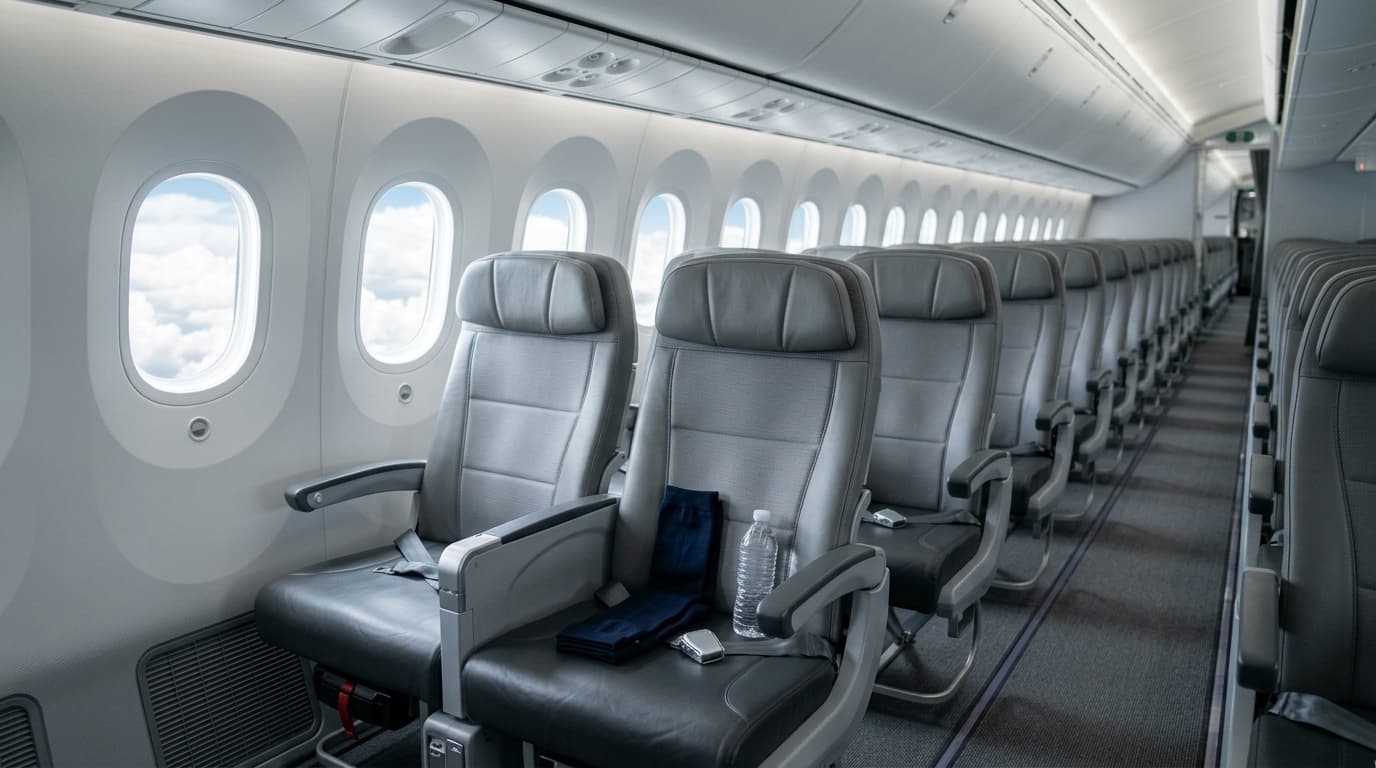
Almost every post-operative instruction sheet in aesthetic surgery covers lifting, driving, showering, sleeping position, and exercise. A surprising number say nothing at all about air travel, and the ones that do usually reduce it to a single line with a number in it. Wait two weeks. Wait ten days. Ask your surgeon.
That silence is strange, because flying is one of the few ordinary activities that changes the physical environment your healing body is sitting in. Driving to work does not lower the ambient pressure around your tissues. A commercial flight does. It also dries you out, immobilizes you in a seated position for hours, and, most consequentially, moves you several hundred or several thousand miles away from the only person who knows what your operation looked like from the inside.
Patients ask about this constantly, usually in the form of a scheduling question. They have a wedding, a work trip, a family obligation, or a return leg already booked. What they are actually asking is whether the airplane is dangerous. The honest answer is that the airplane is a modest, quantifiable risk multiplier, and the geography is the larger problem.
The cabin is not sea level, and that is the entire physiological argument
The short answer: federal regulation permits a commercial cabin to sit at a pressure equivalent to eight thousand feet of altitude, which lowers your blood oxygen saturation by several points and expands any trapped gas in your body by roughly a third.
Under the airworthiness standards in 14 CFR Part 25, a transport aircraft cabin may not exceed a pressure altitude of eight thousand feet at the airplane's maximum operating altitude in normal conditions. That is the ceiling, not a target, and newer composite airframes such as the 787 and A350 pressurize lower, closer to six thousand feet, because the fuselage tolerates the stress. But the planning assumption for any given flight should be the legal maximum.
Eight thousand feet is not Everest. It is Aspen. In a healthy adult it drops arterial oxygen saturation from the high nineties to somewhere around ninety to ninety three percent, with arterial oxygen tension falling to roughly sixty millimeters of mercury. Most people notice nothing. Someone who is anemic from operative blood loss, still clearing anesthetic agents, taking opioids that blunt respiratory drive, or carrying the untreated airway problem described in why sleep apnea belongs in every pre-operative consult is starting from a lower baseline, and the same drop lands differently.
The second physical effect is Boyle's law. Gas expands as pressure falls, and going from sea level to an eight thousand foot cabin expands a fixed volume of trapped gas by approximately thirty percent. This is why patients with recent intraocular gas, a pneumothorax, or air introduced into a body cavity get formal flight restrictions from other specialties. In aesthetic surgery it is mostly relevant as a caution rather than a common event, and it is worth naming what it does not apply to.
Breast implants do not expand on airplanes. Silicone gel and saline are liquids, and liquids are effectively incompressible at these pressures. The persistent internet story about implants rupturing or swelling at altitude has no mechanism behind it. What can happen with a saline device is that the small amount of residual air trapped during filling expands slightly and produces an audible sloshing or gurgling, which is harmless and unrelated to the shell integrity questions discussed in what long-term implant monitoring actually requires and whether saline or silicone is the better trade. Tissue expanders are the exception worth flagging, because many contain a metal or magnetic injection port, but that is a screening and imaging issue rather than a pressure one.
"The airplane will not rupture your implants. It will dehydrate you, hold you still for five hours, and put you three time zones away from the person who would have to take you back to the operating room.
"
The third effect gets the least attention and produces the most complaints. Cabin humidity typically runs under twenty percent and frequently near ten, which is drier than most deserts. Combined with the diuretic effect of alcohol or caffeine on board and the general reluctance to drink water when the aisle seat is occupied, passengers routinely land mildly dehydrated. On a body that is already retaining fluid unevenly through the post-operative swelling timeline, that produces the phenomenon patients describe as looking worse after landing than they did before boarding. It is real, it is usually transient, and it is the same mechanism that makes the under-eye fullness described in malar mounds and festoons visibly worse the morning after a flight.
The same pressure physics produces one genuinely injurious problem, and it is specific to the nose. Flying with a recently operated nose is uncomfortable and occasionally damaging, because the pressure changes on climb and descent require a functioning Eustachian tube and a swollen nasal airway does not provide one.
Middle ear pressure equalizes through the Eustachian tube, which opens into the back of the nose. On descent, ambient pressure rises faster than the middle ear can equalize passively, and the usual remedies are swallowing, yawning, or a gentle Valsalva maneuver. After rhinoplasty, septoplasty, or the airway work described in functional rhinoplasty and what it corrects, the nasal mucosa is edematous, there may be internal splints or packing in place, and the tube's opening is obstructed by the same swelling that has you mouth-breathing at night. Equalization fails, negative middle ear pressure builds, and the result is barotitis: pain, muffled hearing, and in more significant cases middle ear effusion or a tympanic membrane injury.
There is a second problem specific to nasal surgery. A forceful Valsalva is exactly the pressure spike that surgeons ask patients to avoid in the early weeks, alongside nose blowing, and instructing someone to equalize hard on descent conflicts directly with instructions meant to protect the repair. The refinement work in preservation rhinoplasty is measured in millimeters, and while a single flight is unlikely to undo it, the entire point of the early restrictions is not testing that assumption.
The same congestion logic applies after a deep peel, extensive facial resurfacing, or any procedure that leaves the sinuses inflamed. Sinus barotrauma on descent with blocked ostia produces facial pain that patients reliably misinterpret as a surgical complication.
The clot risk is the one with an actual number attached
The short answer: surgery and long-haul flying are independent risk factors for venous thromboembolism, and combining them within the same few weeks stacks two multipliers on the same underlying process.
This is the part of the conversation that has data. The WHO's WRIGHT project, published in 2007, examined travel-related thrombosis and found that flights of four hours or more approximately doubled the risk of venous thromboembolism relative to non-travel periods, with the elevated risk persisting for a period of weeks after landing rather than resolving at the gate. In otherwise healthy travelers the absolute risk remains low, on the order of one symptomatic event per several thousand long flights, which is why the finding rarely changes anyone's travel plans.
Surgery changes the arithmetic. An operation activates the clotting system deliberately, and the Caprini risk assessment model that most plastic surgery practices use counts major surgery lasting more than forty five minutes, and any surgery within the preceding month, as scoring factors in their own right. The full picture of how that assessment works, who gets chemical prophylaxis, and why mechanical prevention is nearly universal is laid out in the clot risk that belongs in every consult. What matters here is that a four hour flight taken two weeks after a body contouring case is not the same event as a four hour flight taken by the same person in an ordinary month. Immobility, dehydration, and a surgically primed coagulation cascade are three separate contributions to the same outcome.
The practical mitigations are unglamorous and mostly work:
- Walk the aisle. Every hour if the seatbelt sign allows it, and calf pumps and ankle circles in the seat when it does not.
- Drink water aggressively and skip the alcohol, which is a bad idea after surgery for several other reasons.
- Wear graduated compression stockings, which are a different garment from the post-operative compression discussed in what the compression garment evidence actually shows and are specifically designed for this.
- Book the aisle seat. The window seat is associated with higher travel thrombosis risk for the obvious reason that people in it move less.
- Ask whether your prophylaxis plan should extend through the travel window, which is a conversation to have before the operation, not at the airport.
How long you should actually wait, and why nobody agrees
The short answer: there is no binding standard, the commonly quoted intervals range from a few days to six weeks depending on the procedure, and the variability reflects genuine uncertainty rather than surgeons being arbitrary.
The Aerospace Medical Association publishes medical guidelines for air travel that address post-surgical passengers, and airlines maintain their own medical clearance processes, typically through the IATA medical information form that a treating physician completes when a passenger's fitness to fly is in question. Neither produces a cosmetic-surgery-specific rule. What exists in practice is a set of conventions that most surgeons converge on, with real disagreement at the edges:
- Injectables and non-surgical treatments: essentially no restriction, though most injectors prefer you not fly the same day, mostly so that swelling and any early asymmetry can be assessed in person rather than over text.
- Minor facial procedures and small local-anesthetic cases: commonly a few days, contingent on the wound being closed and dry.
- Facelift, neck lift, blepharoplasty, brow lift: commonly one to two weeks, driven far more by the hematoma window than by anything the cabin does.
- Breast augmentation, mastopexy, gynecomastia surgery: commonly one to two weeks, with the overhead-bin problem discussed below as a live constraint.
- Abdominoplasty, liposuction, and combined body contouring: commonly two to four weeks, and longer for the extended cases described in how body contouring gets sequenced or a full mommy makeover.
- Long combined procedures and any case with a raised Caprini score: four to six weeks is not an unusual instruction, and it is a clot decision rather than a wound decision.
Two things are worth understanding about this list. First, these numbers are conventions rather than evidence. There is no randomized trial of flight timing after abdominoplasty and there is never going to be one, so the intervals come from physiology, from complication timing curves, and from accumulated practice experience. Second, the number your surgeon gives you should be specific to your operation, not copied from a list, and the reasoning should be available on request. A surgeon who says four weeks because of your combined case length and your history is telling you something. A surgeon who says two weeks for everything is reciting.
There is also a practical layer nobody mentions until it bites. After breast, chest, or abdominal surgery you cannot lift a bag into an overhead bin, and the lifting restrictions in the return-to-activity timeline apply in an airport exactly as they do in a gym. That means checked luggage, an escort, or a willingness to ask a stranger. Patients underestimate this constantly, then tear something reaching for a roller bag at row 14.
What airport security actually detects, and what it does not
The short answer: breast, facial, and body implants are not metallic and do not trigger walk-through metal detectors, but body scanners image the surface of your body and will flag dressings, drains, and compression garments.
The walk-through metal detector question comes up constantly and has a clean answer. Silicone elastomer, silicone gel, and saline are not metal. Neither are the solid facial devices in what a bone-level facial implant does or the body devices in calf and pectoral augmentation. They will not set off a metal detector, and the story about an implant triggering airport security is a myth in almost every case. The exceptions are genuinely metallic hardware: plates and screws from facial skeletal work of the sort used in orthognathic surgery, and tissue expanders with metal ports.
Millimeter-wave advanced imaging technology is a different machine and works differently. It images anomalies on the body surface rather than detecting metal, which means a post-operative binder, an abdominal compression garment, a surgical drain, a bulky dressing, or a nasal splint may generate an alarm and a targeted pat-down of that area. This is a nuisance rather than a hazard, and it is manageable:
- Use the TSA notification card or simply tell the officer, before screening starts, that you have had recent surgery and where.
- Call TSA Cares in advance if you need assistance or want to arrange a private screening rather than a pat-down in the open checkpoint.
- Ask for a private screening if a pat-down would involve an operated area. You are entitled to request one.
- Carry medications in labeled containers, and note that medically necessary liquids are exempt from the standard carry-on liquid limits when declared at the checkpoint.
- Bring your implant card and operative note if you have breast or body devices, which is useful for other reasons anyway when checking the complaint record described in how to read the FDA device database.
The real risk is not the airplane, it is the distance
The short answer: the complications that matter most in aesthetic surgery cluster in the first seventy two hours, and boarding a plane inside that window trades a treatable emergency for an untreatable geography problem.
Post-facelift hematoma is the clearest example. It occurs in roughly one to three percent of cases overall, notably higher in men, and the overwhelming majority declare themselves within the first twenty four hours, with nearly all of the rest inside forty eight to seventy two. An expanding hematoma is a time-sensitive problem with a straightforward solution when the surgeon who performed the operation can evacuate it. The same event at cruising altitude, or in a hotel in another city, becomes an emergency room visit with a physician who did not do the surgery, does not know the plane of dissection, and will reasonably be conservative. The gap between those two scenarios is not a small quality-of-outcome difference.
The same reasoning applies to early infection, wound dehiscence, an expanding seroma, or the sudden shortness of breath that has to be assumed to be a pulmonary embolism until proven otherwise. Everything on that list has a good answer if you are within driving distance of your surgeon and an accredited facility of the sort discussed in what facility accreditation certifies. Everything on it gets meaningfully worse when the answer is a stranger.
This is the structural problem underneath surgical tourism, examined at length in what an operation abroad actually costs. The itinerary that makes the price attractive is the one that puts the flight home inside the complication window, and the patient absorbs a risk that never appears on the quote. It also drives a large share of the redo work described in the revision consult economy, because a complication managed by someone else, at distance, under time pressure, frequently produces a result that needs correcting later.
One more item belongs on the ledger. Standard travel insurance policies exclude elective cosmetic surgery and, critically, complications arising from it. A patient who assumes their trip insurance will cover an emergency abroad after a cosmetic procedure is usually wrong, and discovering that at the point of need is expensive. Specialist cosmetic surgery travel cover exists and has to be bought deliberately. Price it into the total the way you would price everything else in what a cosmetic surgery quote actually covers.
The honest summary
Flying after cosmetic surgery is not dangerous in the way patients usually fear it is. The cabin is not going to rupture your implants, the altitude is not going to open your incisions, and healthy people tolerate an eight thousand foot equivalent without noticing. The two physiological effects worth taking seriously are modest and manageable: mild hypoxia in someone who is already compromised by blood loss, sedating medication, or an untreated airway problem, and a clot risk that is genuinely multiplied when a long flight and a recent operation land in the same few weeks.
The waiting intervals your surgeon gives you are conventions rather than evidence, and that is worth knowing rather than worrying about. There is no trial establishing that fourteen days is correct and eleven is not. What the intervals encode is the timing of the complications that matter for your specific operation, which is why the number should come with a reason attached and why an interval quoted identically for every procedure is not a real answer.
The part that deserves more weight than it gets is the geography. Every serious early complication in aesthetic surgery has a good outcome when the operating surgeon can put hands on the problem quickly, and a worse one when they cannot. Boarding a flight on day three does not create the hematoma. It removes the person who would have fixed it in twenty minutes. If your itinerary and your recovery window are in conflict, the itinerary is the thing that should move, and it is a great deal cheaper to move it before the operation than to discover the conflict from a hotel bathroom at two in the morning.
Book the recovery, then book the flight. Not the other way around.