Industry · August 14, 2026
Malignant Hyperthermia: The Rare Emergency That Decides What Is in the Cabinet Down the Hall
It is a pharmacogenetic reaction to two classes of anesthetic drug, it kills by consuming a body faster than it can cool or breathe, and the entire treatment is one medication that has to already be in the building. Most office-based cosmetic surgery now runs on anesthesia that cannot trigger it, which is the strongest safety argument the setting has. The complication is that the rescue drug most offices keep for a blocked airway is also the second trigger. Here is what malignant hyperthermia actually is, why the first sign shows up on a monitor rather than a thermometer, and the single stocking question that separates a prepared facility from a hopeful one.
By The Editorial Desk
12 min read
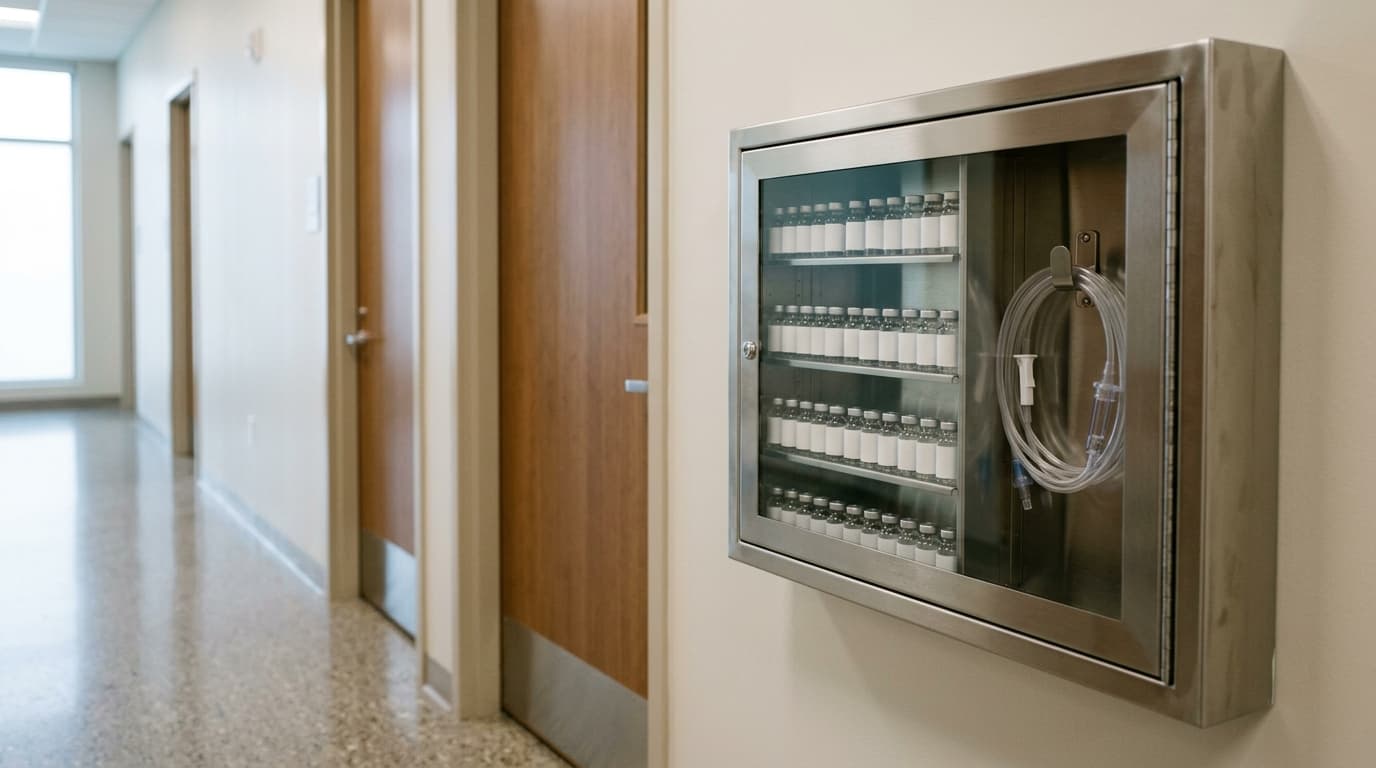
Malignant hyperthermia is the rarest thing on any cosmetic surgery consent form that can still kill a healthy patient in under an hour. It is not an allergy, not an infection, and not a reaction to the surgery itself. It is an inherited defect in the way skeletal muscle handles calcium, and it stays completely silent for a lifetime until a specific class of anesthetic drug reaches the muscle and switches it on.
Patients almost never ask about it, which is reasonable. The published incidence sits somewhere between roughly one in ten thousand and one in two hundred fifty thousand anesthetics depending on the population studied and the definition used, and most people will never meet anyone it has happened to. Reciting a list of rare catastrophes at a consultation is not a useful way to choose a surgeon.
The reason it belongs in this publication is different, and it has nothing to do with your odds. Malignant hyperthermia is the one emergency where survival depends almost entirely on a purchasing decision made months earlier by whoever runs the building. There is exactly one drug that treats it. Either it is in the room and can be given within minutes, or it is not and the outcome is decided by driving time. That makes it the cleanest available test of whether a facility is equipped for the worst thing that can happen in it, which is a question that generalizes well past this one diagnosis.
What malignant hyperthermia actually is, and why calling it a fever gets it backwards
The short answer: it is a hypermetabolic crisis in skeletal muscle, in which a genetically abnormal calcium channel floods muscle cells with calcium and locks them into sustained contraction, and the temperature rise is a byproduct of that runaway metabolism rather than the disease itself.
The machinery is worth understanding because it explains why the treatment works and why cooling alone does not. Inside skeletal muscle, calcium is stored in the sarcoplasmic reticulum and released through a channel called the ryanodine receptor. In susceptible people, that channel carries a variant that makes it open too easily and close too poorly. Most identified cases involve the RYR1 gene, with a small minority attributed to CACNA1S. Inheritance is autosomal dominant with variable penetrance, which means it runs in families and skips people unpredictably.
When a triggering drug arrives, the channel dumps calcium into the muscle cell and will not stop. The muscle contracts continuously. Sustained contraction burns adenosine triphosphate at an enormous rate, and burning it produces carbon dioxide, lactic acid, and heat. The patient develops a mixed respiratory and metabolic acidosis, potassium pours out of damaged muscle into the bloodstream, muscle cells break down and release myoglobin, and body temperature climbs. In fulminant cases the temperature can rise a degree or two Celsius every few minutes, which is why the classic descriptions include a patient who feels hot to the touch through surgical drapes.
The downstream events are what actually kill. Hyperkalemia causes cardiac arrhythmia and arrest. Rhabdomyolysis causes acute kidney injury. Extreme hyperthermia causes disseminated intravascular coagulation and neurologic injury. Treating the temperature without stopping the calcium release is treating an exhaust pipe.
One historical number frames the stakes better than any other. Before dantrolene became clinically available at the end of the 1970s, mortality from a fulminant episode was commonly cited at around seventy to eighty percent. With prompt recognition and treatment it is now generally reported below five percent. Almost the entire difference is one drug, given fast.
"Every other surgical emergency is a contest between the problem and the surgical team. This one is a contest between the problem and a cabinet that was either stocked two years ago or was not.
"
The other fact that matters clinically, and that patients get wrong constantly: a history of uneventful anesthesia does not rule susceptibility out. Many people who have an episode have been under anesthesia before without incident, sometimes several times. The trigger exposure has to be sufficient, and penetrance is inconsistent. "I have had surgery before and was fine" is reassuring in the way that not having been in a car accident is reassuring.
The trigger list is short, and the whole office-based argument turns on one drug
The short answer: only two categories of drug trigger it, the potent inhaled volatile anesthetics and the depolarizing muscle relaxant succinylcholine, and most office-based cosmetic surgery avoids the first category entirely while keeping the second on the shelf for airway emergencies.
The triggering agents are a closed list. Volatile inhalational anesthetics: sevoflurane, desflurane, isoflurane, and the older halothane and enflurane. Plus succinylcholine, the fast-acting depolarizing paralytic used mainly to secure an airway quickly.
Everything else in routine use is non-triggering. Propofol does not trigger it. Ketamine, benzodiazepines, opioids, nitrous oxide, and the non-depolarizing muscle relaxants do not trigger it. Local anesthetics do not trigger it either, and that is worth stating plainly because an older generation of teaching held that amide local anesthetics were unsafe in susceptible patients. That belief was wrong and has been formally abandoned. A patient known to be susceptible can have lidocaine and bupivacaine without concern.
That list produces a genuinely strong safety argument for the way most aesthetic surgery is now anesthetized. Total intravenous anesthesia, built on propofol with an opioid, contains no trigger at all. Sedation cases and local cases contain no trigger. If a facility owns no vaporizers and no volatile agent, the risk of vapor-triggered malignant hyperthermia in that building is not low, it is structurally absent. The related tradeoffs of sedation depth and provider choice are covered in how anesthesia choice shapes the operative plan, and the specific case for staying awake is covered in what the awake liposuction evidence actually shows.
Then there is succinylcholine, and this is where the clean argument gets complicated.
Succinylcholine is the drug you reach for when an airway closes. Laryngospasm during sedation, an unexpected loss of airway, a difficult intubation that has to happen now: succinylcholine works in under a minute and wears off in minutes, and no other agent substitutes for it in that situation. Which means enormous numbers of offices that never open a bottle of sevoflurane still keep succinylcholine in the emergency drawer, exactly as they should. That is good practice. It also means the building contains a malignant hyperthermia trigger.
The Malignant Hyperthermia Association of the United States, the body that maintains the treatment protocols and the emergency hotline, addresses this directly, and its position is not ambiguous: a facility that stocks succinylcholine, even solely for rescue, should stock a full supply of dantrolene. The counterargument heard in practice is that rescue-dose succinylcholine given once is a small exposure and that a transfer agreement covers the remainder. That argument is a cost argument wearing clinical clothing. The exposure is sufficient to trigger an episode in a susceptible patient, and an episode triggered in an office without dantrolene is an episode being managed by ambulance.
This is the same structural pattern as the one described in the operating room fire nobody consents you for: a low-frequency, high-consequence event whose prevention lives entirely in facility preparation rather than in surgical skill.
The first sign is on a monitor, not a thermometer
The short answer: the earliest reliable indicator is an unexplained and climbing end-tidal carbon dioxide reading, and temperature is frequently a late sign, which means the diagnosis depends on capnography being in use and being watched.
The clinical sequence, roughly in the order it tends to appear:
- Rising end-tidal carbon dioxide that does not respond to increased ventilation. This is the single most sensitive early sign. The muscle is producing carbon dioxide faster than the lungs can clear it.
- Unexplained tachycardia, and tachypnea in a spontaneously breathing patient. Often written off initially as light anesthesia or pain.
- Masseter muscle rigidity after succinylcholine. A jaw that will not open after the drug that should have relaxed it is a recognized warning sign.
- Generalized muscle rigidity. Highly specific when present, but not present in every case.
- Mixed acidosis and rising serum potassium, with arrhythmias following.
- Temperature elevation, which can be dramatic and rapid but often arrives after the metabolic signs.
- Dark or cola-colored urine from myoglobin, usually later, signaling muscle breakdown.
The name is the problem. "Malignant hyperthermia" trains everyone to wait for a temperature, and waiting for the temperature is how the treatment gets delayed. Published analyses have repeatedly found that time to dantrolene is the dominant determinant of complications and death, with risk climbing substantially for each additional half hour of delay.
That has an equipment consequence which is specific to the office setting. Continuous monitoring of exhaled carbon dioxide is a standard of care for general anesthesia and, under the American Society of Anesthesiologists monitoring standards updated in 2011, for moderate and deep sedation as well unless the situation genuinely precludes it. A room performing sedation without capnography is a room that has removed the earliest signal for this diagnosis, along with the earliest signal for several more common problems. This sits alongside the equipment and staffing questions raised in what facility accreditation actually certifies, and it is one of the reasons the accreditation seal is a floor rather than a finish line.
Dantrolene is the entire treatment, and stocking it is an accounting decision
The short answer: dantrolene blocks the calcium release at its source, nothing else does, and the reason its availability varies between facilities is that a full stock costs real money, expires, and gets replaced without ever being used.
Dantrolene works directly on the ryanodine receptor to stop the calcium flood. Once the calcium release is interrupted, the metabolic cascade stops. The protocol is to discontinue triggers immediately, deliver one hundred percent oxygen at high flow, give dantrolene at 2.5 milligrams per kilogram intravenously and repeat until the episode breaks, treat the hyperkalemia and acidosis, cool the patient toward normal temperature and then stop to avoid overshooting, and manage arrhythmias while avoiding calcium channel blockers, which interact badly with dantrolene. MHAUS operates a 24-hour hotline for exactly this situation. Patients are then observed in an intensive care setting, because a meaningful minority of episodes recrudesce within the first day.
The stocking problem is a pharmacy and finance problem. The original formulation of dantrolene comes in twenty milligram vials, each of which has to be reconstituted with sixty milliliters of sterile water and shaken until it dissolves, which it does slowly. The recommended stock for a facility using triggering agents is thirty six vials. Reconstituting thirty six vials in an emergency is a genuine staffing task, and the standard advice is that it requires dedicated people doing nothing else while the crisis is managed.
A newer nanosuspension formulation approved in 2014 changed that arithmetic. It comes as two hundred fifty milligrams per vial, reconstitutes in five milliliters of sterile water, and mixes in seconds, so a typical stock is three vials rather than thirty six. It costs substantially more per unit. For a facility that will almost certainly never use it, the cheaper option is thirty six vials of powder that will expire quietly on a shelf, the better option is the fast formulation that will expire equally quietly at higher cost, and the cheapest option of all is to decide the building does not need any.
That last decision is the one worth asking about, and it is invisible from the waiting room. It is part of the same category of unseen fixed cost described in what a plastic surgery quote actually covers: the accredited surgical facility's price includes a crash cart with in-date drugs and an emergency kit that nobody wants to pay for, and the discount facility's price often does not.
What can be known before the day, and what cannot
The short answer: there is no routine screening test, the history questions are narrow and specific, and confirming susceptibility requires either a muscle biopsy at one of a handful of centers or genetic testing that cannot rule it out when negative.
No blood test at a pre-op visit will tell you whether you are susceptible. What the pre-anesthetic interview can do is ask the questions that actually correlate:
- Has any blood relative died or nearly died under anesthesia, or had an unexplained crisis during surgery? This is the highest-yield question on the list, and it is asked poorly and answered vaguely constantly, because the family story usually survives as "an aunt had a bad reaction."
- Have you or a relative had an unexplained high fever, rigidity, or dark urine after an operation?
- Do you have a known muscle disorder? Several are associated, including central core disease, multiminicore disease, King-Denborough syndrome, and other RYR1-related myopathies.
- Have you had exertional or heat-related rhabdomyolysis? The relationship to malignant hyperthermia susceptibility is real, though not equivalent.
Confirmatory testing exists and is unpleasant. The caffeine halothane contracture test remains the reference standard in North America, requires a fresh open muscle biopsy, and is performed at only a small number of centers. Genetic testing can confirm susceptibility when a known causative variant is found, but a negative result does not exclude it, because a substantial share of susceptible individuals carry no identified variant. That asymmetry is the practical point: a positive test settles the question, a negative one does not.
The good news for anyone who does carry the diagnosis is that it is not a barrier to elective surgery. A known susceptible patient can be anesthetized safely with a non-triggering technique. If an anesthesia machine that has been exposed to volatile agent is used, it is prepared by flushing with high fresh gas flow, removing or disabling the vaporizers, and replacing the circuit and absorbent, or more commonly now by fitting activated charcoal filters that scrub residual vapor to negligible concentrations within a couple of minutes. The operation proceeds. What changes is where it should be done, and susceptibility is a reasonable argument for choosing a hospital or a fully equipped accredited center over a lightly equipped office, in the same way that untreated obstructive sleep apnea shifts the setting decision in the snoring question.
The disclosure obligation runs in both directions. Patients withhold or forget family anesthetic history at a remarkable rate, which is the same pattern documented in the pre-op question patients lie about and in the supplement histories described in the stop list before surgery. This one is not a judgment question. Nobody is going to disapprove of your aunt.
The honest summary
Your personal risk of malignant hyperthermia is very small, and it should not be the reason you choose one surgeon over another. Nothing in this article argues that office-based cosmetic surgery is unsafe. The opposite is closer to true: the shift to propofol-based intravenous anesthesia and local techniques has removed the primary trigger from most aesthetic operating rooms, and that is a real and underappreciated safety gain.
What the diagnosis is good for is diagnostic in a different sense. It is the cleanest single question available for finding out whether a facility has thought seriously about the emergency it will probably never have. Succinylcholine is in nearly every building, because airways close and it is the drug that opens them. The organization that writes the protocols says that if succinylcholine is in the building, dantrolene should be too. A facility that stocks it has paid for something it expects to throw away expired, which tells you how it approaches every other line item it could have skipped. A facility that does not has decided that the plan for a metabolic crisis measured in minutes is a hospital measured in miles.
Ask the stocking question once. Ask who admits and treats you if you leave the building in an ambulance, which is the same question that closes the hospital privileges argument. Then stop thinking about malignant hyperthermia, because you will have learned everything it has to teach you about the place you are about to be sedated in, and the odds it ever touches you personally are very long indeed.