Procedure Deep-Dive · September 17, 2026
The 'Non-Surgical BBL': What Biostimulator and Filler Injections Into the Buttocks Actually Do, Why the Volume Arithmetic Almost Never Works, and What FDA Has Specifically Warned About
A category of injectable buttock treatment has grown up alongside surgical fat transfer, sold under names that borrow the Brazilian butt lift's vocabulary while promising to skip its operating room, its cannulas, and its mortality statistics. The products involved are real and one of them is approved for something. The gap between what it is approved for, what a vial of it physically contains, and what the before-and-after photos imply is where patients lose money and occasionally lose a great deal more.
By The Editorial Desk
12 min read
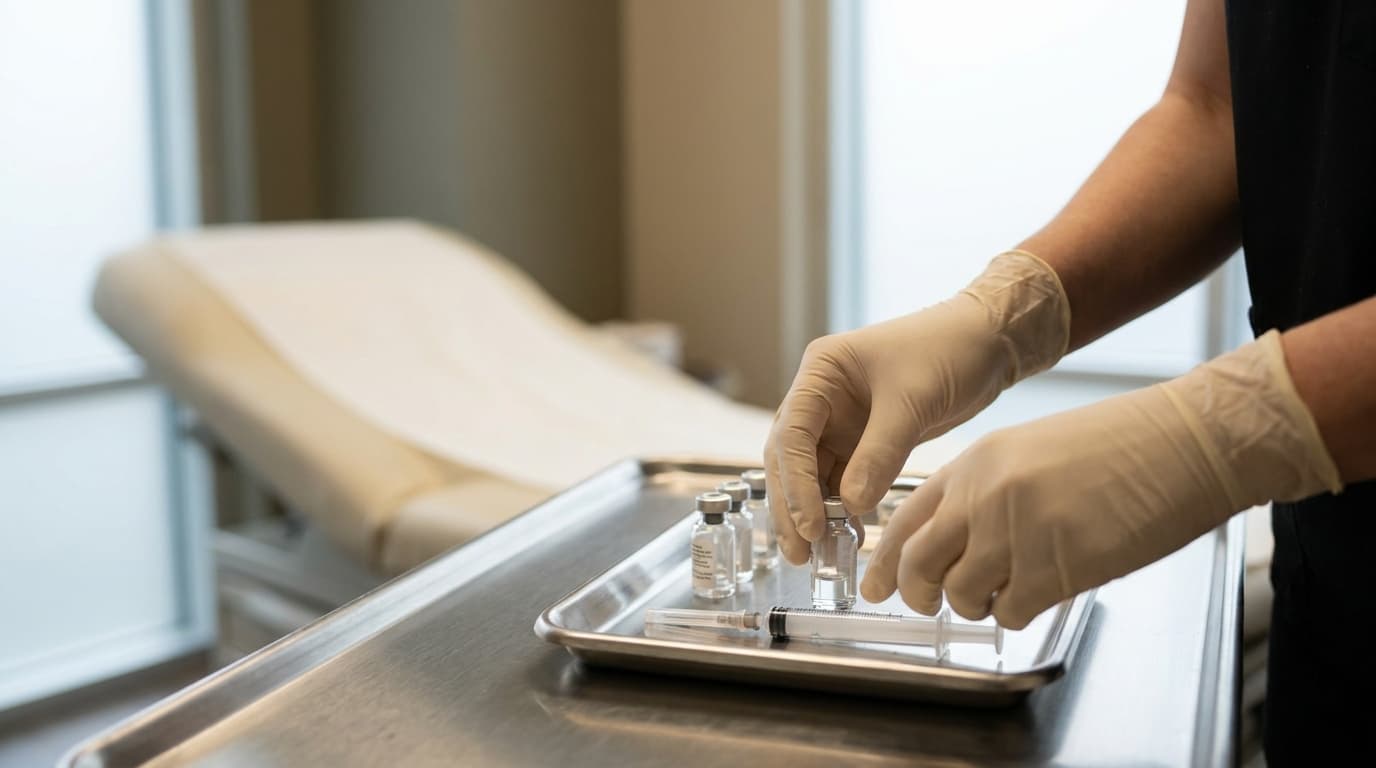
The Brazilian butt lift has a well-documented safety problem, a well-documented recovery, and a well-documented price, and every one of those three facts creates a market for something that sounds like it but is not it. That something is usually advertised as a non-surgical BBL, sometimes as a Sculptra butt lift, sometimes as a liquid BBL, and the pitch is consistent across all of the names: the same shape, delivered through a needle in an office visit, with no anesthesia, no cannula near the gluteal veins, and no week of sleeping face down. Patients arrive at consultations having seen the phrase so many times that they assume it describes an established procedure with an established evidence base.
It does not. It describes the off-label or partially approved use of several different injectable products, with genuinely different mechanisms and genuinely different risk profiles, grouped under a borrowed name because the borrowed name sells. Some of what gets injected in this category is a collagen-stimulating product with a real track record in the face. Some of it is a large-volume hyaluronic acid gel that has never been approved for this use in the United States. Some of it, at the bottom of the market, is not a medical product at all, a problem the piece on illegal silicone injections and biopolymers covers in its own right. Sorting out which is which, and what each one can physically accomplish, is the entire job of this article.
What is actually in the syringe, and why "non-surgical BBL" is a marketing category rather than a procedure
The short answer: there is no single non-surgical BBL, there are at least three distinct product categories sold under that label, and the most common one in a legitimate United States practice is a collagen-stimulating biostimulator, most often poly-L-lactic acid or calcium hydroxylapatite, which does not add meaningful volume on the day it is injected and works instead by provoking the body to lay down new collagen over subsequent months.
Poly-L-lactic acid, sold as Sculptra, is a suspension of tiny polymer particles that the body gradually breaks down while mounting a low-grade healing response that produces new collagen in the treated plane. It is not a filler in the everyday sense. What a patient sees in the mirror an hour after a session is mostly the sterile water used to reconstitute the product, and that apparent volume is gone within a few days, which is why experienced injectors spend a meaningful part of the consultation managing the expectation that the treatment appears to fail in week one. Calcium hydroxylapatite, sold as Radiesse, provides a small amount of immediate volume from its gel carrier and then works through a similar collagen-stimulating mechanism as the microspheres remain in place. The piece comparing biostimulatory fillers to hyaluronic acid works through the underlying difference between these mechanisms in detail, and the piece on the Sculptra collagen-building timeline covers how slowly that process actually delivers. The distinction matters more in the buttock than almost anywhere else on the body, because the buttock is the site where patients most often expect immediate, visible, large-scale volume change.
The second category is large-volume hyaluronic acid gel, formulated at a much higher cross-linking density and sold in much larger syringes than anything used in the face. Products in this class exist and are CE-marked in Europe. None of them carry Food and Drug Administration approval for buttock augmentation in the United States. An earlier product in this general class, Macrolane, was withdrawn by its manufacturer from breast augmentation use in 2012 after concerns that it interfered with the reading of mammograms, a cautionary detail worth remembering whenever an injectable is proposed for large-volume placement in a body region that also gets imaged. The third category, the one that produces the worst outcomes in the literature and in emergency departments, is non-medical silicone or unidentified industrial material injected outside any clinical setting, and it is not a variant of this treatment so much as a separate public health problem.
The volume arithmetic that the before-and-after photos never show
The short answer: a surgical fat transfer typically moves several hundred milliliters of fat per side, while a single vial of a biostimulator reconstitutes to something on the order of five to ten milliliters, which means matching the volume of even a conservative fat transfer would require dozens of vials per side at a cost exceeding the surgery it is supposed to replace, and no reputable practice is actually doing that.
This is the single most useful thing a patient can understand about the category, and it is arithmetic rather than opinion. The piece on buttock implants versus fat grafting describes the volumes involved in surgical augmentation, and the piece on fat graft survival biology explains why surgeons overfill to account for the portion of transferred fat that never establishes a blood supply and is reabsorbed. Those volumes are measured in hundreds of milliliters. A biostimulator session is measured in single-digit or low-double-digit milliliters of reconstituted product, and the volume that eventually appears is not the injected volume at all. It is whatever new collagen the body produces in response, which is a fraction of the injected volume rather than a multiple of it.
What this means practically is that a realistic biostimulator result in the buttock is a modest improvement in skin quality, firmness, and surface contour, plus a small amount of added projection that accumulates over three to six months and several sessions. It is not a size change. A patient who wants to go up a clothing size is in the wrong conversation, and an injector who allows that patient to believe otherwise is either not doing the arithmetic or not sharing it. The honest version of the pitch is closer to what the piece on hip dips and fat grafting describes for a narrow contour irregularity than to anything that has earned the letters BBL.
"A fat transfer is measured in hundreds of milliliters per side. A biostimulator session is measured in single digits, and what eventually shows up is not the injected volume but a fraction of it in new collagen. That is not a smaller version of the same procedure. It is a different procedure wearing its name.
"
What FDA has actually approved here, and what it has specifically warned against
The short answer: calcium hydroxylapatite carries a 2021 FDA approval for improving the appearance of cellulite in the buttocks, which is a skin and dimpling indication rather than an augmentation indication, poly-L-lactic acid is approved for facial indications and its buttock use is off-label, and FDA has issued a standing safety communication warning specifically against injecting fillers or silicone for large-scale body contouring including buttock enhancement.
Those three facts get blurred together constantly in advertising, and the blurring is usually deliberate. An approval for the appearance of cellulite in the buttocks is a real approval, and a clinic offering that treatment for that purpose is on solid ground. It is not an approval for augmentation, projection, or size, and a clinic that cites the approval while selling a shape change is citing a document that does not say what the patient is being told it says. Off-label use of an approved drug or device is legal and is a normal part of medical practice across every specialty, so the fact that buttock poly-L-lactic acid is off-label does not by itself make it improper. What it does mean is that no regulatory body has reviewed safety or efficacy data for that specific product at that specific site in that specific volume, and the patient is entitled to be told that plainly rather than discovering it later.
The safety communication is the part patients have most often never heard. FDA has warned against the use of injectable silicone and dermal fillers for body contouring and enhancement in large volumes, including in the buttocks, citing risks that include product migration, granuloma formation, infection, and embolization. That warning is aimed most sharply at the unapproved large-volume gel and non-medical silicone end of the market, and it is the regulatory backdrop against which any large-volume buttock injection proposal should be read. Patients who want to check a product's complaint history themselves can use the approach described in the piece on the FDA MAUDE database, which applies to injectables as readily as to implants. The same instinct that makes a patient ask what a product is approved for should make her ask what has been reported about it, and both answers are public.
Why the risk profile is not the same as a facial filler appointment
The short answer: the gluteal region contains large deep veins that are the anatomical reason surgical fat transfer developed its mortality problem, and while subcutaneous biostimulator injection is a considerably lower-risk act than deep large-volume fat placement, the site-specific risks of nodules, granulomas, product migration, and infection are all meaningfully higher in the buttock than in the face, and none of these products can be dissolved if the result goes wrong.
The piece on Brazilian butt lift safety protocols explains why the superior and inferior gluteal veins made the surgical version of this procedure the most dangerous elective cosmetic operation in modern practice, and why the safety consensus that emerged insists on subcutaneous placement only, above the muscle, with ultrasound guidance in many practices. An injectable treatment placed correctly in the subcutaneous plane is not carrying that same degree of embolic risk, and it would be alarmist to suggest otherwise. An injectable treatment placed by someone who does not know where that plane ends is a different matter, and the depth discipline that makes the surgical version survivable is the same depth discipline that matters here. The piece on filler vascular occlusion risk covers the general mechanism by which injected material enters a vessel, and the general mechanism does not stop applying below the waist.
The more common problems are the site-specific ones. Nodules are the best-documented complication of poly-L-lactic acid, they are more likely when the product is under-diluted, inadequately massaged, or placed too superficially, and the buttock's larger treatment area and larger product volumes give nodules more opportunity to occur than a small facial session does, a pattern the piece on delayed filler nodules covers in its general form. Migration under the influence of gravity and sitting pressure is a documented issue with large-volume gels in particular, and the piece on filler migration applies with more force here than in the face. Most importantly, the reversal option that makes hyaluronic acid facial filler comparatively forgiving does not exist for biostimulators. The piece on dissolving dermal filler explains that hyaluronidase breaks down hyaluronic acid and nothing else. Poly-L-lactic acid and calcium hydroxylapatite have no antidote, and a poor result waits out its own timeline, which for poly-L-lactic acid is commonly cited at roughly two years and for calcium hydroxylapatite somewhat less.
Who is actually a reasonable candidate, and what a realistic result looks like
The short answer: the reasonable candidate is someone with adequate existing shape who wants improvement in skin quality, dimpling, and minor surface irregularity rather than size, who has been quoted a realistic number of sessions and a realistic total cost, and who would not be better served either by doing nothing or by having an actual operation.
The best-supported use of this category is the one the regulatory approval actually describes: the appearance of cellulite and skin quality in the buttock, in a patient whose underlying shape is already close to what she wants. Improvement in skin firmness and surface smoothness over a series of sessions is a real, achievable outcome, and a patient who wants exactly that and is quoted honestly for it is getting something worth having. The piece on cellulite treatment and what the evidence shows puts that result in context alongside the other options for the same complaint, and the piece on non-surgical body contouring makes the broader point that this entire device and injectable category has matured into something genuinely useful at the margins and still useless as a substitute for surgery.
The candidate who is being poorly served is the one who came in wanting size, was told this was the non-surgical alternative, and will spend four sessions and a five-figure sum discovering that it was not. That patient's actual options are the ones covered in the piece on buttock implants versus fat grafting, including the option of deciding the surgical risk is unacceptable and choosing to do nothing, which is a legitimate outcome of a good consultation rather than a failure of one. There is also a real population of patients who simply do not have enough donor fat for a meaningful transfer and who go looking for an injectable because surgery was ruled out for them. That is a sympathetic position and it does not change the arithmetic. Being unable to have the procedure that produces size does not make a different procedure produce size.
Three practical cautions round out the candidate discussion. The first is who is holding the syringe: buttock injection volumes and depths are not a routine med spa skill set, and the piece on med spa supervision is directly relevant to a treatment where depth discipline is the safety mechanism. The second is the quote itself, since this category is almost always priced per vial or per session while the result is described per outcome, exactly the mismatch the piece on what a plastic surgery quote covers warns about. The third is the name. The piece on trademarked procedure names describes the broader pattern in which a proprietary or borrowed name substitutes for a description of what is actually being done, and "non-surgical BBL" is close to the purest example of it in current aesthetic marketing. Reading the accompanying photos with the skepticism described in the piece on how to read a before-and-after gallery will do more for a patient's decision than any amount of additional consultation time.
The honest summary
The non-surgical BBL is not a procedure. It is a marketing label attached to several unrelated injectable products with different mechanisms, different approval statuses, and different risks. The legitimate end of the category, biostimulator injection with poly-L-lactic acid or calcium hydroxylapatite, produces a real but modest improvement in skin quality, firmness, and dimpling over months and multiple sessions, and calcium hydroxylapatite carries an actual FDA approval for the appearance of cellulite in the buttocks that is worth knowing about and worth not overreading. Neither product produces a size change, and the volume arithmetic explaining why is simple enough that any patient can check it against the quote she is handed. Large-volume hyaluronic acid gel for buttock augmentation is not FDA-approved in the United States, FDA has issued a standing warning against injecting fillers and silicone for large-scale body contouring, and the non-medical silicone end of the market is a separate and considerably worse problem. Nothing in the biostimulator category can be dissolved, so a nodule or an uneven result is managed with steroid injection, time, or surgery rather than undone in an afternoon. A patient who wants smoother, firmer skin on a shape she already likes has a reasonable treatment available here, provided she is quoted honestly for the full course. A patient who wants to be bigger is being sold a name, and the most useful question she can ask at that consultation is how many milliliters are going in, and how that number compares to the hundreds that a fat transfer moves.