Industry · August 16, 2026
The Cold Sore Rule: The Virus Most Patients Carry and Most Consults Never Mention
Roughly half of American adults carry herpes simplex type 1, and most of them have never had a visible outbreak. On intact skin a cold sore is a nuisance that heals without a mark. On a face that has just been resurfaced, peeled, needled, or injected, the same reactivation spreads across an open wound and can scar permanently. Antiviral prophylaxis costs a few dollars, works only if it starts before the procedure, and is still handed out on the basis of a screening question that does not screen for anything.
By The Editorial Desk
11 min read
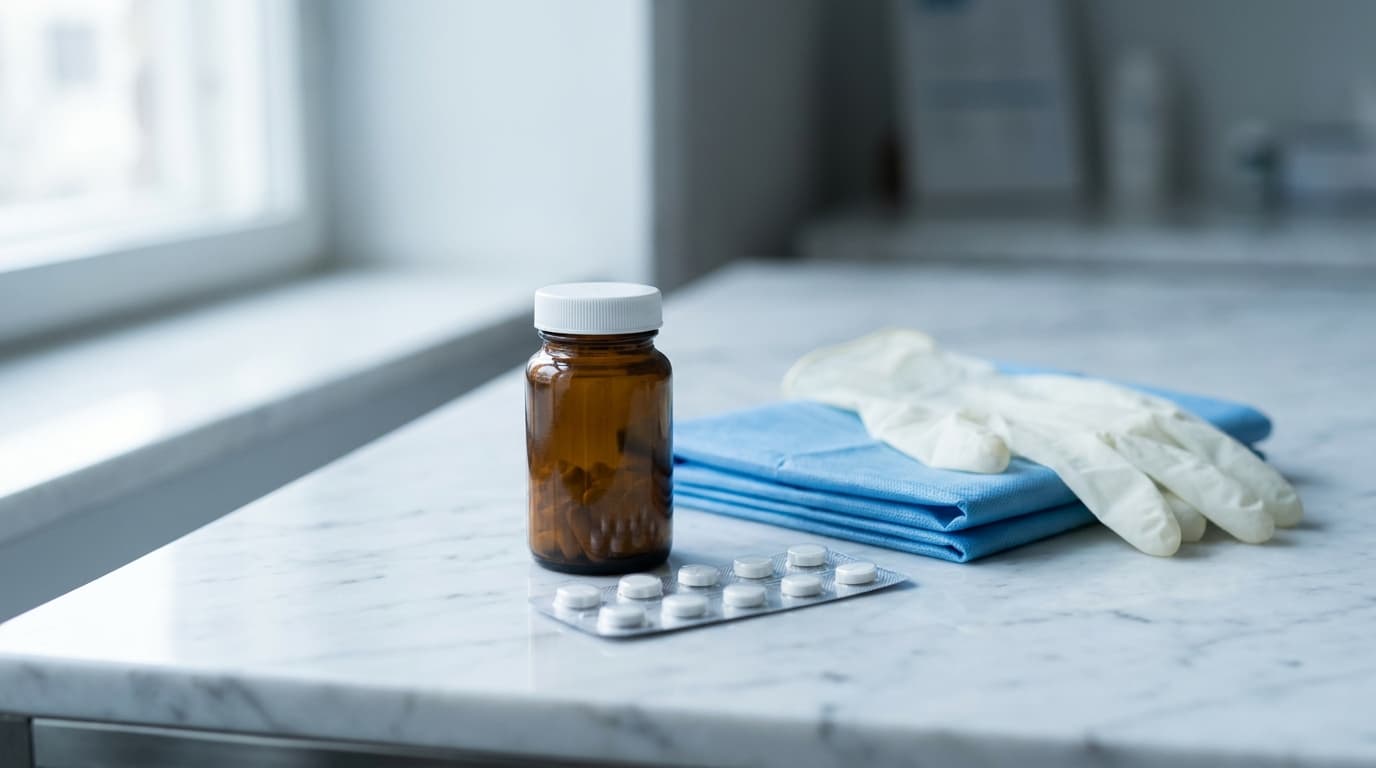
The question is always the same and it is always asked the same way, somewhere between the consent form and the numbing cream: "Do you get cold sores?"
Most patients say no. Most of them are wrong, and the ones who are wrong are not lying. They have simply never had a visible outbreak, which is the ordinary experience of carrying herpes simplex virus type 1. The screening question assumes a patient can report on a virus that spends decades doing nothing observable, and then it uses that answer to decide whether to prescribe a generic pill that costs almost nothing and prevents the single most avoidable scarring complication in facial aesthetics.
This is a small failure with an outsized consequence, and it belongs in the same category as the other quiet procedural habits that separate a careful practice from a busy one.
The virus is far more common than the history suggests
The short answer: national serologic surveys put HSV-1 in roughly half of American adults, a large share of them have no recollection of ever having a cold sore, and that makes patient history a poor tool for deciding who needs prophylaxis.
The CDC's NHANES serologic data has tracked HSV-1 prevalence for decades. In the 2015 to 2016 cycle, seroprevalence among Americans aged 14 to 49 sat just under 48 percent. It climbs steadily with age, so the population that actually presents for facial resurfacing and perioral injection carries it at meaningfully higher rates than that headline figure. Prevalence in younger cohorts has been falling for years, which produces a second-order problem: fewer people acquire HSV-1 in early childhood, so more adults reach the treatment chair with no immunity and no history.
The clinically important fact is what happens after infection. HSV-1 establishes latency in the trigeminal ganglion, the sensory relay for the entire face, and it reactivates by traveling back down the nerve branches to the skin. A large fraction of seropositive people never develop a recognizable recurrent lesion, and asymptomatic viral shedding occurs in people who have never had a symptomatic outbreak in their lives. Studies of oral shedding have repeatedly found detectable virus in saliva on a nontrivial percentage of days in seropositive adults, including the ones who would answer the screening question with a confident no.
So when a consult asks "do you get cold sores," it is not identifying carriers. It is identifying the subset of carriers whose reactivations happen to be visible enough to remember. Everyone else is sorted into the low-risk column by a question that never had the resolution to sort them.
The recognized reactivation triggers make the relevance obvious. Ultraviolet exposure. Fever and systemic illness. Physical trauma to the affected dermatome. Stress. Immunosuppression. A perioral aesthetic procedure is a controlled application of thermal or mechanical trauma to the exact skin the virus reactivates into.
Which procedures actually carry the risk, and in what order
The short answer: risk scales with how much epidermis is removed and how close the treatment sits to the perioral region, so full-face ablative resurfacing and deep peels sit at the top, fractional and medium-depth treatments in the middle, and lip injection at a lower but genuinely documented level.
The ranking is worth stating plainly, because patients are frequently told that only lasers matter.
Full-field ablative resurfacing and deep chemical peels. Fully ablative carbon dioxide and erbium resurfacing, dermabrasion, and phenol-croton oil peels remove the epidermis across a continuous field. Historical series performed without prophylaxis reported reactivation in a substantial minority of patients with a positive history, with figures ranging widely across small studies and older technique. Universal prophylaxis has been standard in this category long enough that modern rates are low, which is the point: the number is low because the drug is given, not because the risk went away.
Fractional ablative and medium-depth work. Fractional carbon dioxide and erbium devices leave bridges of intact skin between treatment columns, which lowers the risk without eliminating it. The same applies to medium-depth trichloroacetic acid peels, discussed alongside the alternatives in laser versus chemical peel. Reactivation in these settings is reported consistently enough that prophylaxis is standard practice for perioral treatment.
Microneedling and radiofrequency microneedling. Thousands of controlled punctures across the dermatome, frequently including the perioral area, and frequently performed in settings with less rigorous pre-treatment screening than a surgeon's office. Reactivation is reported after both conventional microneedling and the platelet-rich plasma variants covered in the vampire facial.
Lip and perioral filler. This is the category most often left out of the conversation. Needle or cannula trauma at the vermilion border is trauma in the trigeminal distribution, and post-injection HSV reactivation is documented in case reports and injector safety literature. It is not common. It is common enough that the major injectable complication guidance addresses it, and common enough that a patient with three or four documented outbreaks a year should be premedicated before a lip appointment, not just before a laser.
Lower risk, not zero. Non-ablative lasers, intense pulsed light, laser hair removal on the upper lip, and superficial peels all have scattered reports. Neurotoxin injection is very rarely implicated. Ultraviolet-driven reactivation is also why post-procedure sun exposure matters beyond the pigmentation concerns that usually drive that advice.
"On intact skin, a cold sore is a week of inconvenience that heals without a mark. On a resurfaced face, the same reactivation has no epidermal barrier to stop it, and the thing that heals is a scar.
"
Why an outbreak on a treated face is a different event entirely
The short answer: an intact epidermis contains a cold sore to a small cluster of vesicles, and a resurfaced or needled face has no epidermis to contain it, so the infection spreads laterally across the wound, stalls re-epithelialization, and can leave permanent scarring and pigment change.
This is the mechanism that makes the whole subject worth an article rather than a footnote.
A recurrent labial lesion on untreated skin is self-limited. The virus reactivates, produces grouped vesicles on an erythematous base, crusts, and resolves in seven to ten days without scarring, because the surrounding epidermis is intact and confines it. Remove that barrier across an entire face and the containment disappears. Reported consequences of postoperative HSV in a resurfaced field include confluent erosions extending well beyond a normal outbreak, markedly delayed wound healing, secondary bacterial infection, and dyspigmentation and scarring that are permanent.
The irony writes itself. A patient who undergoes ablative resurfacing to treat the textural damage described in acne scar treatment can acquire, from an unprophylaxed reactivation, precisely the kind of atrophic scarring they paid to remove. There is no revision procedure that undoes that cleanly.
Three less common outcomes deserve naming. Patients with atopic dermatitis carry a risk of eczema herpeticum, a widespread and occasionally systemic eruption. Periocular treatment introduces the possibility of HSV keratitis, which is an ophthalmologic emergency rather than a cosmetic complication. And HSV is the most frequent identified trigger of erythema multiforme, which can follow a reactivation rather than accompany it.
Healing timelines matter here too. Full ablative resurfacing takes roughly seven to fourteen days to re-epithelialize. Every day of that window is a day with no barrier, which is why the duration of prophylaxis is not arbitrary and why stopping the pills when the face "looks fine" at day five defeats the purpose.
Prophylaxis is cheap, well defined, and frequently mistimed
The short answer: valacyclovir, acyclovir, or famciclovir started the day before or the day of the procedure and continued through re-epithelialization, given to every patient undergoing perioral resurfacing regardless of stated history, is the standard that actually prevents the complication.
The regimens are not exotic and the drugs are inexpensive generics.
- Valacyclovir is the usual first choice for convenience, typically 500 mg twice daily, with 1 g twice daily used for deeper full-field resurfacing. It is a prodrug of acyclovir with far better oral bioavailability, which is the entire reason it displaced twice-a-day dosing complexity.
- Acyclovir at 400 mg three times daily is the older and cheapest option and works, with the practical drawback of a dosing schedule patients miss.
- Famciclovir at 250 mg twice daily is the standard alternative.
- Timing is the part that gets botched. Prophylaxis should begin the day before or on the morning of the procedure, so drug levels are established before the skin opens.
- Duration should run through re-epithelialization: roughly 10 to 14 days for ablative resurfacing and deep peels, and shorter courses of about 5 days for injectables and lighter treatments in patients with a strong outbreak history.
Two clinical points sit above the dosing table.
The first is universality. For full-face ablative resurfacing, prophylaxis for every patient, not only those reporting a history, is the position of essentially all modern procedural dermatology guidance. The reason is the seroprevalence problem: the history does not identify carriers, the drug is safe and inexpensive, and the complication it prevents is permanent. Selective prophylaxis based on a patient's recollection is a decision to accept a scarring risk in exchange for the cost of a generic antiviral, which is not a trade any informed patient would choose.
The second is that prophylaxis reduces rather than eliminates. Breakthrough reactivation happens, and when it does, patients on antivirals generally have milder and shorter courses. That is an argument for starting the drug, not against it. Dose adjustment is required in significant renal impairment, and that is nearly the entire safety conversation for a course this short.
The differential nobody has time for at 9 p.m.
The short answer: HSV reactivation, bacterial infection, and filler vascular occlusion are three different emergencies with three different treatments and overlapping first impressions, and confusing the first with the third is the mistake with the worst consequences.
A patient who calls about a painful, discolored area on the lip two days after injection has presented a genuine diagnostic problem, and the person answering the phone needs to be able to sort it.
HSV reactivation typically appears 24 to 72 hours after the procedure, frequently with a prodrome of tingling, itching, or burning that precedes any visible lesion. The eruption is grouped vesicles on an erythematous base, often unilateral, and it tends to respect a dermatomal distribution. Unroofed vesicles leave shallow punched-out erosions with scalloped borders. Treatment is prompt full-dose antiviral therapy and attentive wound care.
Vascular occlusion from filler is a different animal on a different clock, and it is covered in detail in the filler complication that belongs at the front of the consent form. It usually begins during or within hours of injection. Pain is out of proportion. The skin blanches and then goes dusky and mottled in a reticulated pattern that follows a vascular territory rather than a nerve distribution. There are no grouped vesicles at the outset. The treatment is high-dose hyaluronidase, urgently, and the window for saving the tissue is measured in hours.
Bacterial infection generally builds over days rather than hours, with warmth, spreading erythema, tenderness, and sometimes fluctuance or purulence, and it belongs to the entirely separate discussion of when antibiotics are actually indicated.
Delayed inflammatory nodules arrive weeks to years later, are usually firm and non-vesicular, and are a different problem altogether, described in delayed filler nodules.
The cost of getting this wrong runs in both directions. Calling a vascular occlusion a cold sore and prescribing valacyclovir over the phone spends the hyaluronidase window on the wrong drug and risks skin necrosis. Calling an HSV outbreak an occlusion and injecting hyaluronidase into an infected field dissolves a product the patient paid for and does nothing for the infection. This is one of the concrete reasons that who is actually performing your injection and who is reachable afterward is a safety question rather than a snobbery question.
The honest summary
Herpes simplex prophylaxis is the least glamorous topic in facial aesthetics and one of the highest-yield. The virus is in roughly half the adult population, the patient history that supposedly identifies carriers identifies only the ones with memorable outbreaks, the drugs that prevent reactivation are old generics with a short course and a clean safety profile, and the complication they prevent is permanent scarring on a face that was treated specifically to look better.
Three things are worth carrying out of this.
Prophylaxis for perioral ablative resurfacing and deep peels should be universal, not conditional on what you remember. Any practice still sorting patients by the cold sore question for those procedures is running an older protocol than the evidence supports.
Timing is the whole mechanism. Starting the antiviral the day before and running it until the skin has closed is what prevents the complication. A prescription written after the vesicles appear is treatment, and treatment on an open field is already a worse outcome than prevention.
And the risk category is broader than lasers. Microneedling, medium-depth peels, and lip filler all sit on the list, and patients with frequent outbreaks should be premedicated before any of them, including the routine appointments people book casually and schedule right before an event.
If you want a single question to take into a consult, it is the one from the framing test above: does the antiviral plan change based on my history. The answer tells you whether the practice is following a protocol or following a habit, which is roughly the same thing the second consultation exists to find out.