Industry · September 1, 2026
The Dog in the Recovery Bed: What Pets Actually Do to Healing Incisions
Discharge paperwork covers showering, driving, compression garments, and pain pills, and then sends the patient home to a house where a seventy-pound dog sleeps on the bed and a cat treats every warm incision like a heating pad. The pet question almost never comes up in a cosmetic surgery consult, and the evidence says it should: the bacteria that live in a healthy pet's mouth are documented causes of surgical wound infections, and the leash, the litter box, and the midnight jump onto the bed all collide with recovery restrictions nobody thought to apply to an animal. Here is what the infectious disease literature actually shows, and the protocol that survives contact with real life.
By The Editorial Desk
11 min read
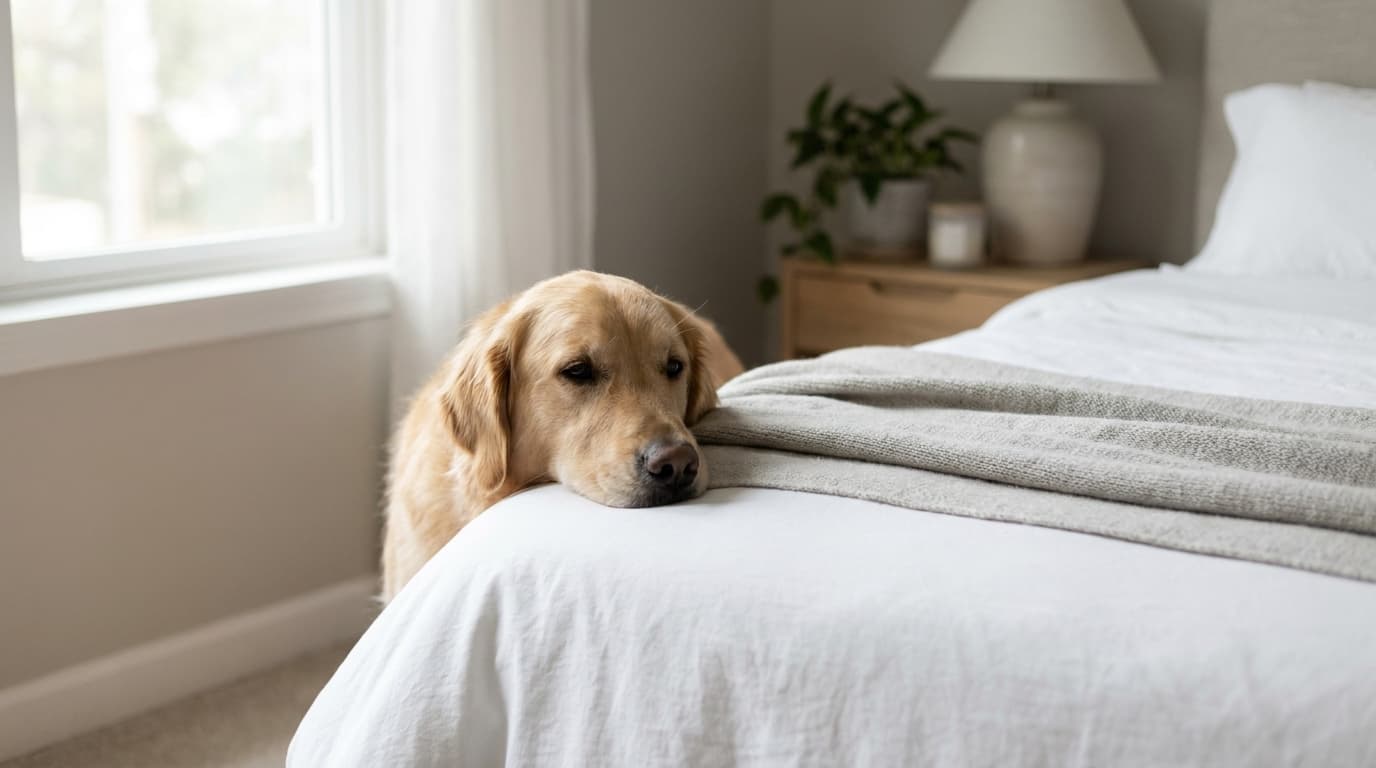
Somewhere in the standard pre-operative packet, between the instructions about arnica and the warning about driving on narcotics, there is a gap shaped like a golden retriever. Roughly two-thirds of American households have a pet, surveys consistently find that about half of those pets sleep in or on their owner's bed, and cosmetic surgery is an outpatient business: the patient who had a tummy tuck at eight in the morning is home on the couch by mid-afternoon, drains in, incision taped, dog overjoyed.
Almost nothing in the consultation prepares anyone for this collision. Surgeons hand out precise rules about when water can touch the incision and how many pounds a patient may lift, and then say nothing about the animal that will spend the next two weeks trying to lick the one part of its owner that smells interesting. Ask a room of patients what their surgeon said about pets and most will tell you the subject never came up.
That silence is not because the question is trivial. The organisms that live in a healthy dog or cat's mouth are well characterized, some of them are genuinely dangerous in a wound, and the case report literature contains enough post-surgical infections traced to pets that the pattern has a shape. At the same time, the internet's answer, which tends toward banishing the animal from the house for a month, is not supported by evidence either. The honest picture sits in the middle, and it is specific enough to be useful.
What is actually living in a healthy pet's mouth
The short answer: a normal dog or cat mouth carries a dense mix of bacteria that includes Pasteurella multocida and Capnocytophaga canimorsus, organisms that are harmless where they are and genuinely dangerous inside broken skin, which is why the concern is not a dirty animal but an ordinary one.
The definitive study here is old and still standing. In 1999, Talan and colleagues published the bacteriology of infected bite wounds in the New England Journal of Medicine and found Pasteurella species in half of infected dog bites and three-quarters of infected cat bites, alongside streptococci, staphylococci, and a long tail of anaerobes. Pasteurella is the reason cat bites are treated with such respect in emergency departments: it grows fast, it produces a spreading cellulitis within twelve to twenty-four hours, and it has a documented taste for joints, tendon sheaths, and implanted hardware. None of this requires a sick animal. Pasteurella is normal oral flora for the majority of cats and a large fraction of dogs.
Capnocytophaga canimorsus is the rarer, darker entry. It lives in the mouths of most dogs and many cats, and in most people it does nothing at all. In patients without a spleen, patients with cirrhosis or heavy alcohol use, and patients on immunosuppression, it has caused fulminant sepsis, and the CDC's own materials note that transmission does not require a bite: scratches and licks over broken skin have been enough in reported cases. The mortality rate in established Capnocytophaga sepsis runs around one in three. This is a rare event and it would be dishonest to present it as a routine cosmetic surgery risk. It is also exactly the kind of tail risk that changes the calculus for the subset of patients who carry the predisposing conditions, which is a conversation worth having before surgery rather than in an intensive care unit.
Then there is staph. Pets can carry Staphylococcus aureus, including resistant strains, usually acquired from the humans they live with, and they can hand it back. Dogs also carry their own species, Staphylococcus pseudintermedius, which occasionally infects people and is frequently multidrug resistant. For a field that has started taking pre-operative screening seriously enough to build staph decolonization protocols around the patient's own nose, it is a little strange that the colonized animal sleeping on the pillow next to it never gets a mention.
The lick, the lore, and the case reports
The short answer: the folk belief that animal saliva helps wounds heal is wrong for human incisions, and the infectious disease literature contains documented surgical wound and implant infections that began with a pet licking healing skin.
The idea that a dog licking a wound is somehow cleansing has ancient roots and a small kernel of biological truth: saliva contains lysozyme and other antimicrobial peptides, and animals licking their own wounds is normal behavior. But the kernel does not survive the arithmetic. Whatever mild antimicrobial activity dog saliva has is swamped by the bacterial load it delivers, which is why veterinarians put cones on post-surgical animals rather than letting them administer their own wound care. A lick is an inoculation.
The case reports make the mechanism concrete. The literature contains Pasteurella infections of surgical sites, prosthetic joints, and other implanted hardware in which the only identified exposure was a pet licking intact-looking healing skin, or licking the patient's hands, or sleeping against the operated site. Individually these are anecdotes. Collectively they establish that the route exists, that it does not require a bite or a visible wound, and that implants are the recurring theme, which should get the attention of anyone going home with breast implants and fresh incisions. A late-arriving fever in the first weeks of recovery already has a differential worth knowing, laid out in the fever piece, and in a household with animals the pet belongs on the list of things to mention to the surgeon rather than a detail too silly to bring up.
The window of vulnerability is the part most patients get wrong in both directions. A surgically closed incision epithelializes quickly, typically sealing itself against surface water and casual contamination within about twenty-four to forty-eight hours, the same biology that drives modern showering guidance. A sealed, dry, intact incision at two weeks is not an open door, and treating every healed scar as a biohazard for months is theater. The real exposure sits earlier and narrower: incisions still weeping or scabbed, any place where a surgical drain exits the skin, which is a literal tube running from the outside world into the surgical pocket, and any wound complication such as a separated incision or an open spot healing on its own. Those are the sites where a tongue, a paw, or a shed hair pressed into the exudate matters, and they are precisely the sites cosmetic patients carry home in week one.
"The bacteria in a healthy pet's mouth are harmless exactly where they are. A surgical drain is a tube that runs from your pet's world directly into your surgical pocket. The whole protocol is about keeping those two facts apart for about two weeks.
"
The bed: what sharing it during recovery actually risks
The short answer: the bed question is less about germs than about mechanics, because a sealed incision tolerates a nearby animal far better than a swollen surgical site tolerates a direct hit from a jumping dog or a kneading cat, and the sleep disruption is measurable too.
Start with what the sleep researchers found, because it is more balanced than the scolding version. Mayo Clinic investigators who actually instrumented the question found that a dog in the bedroom did not meaningfully harm sleep, while a dog in the bed measurably reduced sleep efficiency. For a healthy adult that trade may be worth it. For a post-surgical patient, sleep is not a lifestyle preference: it is the block of hours in which most healing happens, it is already compromised by pain and positioning, and the whole architecture of post-operative sleep, the wedge pillows, the back-sleeping, the protected positions, is easily defeated by a thirty-pound animal that relocates at 3 a.m.
The mechanical risks are the ones surgeons actually see. A dog that greets the morning by landing on its owner's abdomen is a genuine threat to a fresh abdominoplasty closure, which is under real tension and earns its result by being protected from exactly that kind of load. A cat that kneads before settling puts concentrated pressure through claws onto whatever is underneath, and cats select warm, elevated surfaces, which describes a healing surgical site with unfortunate precision. Sudden defensive movement, the flinch when a pet steps somewhere painful, is its own problem for patients under movement restrictions. None of this commonly rips an incision open, and true wound dehiscence usually has more to do with tension, infection, and blood supply than with a single insult. But swelling, pain spikes, and torn stitches at the skin level are all cheap to avoid: the animal sleeps elsewhere for the first stretch.
There is also the unglamorous matter of hair and dander. Pet hair is not sterile, it is mobile, and it has a documented talent for finding adhesive dressings, tape edges, and drain sites. Nobody has run a trial on golden retriever hair and infection rates, and nobody will. It is enough to note that keeping shedding animals off the bedding that touches fresh dressings costs nothing and requires no evidence review.
The rest of the animal: scratches, litter boxes, and the leash as a lifting event
The short answer: the non-mouth exposures are mostly logistics problems, because cat scratches carry their own pathogens, a litter box violates bending and hygiene rules at the same time, and a large dog on a leash is a lifting event that blows through every restriction on the discharge sheet.
Cat scratches deserve one specific mention: Bartonella henselae, the agent of cat scratch disease, transmits through scratches and is most common with kittens. A scratch across or near a healing surgical site combines broken skin, a fresh pathogen, and an operated field, and it earns a call to the surgeon's office rather than a shrug. Trimmed claws and no rough play during recovery is the entire preventive program.
The litter box is a quieter conflict. It sits at floor level in a recovery period defined by bending and lifting restrictions, it is a concentrated source of enteric bacteria handled at close range, and scooping it is exactly the kind of low, twisting, repetitive task that abdominal and breast surgery patients are told to avoid. This is delegation, not danger: someone else scoops for two weeks, and the patient washes hands after any pet handling before touching dressings or drains, the same hand hygiene rule that applies to everything else in the house.
The dog walk is the restriction people most reliably ignore. Post-surgical lifting limits commonly sit at ten pounds or so in the early weeks, with a gradual return mapped out in the return-to-activity timeline. A leashed seventy-pound dog that sees a squirrel converts its owner's arm, shoulder, and abdominal wall into the anchor for a seventy-pound dynamic load, which is not a walk, it is an uncontrolled deadlift. Patients on early post-operative pain medication are also managing sedation and balance, and a leash pull or an underfoot animal on a nighttime bathroom trip is a fall risk stacked on top of the ones the recovery pharmacology already creates. The answer is boring: another human walks the dog, or the dog is boarded or day-cared through week one, and strong pullers stay off the patient's hands until lifting clearance catches up.
The protocol that survives contact with real life
The short answer: no randomized trial governs pets and cosmetic surgery recovery, so the defensible protocol is a short list of hard rules during the open-wound window and a fast return to normal life afterward, rather than either denial or a month of quarantine.
It is worth saying plainly that the major professional societies have no formal position statement on pets in surgical recovery, and the guidance that exists is extrapolated from wound biology, bite and lick microbiology, and case reports. That extrapolation still lands somewhere concrete. No licking of incisions, drain sites, or the hands that touch them, ever, at any stage: this is the one absolute, because it is the one exposure with a documented causal chain to deep infection. No pets in the bed while drains are in place or any wound is open, weeping, or scabbed, which for most facelifts, breast procedures, and abdominoplasties means roughly the first one to two weeks, longer if healing is slow. Hands washed after touching the animal and before touching anything surgical. The animal's physical management delegated until lifting and bending clearances return.
And then, the part the scolds leave out: after the incisions are sealed and dry and the drains are gone, the marginal risk of a pet in the bedroom collapses toward zero, and the benefits are not imaginary. Recovery is boring, sometimes lonely, and measurably harder on mood than patients expect. A calm animal on the far side of the bed, off the operated side, with trimmed claws and a rule against face-level enthusiasm, is for most patients at two or three weeks a net positive, and pretending otherwise just guarantees the advice gets ignored. The goal is a narrow window of real discipline, not a gesture of permanent suspicion toward an animal that was always going to win the standoff anyway.
The honest summary
Pets are a real but narrow variable in cosmetic surgery recovery, and the consultation process mostly pretends they do not exist. The microbiology is not in dispute: healthy dog and cat mouths carry Pasteurella in most cats and many dogs, per the New England Journal of Medicine's bite wound bacteriology, plus Capnocytophaga, resistant staph species, and a deep bench of anaerobes, and the case literature documents surgical site and implant infections that started with nothing more dramatic than a lick. The window that matters is short: unsealed incisions, drain sites, and any open wound, which for most patients means the first one to two weeks. During that window the rules are absolute and cheap: no licking, no pets on the bed, hand hygiene between animal and dressing, and someone else holding the leash and the litter scoop. Outside that window, the evidence for banishing animals is thin to nonexistent, and a recovered incision does not need protecting from a sleeping cat. Patients without a spleen, with liver disease, or on immunosuppression are the exception in the other direction: for them the rare Capnocytophaga disaster is real enough that the pet belongs in the pre-operative conversation by name. Say it in the consult. The dog was always going to be in the house; the plan for it should be, too.