Industry · August 17, 2026
The Cold Room: Why You Shiver After Surgery and What Warming You Actually Prevents
Almost every patient remembers being cold. Almost nobody is told that hypothermia after surgery is a measurable complication with its own trial evidence, linked to higher infection rates, more bleeding, slower drug clearance, and longer recovery. A one degree drop in core temperature is not a comfort problem. It is the cheapest preventable risk in the operating room, and in office based aesthetic surgery it is the one nobody puts in the brochure.
By The Editorial Desk
11 min read
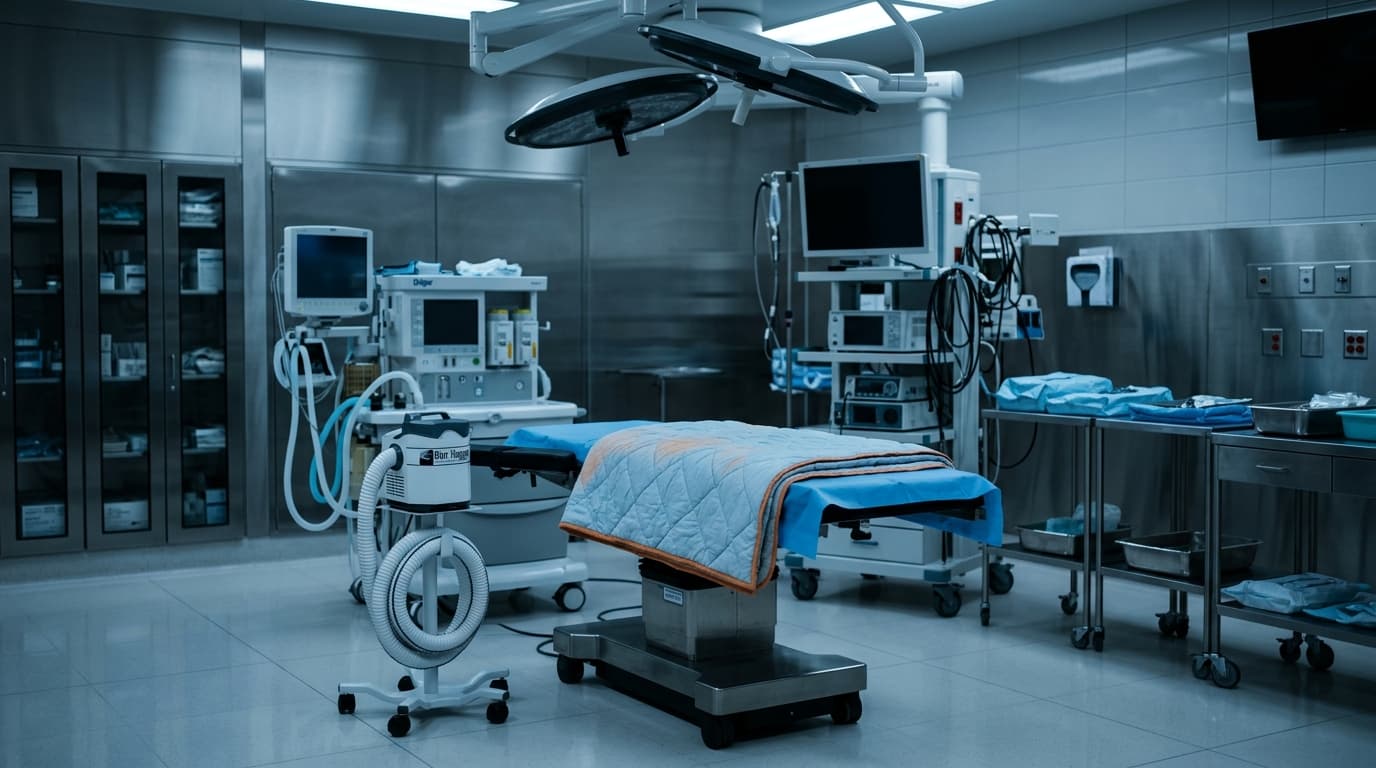
Ask ten people who have had cosmetic surgery what they remember about waking up, and a striking number will describe the same thing before they describe the pain: they were freezing, they could not stop shaking, and somebody put a warm blanket on them. It is filed away as an unpleasant detail of anesthesia, the way a dry mouth is.
It is not a detail. Hypothermia after surgery, meaning a core body temperature that has drifted below 36 degrees Celsius, is one of the best studied complications in perioperative medicine, and the trials attached to it are unusually blunt. Letting a patient get cold raises surgical site infection rates, increases blood loss and transfusion, prolongs the effect of anesthetic drugs, and extends recovery. Keeping a patient warm costs a blanket, a fluid warmer, and about thirty minutes of attention.
The reason this belongs in an aesthetic surgery journal rather than a hospital quality newsletter is that cosmetic operations concentrate almost every risk factor for heat loss into one case, and they frequently run in office based surgical suites where the monitoring and the equipment are optional rather than mandated.
Your body stops defending its own temperature the moment you go to sleep
The short answer: general anesthesia and regional anesthesia both switch off the reflexes that hold your core temperature steady, and the first and largest drop happens in the first hour, before the surgeon has done anything at all.
An awake human defends a core temperature within a few tenths of a degree. Your body does this by keeping warm blood in the trunk and head and clamping down the vessels in your arms, legs, and skin, which run several degrees cooler and act as insulation. That gradient is the whole system.
Induction of anesthesia dismantles it in two moves. First, anesthetic agents widen the thermoregulatory threshold, so the temperature at which your body would normally start vasoconstricting or shivering drops by several degrees. You simply stop noticing you are cold, in the physiologic sense. Second, those same agents dilate the peripheral vessels, and warm core blood floods outward into the cool shell.
This is called redistribution, and it accounts for a core temperature fall of roughly 0.5 to 1.5 degrees Celsius in the first hour after induction. No heat has actually left the body yet. It has simply moved somewhere it does not count. After that first hour, real heat loss takes over: radiation and convection from a large exposed surgical field, evaporation from open tissue and wet drapes, cold skin preparation solutions, room temperature intravenous fluids, and an operating room deliberately kept in the high teens Celsius because gowned, masked, lit surgeons overheat.
Regional and sedation based techniques are not exempt. Spinal and epidural blocks produce vasodilation below the block and blunt the shivering response, and patients under heavy sedation lose the behavioral defense that would otherwise make them ask for a blanket. Even the awake and tumescent techniques that avoid general anesthesia involve infiltrating liters of room temperature fluid into the subcutaneous space, which is a very efficient way to cool a person from the inside.
The trial evidence is unusually direct for something this mundane
The short answer: randomized trials have tied mild perioperative hypothermia to roughly a threefold increase in surgical wound infection, a measurable increase in blood loss and transfusion, more cardiac events in at risk patients, and longer recovery times.
Four findings anchor the field, and they are worth naming individually because they are the reason warming protocols exist at all.
- Infection. The 1996 New England Journal of Medicine trial by Kurz and colleagues randomized colorectal surgery patients to routine care or active warming. Surgical site infection occurred in 19 percent of the hypothermic group and 6 percent of the normothermic group, and hospital stay ran about 2.6 days longer in the cold group. The mean temperature difference between groups was under two degrees.
- Bleeding. Schmied and colleagues, publishing in The Lancet the same year, found that mild hypothermia during hip arthroplasty significantly increased blood loss and transfusion requirement. A 2008 meta analysis in Anesthesiology put the effect at roughly 16 percent more blood loss and about a 22 percent higher relative risk of transfusion for less than one degree of cooling.
- Cardiac events. A 1997 JAMA trial by Frank and colleagues in patients with cardiac risk factors found morbid cardiac events in 6.3 percent of the hypothermic group versus 1.4 percent of the normothermic group. Shivering drives a large increase in oxygen consumption, and a heart with limited reserve is the organ that pays for it.
- Drug handling. Enzymatic drug metabolism slows with temperature. The duration of common neuromuscular blocking agents roughly doubles with a two degree drop, and volatile anesthetic clearance slows too. That translates into delayed emergence and a longer stay in recovery, which in an office suite means the schedule backs up and a patient goes home later than planned.
Two mechanisms explain most of this. Cold triggers subcutaneous vasoconstriction, which drops tissue oxygen tension in the wound. Neutrophils kill bacteria by an oxidative burst that is oxygen dependent, and collagen deposition is oxygen dependent, so a cold wound is both less able to fight contamination and slower to gain tensile strength. Separately, hypothermia impairs platelet function and slows the enzymatic clotting cascade. The uncomfortable footnote there is that standard coagulation laboratory tests are run at 37 degrees, so they will look reassuringly normal on a patient whose clotting is being suppressed by temperature.
"A one degree drop does not feel like a complication. It feels like being cold. That is exactly why it survives in practices that would never tolerate any other threefold increase in infection risk.
"
The guidance followed this evidence closely. The UK's NICE guideline on inadvertent perioperative hypothermia set 36.0 degrees Celsius as the floor and recommended active warming from thirty minutes before induction for at risk patients and for anesthesia expected to exceed thirty minutes. AORN publishes a dedicated guideline for the prevention of unplanned patient hypothermia. American Society of Anesthesiologists monitoring standards require temperature monitoring whenever clinically significant changes in body temperature are intended, anticipated, or suspected, which for a two hour operation under general anesthesia is always.
Cosmetic surgery collects the risk factors, then holds the case in an office
The short answer: long combined aesthetic operations expose more body surface for more hours, often in patients with less insulating body fat, frequently in facilities that are not required to hold themselves to hospital warming and monitoring standards.
Run down the list of what makes a patient cold and then read it against a typical elective aesthetic schedule.
Duration. Heat loss is cumulative, and a case that stacks procedures runs long by design. The reasons to think carefully about combining operations in one sitting are usually framed around anesthesia time and clot risk. Temperature belongs on the same list.
Exposed surface area. Body contouring is the extreme case. A circumferential lower body lift or a large volume liposuction case requires most of the torso and thighs uncovered and prepped, which is the largest radiating surface a surgeon ever exposes electively.
Wetting solution and irrigation. Liposuction infiltrates liters of tumescent fluid. If that fluid goes in at room temperature, the patient is being actively cooled with each syringe. Warming wetting solution and irrigation to body temperature is a standard recommendation in the plastic surgery literature and it is not universally practiced.
Body habitus. Thin patients with low subcutaneous fat have less insulation, and massive weight loss patients presenting for contouring frequently sit in that category. Extremes of age matter too, which is one more strand in the argument for formal preoperative assessment in older patients.
Facility. This is the structural piece. Accredited surgical facilities generally have forced air warming units, fluid warmers, and continuous core temperature monitoring, because their accreditation requires it. A non accredited procedure room may have a warm blanket from a cabinet, which raises skin temperature pleasantly and does almost nothing for core temperature. The same infrastructure gap runs through malignant hyperthermia preparedness and anesthesia provider staffing, and it tends to be all or nothing: facilities that get one of these right usually get all three right.
What actual warming looks like, and what merely looks like warming
The short answer: pre warming before induction, forced air warming during the case, warmed intravenous fluids and irrigation, and continuous core temperature measurement. A heated blanket handed to you in recovery is comfort, not prevention.
The single most effective intervention is the one patients never see, because it happens before they are asleep. Thirty to sixty minutes of forced air pre warming in the holding area raises the temperature of the peripheral tissues, which shrinks the core to periphery gradient. Since redistribution is a movement of heat down that gradient, narrowing the gradient blunts the biggest single drop of the entire case. It is cheap, it takes an appointment slot, and it is skipped constantly because it requires the patient to arrive earlier.
The rest of the toolkit is straightforward.
- Forced air warming over or under the patient during the case is the best studied active method. Conductive fabric and water circulating mattresses are reasonable alternatives, particularly when the surgical field occupies the areas a blanket would cover.
- Fluid warming matters once volumes get significant. Room temperature intravenous fluid and cold irrigation are direct heat sinks, and warming both is standard for larger cases.
- Ambient temperature in the room can be raised for induction and prep, then dropped once the patient is draped and covered.
- Core temperature monitoring is the part that separates a protocol from a habit. Esophageal, nasopharyngeal, and bladder probes measure something close to core. Axillary and forehead skin readings are convenient and considerably less reliable, and an intermittent reading taken twice during a three hour case does not describe a trend.
- Device discipline. Forced air warmers must be used with their blankets attached. Directing the hose under drapes without the blanket is a recognized cause of contact burns, and burns from misused warming equipment are a real, if uncommon, source of litigation.
Shivering afterward is not simply being cold
The short answer: post anesthetic shivering is common, it happens even in patients whose temperature was well controlled, and beyond being miserable it raises oxygen consumption, spikes blood pressure, and puts mechanical stress on fresh incisions.
Shivering after anesthesia has historically been reported in something like a fifth to more than half of patients depending on the drugs, the case, and how carefully anyone was looking. Active warming reduces it substantially but does not eliminate it, partly because some of it is a drug effect on thermoregulatory control rather than a pure response to a low temperature.
The consequences are not trivial in aesthetic surgery specifically. Shivering can raise metabolic oxygen demand several fold. It drives up heart rate and blood pressure, and blood pressure surges in the first hours after a facelift are the classic setup for the hematoma discussed alongside neck and lower face surgery. It generates repeated muscular tension across suture lines, which is unhelpful anywhere but particularly unhelpful across an abdominal closure. It also worsens pain and contributes to the nausea covered in post operative nausea and vomiting, and severe early pain is one of the recognized predictors of persistent pain later.
Treatment is well established. Continued active warming is the foundation. Low dose meperidine remains the most reliably effective drug for stopping shivering itself, with dexmedetomidine and several alternatives also used. Supplemental oxygen is standard while it lasts. None of this is exotic, and all of it is easier if the patient never got cold in the first place.
One clarification worth making, because it causes real confusion: feeling cold and being hypothermic are not the same measurement. A patient can report feeling freezing at a normal core temperature, because the sensation tracks skin temperature. A patient can also be genuinely hypothermic and report feeling fine. This is precisely why the answer to "were you kept warm" is a number on a monitor and not a memory from recovery.
The honest summary
Perioperative hypothermia is the rare complication where the evidence is old, strong, uncontroversial, and still inconsistently acted on. The trials date to the 1990s. The mechanisms are understood. The interventions cost very little and carry almost no risk when the equipment is used correctly. And yet the temperature conversation almost never appears in a cosmetic surgery consult, because it is not a selling point and because patients do not know to ask.
Three things are worth carrying out of this.
Temperature is a surgical outcome variable, not a comfort variable. Roughly one degree of cooling has been tied in randomized trials to a threefold difference in wound infection, meaningfully more bleeding, and slower emergence. It sits in the same category as the antibiotic decision, the tranexamic acid decision, and glycemic control: small, boring, protocol driven choices that quietly determine the complication rate.
The most valuable warming happens before you are asleep. Pre warming addresses the redistribution drop that accounts for the largest single fall in the entire case, and it is the step most often skipped, because it costs schedule time rather than money.
And the facility question keeps answering itself. Continuous core monitoring, forced air units, warmed fluids, and warmed wetting solution are ordinary in an accredited operating room and optional in a procedure room. If you are weighing where to have an operation done, temperature control is one more concrete item to raise at the second consultation, and the quality of the answer will tell you a good deal about everything else you cannot see from the waiting room.