Procedure Deep-Dive · September 15, 2026
Hair Dye and Hair Washing After a Facelift: What the Incision Actually Restricts, Why Chemical Color Waits Longer Than Shampoo, and the Blow-Dryer Rule Nobody Explains
Most facelift discharge instructions say a version of the same thing: no hair dye for a while, be gentle when you wash. Patients hear that as a vague caution and treat the first appointment with their colorist as a scheduling question rather than a wound-healing one. It is not a scheduling question. A facelift incision sits at the hairline, in front of and behind the ear, on skin that has been elevated, resutured, and in many cases left partially numb for weeks. Shampoo, hair dye, and a blow dryer are three different hazards with three different timelines, and conflating them is how patients end up with an irritated incision, a chemical burn they never felt happening, or a scalp reaction that has nothing to do with the surgery and everything to do with a colorist who was never told one occurred.
By The Editorial Desk
11 min read
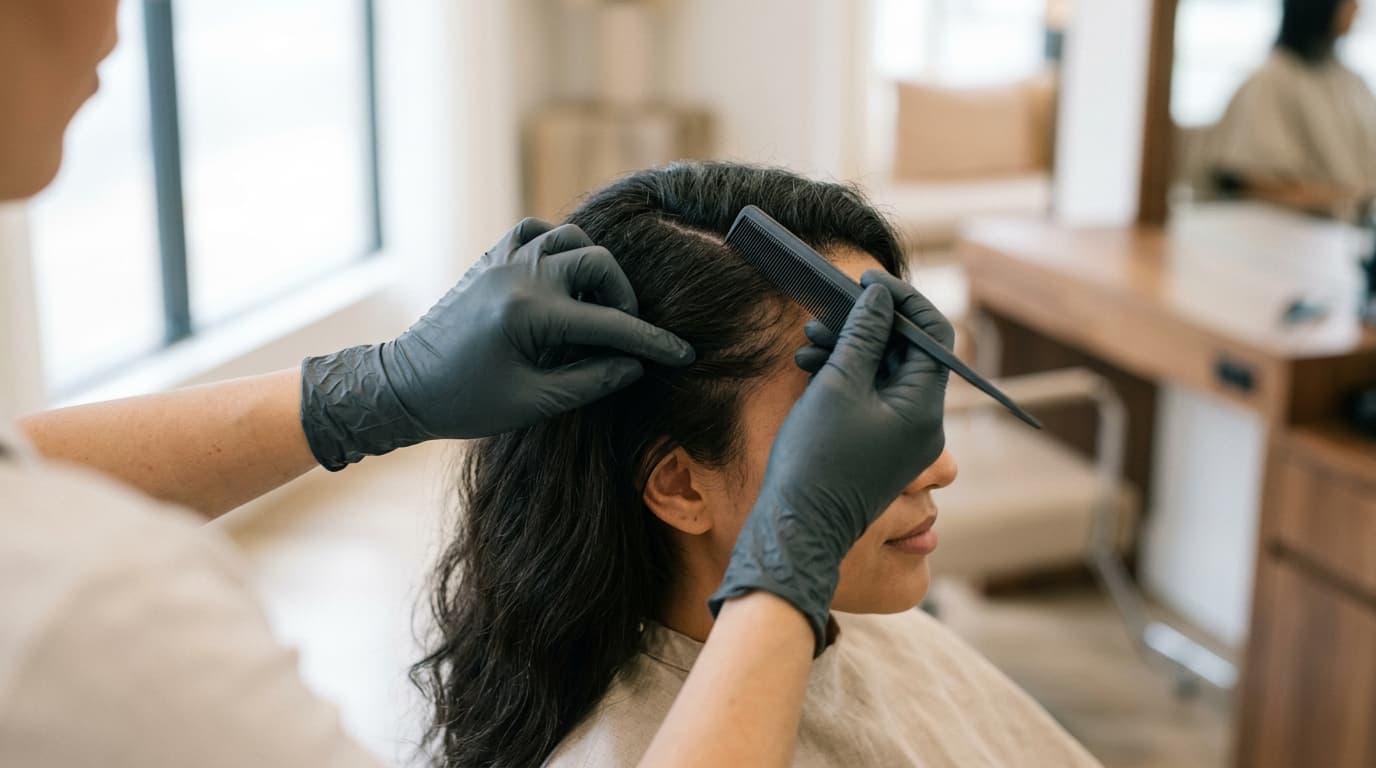
Ask a facelift patient when she can dye her hair again and she will usually repeat whatever the discharge sheet said, a number somewhere between four and six weeks, delivered with the same confidence as the two-week makeup rule that turns out, on inspection, to describe an average rather than any individual wound. The number is not wrong so much as it is incomplete. A facelift does not create one wound. It creates an incision line along the hairline and around the ear, a flap of skin between those incisions that has been lifted off its normal blood supply and is healing from underneath as much as from the surface, and, in most patients, a patch of genuinely numb skin around the incision that can persist for months. Shampoo, chemical hair dye, and heat styling stress those three things in different ways and on different timelines, and the practices that hand patients one blanket rule are simplifying a question that actually has three separate answers.
This piece works through what the incision and the flap actually restrict, when the first real hair wash is safe and how that shifts by facelift technique, why chemical dye needs a longer runway than plain shampoo, why a blow dryer is a genuinely underrated risk on skin that cannot feel heat the way it used to, and what protects the incision once washing and coloring resume for real.
What a facelift incision actually restricts, and why it is about blood supply, not the hair itself
The short answer: the incision line closes on roughly the same schedule as any other sutured wound, but the skin between the incisions has been elevated off its blood supply as a flap, and it is the flap, not the suture line, that determines how much friction, pressure, and chemical exposure the scalp and face can tolerate in the first several weeks.
A facelift incision typically runs along the hairline at the temple, down in front of the ear, around the earlobe, and back up behind the ear into the hair-bearing scalp, a pattern designed to hide the scar rather than to avoid the hairline altogether, which is exactly why hair care becomes a wound-care question instead of a cosmetic one. The suture line itself seals in roughly a week to ten days, similar to any incision closed with sutures or staples elsewhere on the body. What makes a facelift different, and what the piece on the deep-plane facelift covers in more detail, is that the skin and, in a deep-plane approach, the underlying muscle layer between those incisions has been separated from the tissue beneath it and repositioned, which means it is relying for the first one to two weeks on a blood supply that is measurably more fragile than intact, undisturbed skin. That is also why hematoma after a facelift and skin necrosis after a facelift or tummy tuck are the two complications surgeons watch hardest in that window, and why anything that adds friction, tension, or chemical irritation to that flap, including a vigorous scalp massage under running water or a fistful of dye worked in with the fingertips, is treated as a real risk rather than an abundance of caution.
The incisions running through hair-bearing skin add a second, less obvious restriction: the temporal branch of the facial nerve runs close to the surgical plane near the hairline, which is one reason the piece on facial nerve injury after a facelift exists as its own topic, and it is also part of why surgeons ask patients to avoid anything that tugs or pulls at the hair near the incision, a comb dragged too hard, a dye brush pressed too firmly, a hair tie cinched right over the healing line, in the early weeks regardless of how closed the suture line looks from the outside.
When the first real hair wash is safe, and how the answer changes by facelift technique
The short answer: most practices clear a first gentle hair wash somewhere between 48 hours and one week after surgery, performed by someone else and away from direct water pressure on the incisions, and the exact day depends less on a fixed rule than on whether drains are still in, how much of the scalp was elevated, and which facelift technique was actually performed.
A patient with a small-incision approach, the kind described in the piece on the modern mini-facelift or the piece on the endoscopic facelift, has elevated a smaller area of scalp and typically gets cleared for a gentle wash sooner than a patient who had a full deep-plane lift with an extended incision into the scalp and, often, a combined neck lift and platysmaplasty, where more hair-bearing tissue was disturbed and drains, discussed in the piece on surgical drains after plastic surgery, are frequently still in place for the first several days. The technique described in the piece on the quiet end of the pull-tight facelift is a useful reminder that "facelift" is not one operation with one recovery script, and a patient should ask specifically which variant she had rather than assume the internet's average timeline applies to her case.
The mechanics of that first wash matter as much as the timing. Surgeons who clear an early wash are almost always describing a specific, low-force method: lukewarm water poured or sprayed gently rather than a showerhead aimed directly at the incisions, a mild, unscented cleanser applied with fingertips well away from the suture lines and worked toward them rather than starting on top of them, and someone else doing the washing for at least the first attempt, covered in more general terms in the piece on showering and bathing after cosmetic surgery. The goal is to remove dried blood, antiseptic residue, and ordinary scalp oil without introducing the kind of scrubbing or pressure that can pull at a suture line, which is also relevant to the piece on spitting sutures after cosmetic surgery, since friction over a healing incision is one of the mechanical triggers that can push a suture toward the surface before it has finished dissolving.
"The suture line and the flap underneath it are not the same wound healing on the same clock, which is exactly why one blanket rule for hair care was never going to describe either one accurately.
"
Why chemical hair dye needs a longer runway than plain shampoo
The short answer: hair dye is not restricted because it is dirty or because it involves water, it is restricted because the chemicals in permanent and semi-permanent color, most notably para-phenylenediamine, are irritants and, in a meaningful number of people, allergens, and a fresh incision at the hairline is both more absorbent and less able to signal a reaction than intact skin.
Plain water and a mild cleanser are mechanically simple: the risk is friction and pressure, not chemistry. Hair dye adds an actual chemical exposure directly at or near the wound margin, and wound margins are, by definition, the most permeable point on the scalp, since the epidermal barrier that normally limits absorption has been cut through and is still rebuilding. Para-phenylenediamine and related oxidative dye components are already a recognized cause of allergic contact dermatitis in patients with entirely normal, unoperated skin; applying the same chemical directly over or immediately adjacent to a healing incision, before that barrier has reformed, raises both the odds of an irritant reaction and the stakes if one happens, since a reaction at a healing incision is not just uncomfortable, it can also delay closure and increase the odds of a visible scar. This is a version of the same logic covered in the piece on adhesive and tape rash after cosmetic surgery: compromised skin reacts differently and less predictably to substances that a normal scalp tolerates without incident.
There is also a signal problem. Ordinary itching at the scalp during a chemical dye process is a normal, expected sensation that tells a person to rinse or stop; the piece on itching after plastic surgery covers how common a milder version of that sensation already is during ordinary healing, which makes it a poor early-warning system for a real allergic reaction layered on top of it. A patient and colorist relying on "let me know if it starts to burn" as the safety check are relying on a signal that is already noisy in a freshly operated scalp, which is one of several reasons most surgeons set the dye restriction meaningfully longer than the plain-wash restriction, often four to six weeks rather than days, and ask to see the incision at a follow-up visit before signing off, the same visit-based logic that governs scar care after plastic surgery more broadly. A colorist who is not told a facelift happened recently has no reason to keep dye away from the hairline at all, which is why telling the salon, not just the surgeon, is part of doing this safely.
The blow-dryer risk nobody explains: numb skin cannot feel a burn forming
The short answer: the skin around a facelift incision is frequently numb, sometimes for months, because the nerve branches that carry sensation to that area were unavoidably disturbed during the dissection, and numb skin cannot deliver the early heat-pain warning that normally stops a person from holding a hot blow dryer or curling iron too close for too long.
Temporary numbness around the incisions, in front of and behind the ear and along part of the cheek, is an expected and usually self-resolving part of facelift recovery rather than a complication, and the piece on numbness after plastic surgery describes how long that sensory return typically takes and why it is uneven, with some areas recovering in weeks and others taking several months. The practical problem that gets far less attention than it deserves is what that numbness means the moment a patient reaches for a blow dryer set to its usual heat, a habit built over a lifetime of normal skin that reliably signals "too hot" well before an actual burn starts. Numb skin does not send that signal, or sends a delayed and blunted version of it, which means a heat exposure that would make an intact-sensation patient flinch and pull away can sit against numb, healing skin near an incision for several extra seconds before anything registers, and several extra seconds of direct heat against thin, already-stressed healing tissue is enough to cause a genuine thermal injury.
The fix is not complicated, but it is rarely stated as explicitly as it should be: use the cool or low-heat setting near the incisions specifically, keep the dryer moving rather than holding it in one spot, and let the areas directly around the hairline and ear air-dry the rest of the way rather than relying on the same sensory feedback a patient would normally trust without thinking about it. The same logic applies to a curling iron or flat iron used anywhere near the temple or ear incisions in the weeks before full sensation returns, and it is worth treating as a genuine safety rule rather than a minor inconvenience, since a thermal burn on top of a healing surgical incision is a considerably worse outcome than a slightly less polished blowout for a few weeks.
What actually protects the incision once washing and coloring resume for real
The short answer: the products that matter most are unglamorous, unscented, mild non-detergent cleansers, and low-friction technique, the technique matters more than the brand, and the honest clearance to fully resume normal hair care comes from a surgeon looking at the incision, not from counting days on a calendar.
Once a surgeon has actually examined the incision and the flap and cleared normal washing, most of what protects the area going forward is technique rather than product: applying cleanser and, later, color with light fingertip pressure rather than vigorous massage, working outward from a safe distance rather than starting at the incision, and avoiding a hard scrub with a towel in favor of blotting the area dry, an approach that mirrors the skepticism already applied to makeup in the piece on makeup after surgery and camouflage timing: the label on a product matters less than whether it is gentle, unscented, and applied without unnecessary friction over a healing wound. A patch test of any new dye on skin well away from the incision, done regardless of surgery history but especially important here, remains the single most reliable early warning for a chemical reaction before it happens over the wound itself.
Patients occasionally connect hair dye timing to an unrelated event, the diffuse shedding covered in the piece on hair shedding after surgery and telogen effluvium, and worry that a dye job caused hair loss that actually started weeks earlier as a normal physiological response to the operation itself. The two are not connected: telogen effluvium is a systemic reaction to the stress of surgery working on a three-month delay, while dye and heat restrictions are strictly local, mechanical, and chemical questions about the incision and the flap, and conflating them leads patients to blame the wrong thing while missing the actual local risk. The same distinction holds for ordinary post-operative swelling, discussed in the piece on the swelling timeline after plastic surgery: a scalp that still looks and feels puffy at three weeks is not, by itself, a sign that hair care is unsafe, and a scalp that looks perfectly normal at ten days is not, by itself, proof that it is.
The honest summary
A facelift restricts three separate things about hair care, on three separate timelines, and treating them as one rule is how patients end up either overly cautious for no reason or genuinely at risk without realizing it. Plain, gentle washing can usually resume within days once the incision is stable and drains are out, guided by technique more than by a fixed number. Chemical hair dye needs meaningfully longer, often four to six weeks, because it introduces a real irritant chemical directly at the most absorbent, least protected point on the healing scalp, and because a colorist who has not been told about the surgery has no reason to route around the hairline at all. Heat styling deserves its own explicit caution independent of both, because numb skin near the incisions cannot deliver the ordinary pain signal that normally prevents a burn, which means the usual habit of trusting how hot something feels stops working exactly where it matters most. The only clearance worth trusting for any of the three is the one that comes from a surgeon who has actually looked at the incision and the surrounding skin, not a number printed in advance on a discharge sheet that had no way of knowing how any individual patient, or any individual flap, was actually going to heal.