Industry · September 13, 2026
Makeup After Plastic Surgery: Why the Timeline Is Set by the Wound and Not a Fixed Number of Days, What Actually Camouflages Bruising Safely, and Which Products to Avoid Until a Surgeon Clears Them
Every recovery handout says roughly the same thing about makeup: wait about two weeks. Patients treat that number the way they treat a speed limit sign, as an approximate suggestion rather than a biological fact, and they are usually right to be skeptical of it, because the real rule has nothing to do with a calendar. What determines when a concealer, a foundation, or a color corrector becomes safe is a single mechanical question: is the skin under it a closed, epithelialized surface, or is it still an open wound. That question has a different answer for a facelift incision behind the ear, a blepharoplasty stitch on the eyelid, a rhinoplasty under a splint, and a phenol peel that has stripped the entire face down to raw dermis, which is why one universal number was never going to be honest advice, and why the useful version of this guidance has to be sorted by procedure rather than handed out as a single line on a discharge sheet.
By The Editorial Desk
16 min read
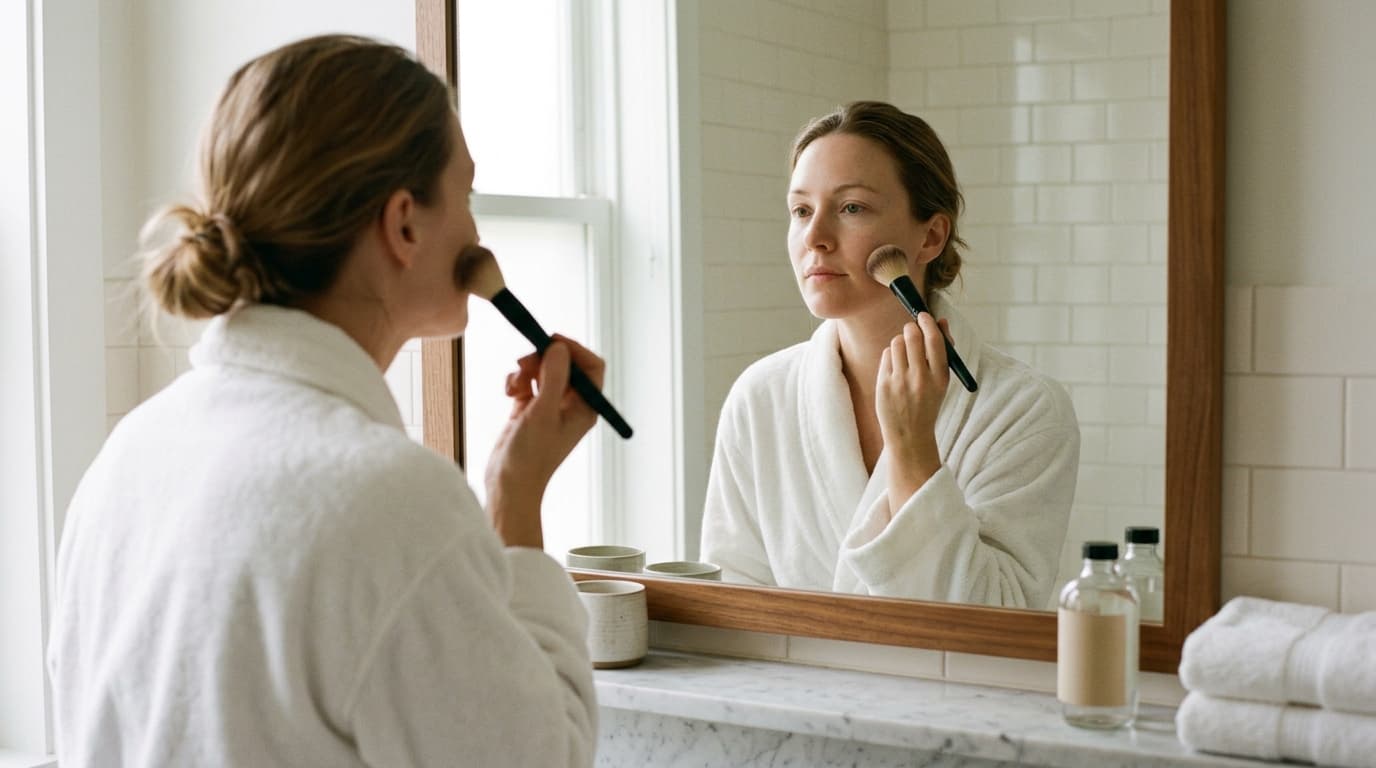
Ask a recovering patient when she can wear makeup again and she will usually recite the same folk number: two weeks. It is the answer most discharge instructions give, and it is close enough to correct often enough that nobody has bothered to fix it, which is a problem, because "close enough" is exactly the kind of advice that fails the patient whose case does not match the average. A closed facelift incision behind the ear and an open phenol peel covering the entire face are not the same wound, they do not heal on the same schedule, and treating them as interchangeable because both happened under the umbrella of "plastic surgery" is the reason so many patients either cover up too early, over an incompletely closed wound, or wait weeks longer than necessary out of an abundance of caution nobody explained the limits of.
The actual rule is simpler than a day count and more useful than one: makeup is unsafe over any surface that has not finished epithelializing, meaning the surface is not yet a continuous, closed layer of new skin cells sealing off the tissue underneath, and it becomes progressively safer as that surface closes, hardens, and stops weeping. A suture line that closed cleanly at ten days is a different surface than a peeled cheek that is still pink and glistening at ten days, even though both patients are "ten days post-op" on the same generic calendar. This piece works through what re-epithelialization actually means and why it is the real gate, what genuinely camouflages bruising once the skin is intact, why a facelift, a blepharoplasty, a rhinoplasty, and a resurfacing procedure each run on their own separate timeline, which products cause more harm than the ones patients are told to avoid, and how a surgeon's office actually decides a patient is cleared rather than just guessing at two weeks and hoping.
What actually determines when makeup is safe, and why it is wound biology, not a universal calendar
The short answer: makeup becomes safe once the skin under it has finished re-epithelializing, meaning it is an intact, closed barrier again rather than an open or partially open wound, and that milestone happens on a different day for a suture line, a laser field, and a chemical peel, which is why a single number was never going to describe all three.
An incision closed with sutures or staples, the kind made in a facelift, a blepharoplasty, or a rhinoplasty, heals from the edges inward. The epidermis on either side of the cut migrates across the gap and seals it, a process that is largely complete within about a week to ten days for a well-approximated incision, even though the deeper layers and the scar itself keep remodeling for a year or more, a distinction covered in more depth in the piece on the swelling timeline after plastic surgery. Once that surface has sealed, a light layer of makeup sitting on top of it is mechanically similar to makeup on any other patch of skin: a cosmetic risk of clogged pores or irritation, not an open door for bacteria to reach living tissue underneath.
A resurfacing procedure is a different category of wound entirely, and the mistake patients make most often is assuming the same clock applies. A deep phenol peel or an aggressive ablative laser does not create a line that heals edge to edge. It removes the epidermis, and in the deepest cases part of the dermis, across the entire treated area at once, so the surface has to re-form as a sheet rather than close as a seam. The piece on deep phenol peel resurfacing puts that re-epithelialization window at roughly seven to fourteen days for the acute phase, and a milder fractional or non-ablative treatment, discussed in the piece comparing ablative and non-ablative laser resurfacing, can seal in as little as two to four days precisely because it leaves untouched skin bridging the treated columns. Applying makeup to a face mid-peel, before that sheet has closed, does two things at once: it introduces bacteria, oils, and preservatives directly into exposed dermis, which is a real infection risk, and it physically disrupts the fragile new cell layer as it tries to form, which can leave a patchier, slower, or more pigment-irregular result than the peel would otherwise have produced. Neither risk exists in the same way once the same skin has closed over.
The other reason "two weeks" fails as a universal rule is that swelling, not wound closure, is often what patients are actually reacting to when they decide they are ready to cover up. A face that is still swollen at day ten looks like it needs concealing, and a patient who feels self-conscious will reach for makeup regardless of what the wound underneath is doing. That is a real and understandable impulse, but it is a separate problem from wound safety, and the honest answer is that swelling frequently outlasts the makeup restriction by weeks, sometimes months, which means "when can I finally look like myself again" and "when is it safe to put concealer on this skin" are two different questions that deserve two different answers rather than one number that quietly tries to solve both.
Camouflage makeup for bruising and swelling: what actually works once the skin is closed
The short answer: once an incision or treated surface has re-epithelialized, color-correcting camouflage makeup, whether an ordinary drugstore concealer or a dedicated medical-grade camouflage line, is genuinely effective at masking bruising and works by the same optical principle either way, and the meaningful choice at that point is about formulation and hygiene, not brand marketing.
Bruising reads as a color problem before it reads as a texture problem, which is why color theory does most of the work. Fresh bruising skews purple to blue-black, and a peach or orange-based corrector neutralizes that undertone before a layer of foundation goes on top; as the bruise ages into its yellow-green phase, a lavender or violet-tinted corrector does the opposite job. This is standard color-correction technique, not a specialty invented for surgical patients, and it works exactly as well on post-surgical bruising as it does on a bruised shin. What changes after surgery is not the color theory but the surface it is applied to: thinner, more reactive, sometimes still slightly swollen skin that tolerates less friction and fewer harsh ingredients than an ordinary bruise on a shin does.
There is a real product category built around this, sold as medical or camouflage makeup, distinguished by heavier pigment load, a thicker and more opaque base, and, in the better lines, a setting formula meant to survive humidity and touch without transferring. Patients who have used ordinary drugstore concealer and found it either too sheer to cover surgical bruising or prone to sliding off by midday are the ones who benefit most from the dedicated category; patients with mild bruising and healthy, intact skin generally do fine with what is already in their bathroom drawer. What is not interchangeable with either option is permanent camouflage, the medical tattooing described in the piece on scar camouflage, which addresses a different problem (a visible scar that never fully blends with surrounding skin tone months or years later) and is not a substitute for temporary makeup during the acute bruising phase, nor is temporary makeup a substitute for it later; patients occasionally conflate the two because both use the word camouflage, and they are answering different timelines.
"The two-week rule was never really a rule about makeup. It was a guess about how long the average incision takes to close, applied to every procedure regardless of whether the wound in question was a six-centimeter suture line or an entire resurfaced face.
"
Arnica and bromelain, covered in the piece on arnica and bromelain for post-surgical bruising, address a related but separate question: whether an oral or topical supplement shortens how long the bruise itself lasts. Camouflage makeup does not touch that biology at all. It hides the bruise that is already there; it does nothing to make it resolve faster. Patients using both are not being redundant, they are treating two different aspects of the same problem, one cosmetic and immediate, one biological and slower, and a patient who is told to pick one or the other has been given advice that misunderstands what each one actually does.
Why a facelift, a blepharoplasty, a rhinoplasty, and a resurfacing procedure do not share one timeline
The short answer: each procedure creates a different kind of surface (a closed incision under an elevated flap, a suture on the thinnest skin on the body, an incision under a rigid splint, or a fully open resurfaced field), and the makeup restriction that actually matters follows that surface, not the procedure's reputation for being "major" or "minor."
A facelift closes its incisions along the hairline and behind the ear, and those lines typically seal within a week to ten days, similar to any other sutured wound. What makes a facelift its own case is not the incision, it is the flap: the skin between the incisions has been elevated off the tissue underneath and is relying on a blood supply that is, for the first couple of weeks, more fragile than intact skin. The piece on hematoma after a facelift and the piece on skin necrosis after a facelift or tummy tuck both describe how much this early period depends on the flap being left alone: minimal pressure, minimal friction, and close attention to any color change that could signal reduced blood flow. A heavy foundation applied with a stippling motion, or a makeup wipe dragged across the cheek to remove it, is exactly the kind of mechanical stress surgeons ask patients to avoid in that window, independent of whether the suture lines themselves have closed. The specific answer also shifts by technique: a deep-plane facelift or a mini-facelift elevates a different amount of tissue than an endoscopic facelift or the more conservative lift described in the piece on the quiet end of the pull-tight facelift, and a patient should ask which category her own operation falls into rather than assume "facelift" means one recovery script.
Blepharoplasty runs on the tightest and most procedure-specific rules of the group, because eyelid skin is the thinnest skin on the body and sits immediately next to the eye itself, discussed at length in the piece on blepharoplasty for sagging skin and under-eye bags and the piece distinguishing eyelid ptosis from blepharoplasty. Sutures here often come out within five to seven days, faster than a facelift, but eye makeup specifically, meaning anything applied near the lash line such as eyeliner or mascara, is typically restricted longer than foundation on the rest of the face, because the periorbital area has a much lower tolerance for both infection and mechanical irritation, and any contamination that reaches the eye itself is a materially different problem than a blemish on the cheek. A patient cleared to wear foundation at one week after a facelift is not automatically cleared for eyeliner at one week after a blepharoplasty, and the two should not be assumed to move together just because both are facial procedures.
Rhinoplasty adds a mechanical obstruction that neither of the other two has: a splint or cast sitting directly on the treated area for about a week, which makes the makeup question moot on the nose itself until the splint comes off, and then relevant mainly around, rather than on, the healing bridge. The recovery notes in the piece on male rhinoplasty cover the related issue of keeping any rigid object, including glasses, off the bridge for four to six weeks after bone work, a different but adjacent restriction driven by the same fragile-healing-bone logic that also governs how much pressure a beauty blender should apply nearby. The piece on tip-only rhinoplasty and the piece on rhinoplasty revision rates are useful context for how much this varies by what was actually done: a tip-only procedure without bone work has a gentler restriction than one involving osteotomies, and the piece comparing a liquid nose job to surgical rhinoplasty is a reminder that the non-surgical version of this procedure carries almost none of these restrictions at all, since there is no incision and no splint to work around.
Resurfacing procedures, covered already in the peel and laser pieces above, are the strictest category because there is no closed incision to point to at all, only an open field that has to seal as a sheet. The piece comparing laser and chemical peel resurfacing, the piece on lasers for sun spots and pigmentation, and the piece on facial redness and broken capillaries treated with vascular laser all describe versions of this same open-wound logic at different depths and intensities, and in every one of them the honest instruction is the same: no makeup of any kind until a clinician has looked at the skin and confirmed it has closed, not until a number of days has passed on a printed sheet.
The products that cause more harm than patients are warned about, and the ones marketed as "surgery safe" that are not meaningfully different
The short answer: the products worth avoiding are not exotic, they are the same heavy, oil-based, fragranced, or waterproof formulas that cause problems on any compromised skin, and a product labeled as made for post-surgical or sensitive skin is worth reading the ingredient list on rather than trusting the label, because the claim is not regulated.
Heavy, pore-clogging foundations, particularly oil-based or high-coverage formulas designed to sit on the skin all day, are a genuine risk over a healing incision or a recently closed resurfaced area, not because the incision reopens but because the combination of occlusion, trapped bacteria, and irritated new skin raises the odds of folliculitis, small pustules, or a milia-like buildup along the healing line. Waterproof and long-wear formulas compound the problem at the removal step: they typically require a stronger solvent or more vigorous rubbing to take off, and vigorous rubbing on a facelift flap, a fresh rhinoplasty, or peeled skin is precisely the mechanical stress surgeons are trying to prevent. A lighter, mineral-based formula, applied and removed gently, is generally the safer default in the weeks immediately after clearance, not because mineral makeup has some special medicinal property but because it tends to be lower in the comedogenic oils and fragrance that cause the most avoidable irritation.
Self-tanners and bronzing products deserve a specific warning that rarely makes it onto a discharge sheet: they interfere with a surgeon's ability to see the actual color of healing skin. A subtle change toward dusky, pale, or mottled coloring is one of the earliest visible signs of a circulation problem, the same category of concern covered in the discussion of flap viability in the piece on skin necrosis after a facelift or tummy tuck, and a self-tanner or a heavy bronzer sitting on top of that skin can mask exactly the signal a patient or a nurse would otherwise catch early. This is a stronger version of the same argument that governs pulse oximeters and bare nails on the day of surgery itself, discussed in the piece on day-of-surgery rules: clinicians need to see the real color of the tissue, and anything cosmetic that interferes with that is a bigger problem than its ingredient list suggests.
Products marketed explicitly as "surgery safe" or "post-op approved" makeup are not held to any regulatory standard that makes the label meaningful. The FDA regulates cosmetics for safety and labeling but does not certify a "post-surgical" category, which means the claim is a marketing choice, not a clinical one, and a patient should evaluate the actual formulation, whether it contains fragrance, whether it is non-comedogenic, how many irritating actives it carries, rather than the word "surgical" on the packaging. The same skepticism applies to any product claiming to speed up wound closure when applied topically before the skin has actually re-epithelialized; the honest, unglamorous version of this advice is that the product that matters most in that early window is usually the plain ointment or silicone the surgeon already prescribed, covered in the piece on scar care after plastic surgery, not a cosmetic line borrowing medical language to sell concealer.
How a surgical practice actually clears a patient for makeup, and why the real answer is a visit, not a date
The short answer: reputable practices clear makeup at a follow-up visit where someone actually examines the wound, rather than printing a fixed day count on a discharge sheet, and the honest reason "two weeks" persists anyway is that it is close enough to the average follow-up schedule that nobody has had a strong incentive to correct it.
Most surgical practices schedule a follow-up visit somewhere between one and two weeks after a procedure specifically to check the incision, remove sutures if they were not the dissolving kind, and assess swelling, and that visit is also, practically speaking, when makeup clearance actually gets granted, because that is the first point at which a clinician is physically looking at the wound rather than guessing from a calendar. A patient who has a rougher-than-expected healing course, more swelling, a small area of delayed closure, a suture that took longer to dissolve, should expect that visit to push the makeup clearance later than the generic instruction sheet implied, and that is the system working correctly rather than a delay to complain about. The reverse is also true: a patient healing faster than average, particularly after a smaller procedure like a tip-only rhinoplasty or a non-ablative laser treatment, may be cleared earlier than the printed number, and a good practice will say so rather than defaulting to the same conservative line for every patient regardless of how their specific wound looks.
Some practices, particularly ones that do heavy resurfacing work, keep a camouflage specialist or an esthetician on staff specifically to walk a patient through the first supervised application once clearance happens, which is a genuinely useful service for a patient nervous about touching a face that spent two weeks looking raw, and a reasonable question to ask at consultation is whether that resource exists in-house or whether the patient will be figuring out color correction alone from an online tutorial. The broader context for why patients are eager to get this step right, wanting to look presentable again, wanting to return to work or social life without narrating a recent surgery to everyone who asks, is covered honestly in the piece on emotional recovery after plastic surgery, and it is a real motivation that surgeons should address directly rather than treat as vanity to be managed with a generic date. A patient recovering with help at home, discussed in the piece on recovery house support and the first seventy-two hours, is also often the one most likely to get an honest, in-person read on how the wound is progressing day to day, rather than relying on a mirror and a memory of what a handout said two weeks ago.
The honest summary
There is no single safe day to put makeup back on after plastic surgery, because there is no single kind of wound that plastic surgery creates. A closed suture line, a fragile facelift flap, an eyelid incision next to the eye, a nose under a splint, and an entirely resurfaced face are five different surfaces with five different closure timelines, and the two-week rule printed on most discharge sheets is a rough average of all of them rather than an answer to any one of them specifically. Camouflage makeup, ordinary or medical-grade, works exactly as well on surgical bruising as it does on any other bruise once the underlying skin is genuinely closed, and the products worth avoiding are the same heavy, occlusive, hard-to-remove formulas that cause problems on any compromised skin, regardless of what a "post-surgical" label claims. The only answer worth trusting is the one that comes from someone who has actually looked at the healing wound in front of them, at a follow-up visit, and said yes, this is closed, rather than the one printed in advance on a sheet that had no way of knowing how any individual patient would heal.